Deadlocks: 4 1 def __init__(mynum) self.id = mynum Prevention, - - PowerPoint PPT Presentation

deadlocks
SMART_READER_LITE
LIVE PREVIEW

Deadlocks: 4 1 def __init__(mynum) self.id = mynum Prevention, - - PowerPoint PPT Presentation

Dining Philosophers 0 1 0 class Philosopher: chopsticks[N] = [Semaphore(1),] Deadlocks: 4 1 def __init__(mynum) self.id = mynum Prevention, Avoidance, 2 4 def eat(): 2 3 right = self.id Detection, Recovery left = (self.id+1) % N


slide-1
SLIDE 1

Deadlocks:

Prevention, Avoidance, Detection, Recovery

1

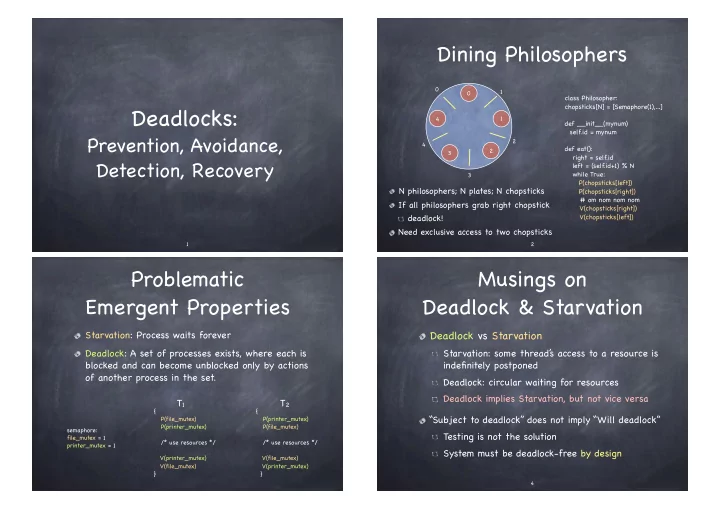
Dining Philosophers

N philosophers; N plates; N chopsticks

class Philosopher: chopsticks[N] = [Semaphore(1),…] def __init__(mynum) self.id = mynum def eat(): right = self.id left = (self.id+1) % N while True: P(chopsticks[left]) P(chopsticks[right]) # om nom nom nom V(chopsticks[right]) V(chopsticks[left])

2

If all philosophers grab right chopstick deadlock! Need exclusive access to two chopsticks

1 2 3 4 1 2 3 4

Problematic Emergent Properties

Starvation: Process waits forever Deadlock: A set of processes exists, where each is blocked and can become unblocked only by actions

  • f another process in the set.

semaphore: file_mutex = 1 
 printer_mutex = 1 { P(file_mutex) P(printer_mutex) /* use resources */ V(printer_mutex) V(file_mutex) } { P(printer_mutex) P(file_mutex) /* use resources */ V(file_mutex) V(printer_mutex) }

T1 T2

Musings on Deadlock & Starvation

Deadlock vs Starvation

Starvation: some thread’ s access to a resource is indefinitely postponed Deadlock: circular waiting for resources Deadlock implies Starvation, but not vice versa “Subject to deadlock” does not imply “Will deadlock” Testing is not the solution System must be deadlock-free by design

4

slide-2
SLIDE 2

System Model

Set of resources requiring “exclusive” access

might be “k-exclusive access” if resource has capacity for k Examples: CPU, printers, memory, locks, etc.

Acquiring a resource can cause blocking:

if resource is free, then access is granted; process proceeds if resource is in use, then process blocks process uses resource process releases resource

5

A Graph Theoretic Model

  • f Deadlock

Computer system modeled as a RAG, a directed graph G(V , E)

V = {P1,…,Pn} ⋃ {R1,…,Rn} E = {edges from a resource to a process} ⋃ {edges from a process to a resource}

Pi Rj

Pi

Rj

Pk

allocation edge request edge

6

Resource Allocation Graph

Deadlock possible only if all four hold

Bounded resources (Acquire can block invoker)

A finite number of threads can use a resource; resources are finite

No preemption

the resource is mine, MINE! (until I release it)

Hold & Wait

holds one resource while waiting for another

Circular waiting

Ti waits for Ti+1 and holds a resource requested by Ti-1 sufficient only if one instance of each resource

Not sufficient in general

P1 P0 P2 P3 P4

waiting for

  • wned

by

Necessary Conditions for Deadlock

cycle

Resource type with 5 instances

7

RAG Reduction

P1 P2 P3 R1 R3 R2 R4

Deadlock?

Step 1: Satisfy P3’ s requests Step 2: Satisfy P2’ s requests Step 3: Satisfy P1’ s requests Schedule [P3 P2 P1] completely eliminates edges!

NO! (no cycles)

8

slide-3
SLIDE 3

RAG Reduction

P1 P2 P3 P1 P2 P3 R1 R3 R2 R4 R2 R4 R3 R1

Deadlock? Deadlock?

Cannot satisfy any of P1, P2, P3 requests! RAG has a cycle Step 1: Satisfy P3’ s requests Step 2: Satisfy P2’ s requests Step 3: Satisfy P1’ s requests Schedule [P3 P2 P1] completely eliminates edges!

NO! (no cycles)

9

Yes!

RAG Reduction

P1 P2 P3 P1 P2 P3 P1 P2 P3 P4 R1 R3 R2 R4 R2 R4 R3 R1 R1 R2

Deadlock? Deadlock? Deadlock?

10

Step 1: Satisfy P3’ s requests Step 2: Satisfy P2’ s requests Step 3: Satisfy P1’ s requests Schedule [P3 P2 P1] completely eliminates edges!

NO! (no cycles)

Cannot satisfy any of P1, P2, P3 requests! RAG has a cycle

Yes!

RAG has a cycle Schedule [P2 P1 P3 P4] completely eliminates edges!

NO!

More Musings on Deadlock

Does the order of RAG reduction matter?

  • No. If Pi and Pj can both be reduced, reducing Pi

does not affect the reducibility of Pj

Does a deadlock disappear on its own?

  • No. Unless a process is killed or forced to release a

resource, we are stuck!

If a system is not deadlock at time T, is it guaranteed to be deadlock-free at T+1?

  • No. Just by requesting a resource (never mind being

granted one) a process can create a circular wait!

11

Proactive Responses to Deadlock: Prevention

Negate one of deadlock’ s four necessary conditions

Remove “Acquire can block invoker”

Make resources sharable without locks

Wait-free synchronization

Make more resources available (duh!)

Remove “No preemption”

Allow OS to preempt resources of waiting processes Allow OS to preempt resources of requesting process if not all available

slide-4
SLIDE 4

Proactive Responses to Deadlock: Prevention

Negate one of deadlock’ s four necessary conditions

Remove “Hold & Wait”

Request all resources before execution begins

Processes may not know what they will need Starvation (if waiting for many popular resources) Low utilization (if resource needed only for a bit)

Release all resources before asking anything new

Still has the last two problems…

Proactive Responses to Deadlock: Prevention

Negate one of deadlock’ s four necessary conditions

Remove “Circular waiting”

Single lock for entire system? Impose total/partial order on resources

Makes cycles impossible, since a cycle needs edges to go from low to high, and then back to low

Havender’ s Scheme (OS/360)

Hierarchical Resource Allocation

Every resource is associated with a level. Rule H1: All resources from a given level must be acquired using a single request. Rule H2: After acquiring from level Lj must not acquire from Li where i<j. Rule H3: May not release from Li unless already released from Lj where j>i.

L1 L2 Ln acquire release

Dining Philosophers (Again)

N philosophers; N plates; N chopsticks

Pi: do forever acquire(min(i, i+1 mod 7) acquire(max(i, i+1 mod 7) eat release(min(i, i+1 mod 7) release(max(i, i+1 mod 7) end

16

1 2 3 4 1 2 3 4

slide-5
SLIDE 5

Living dangerously: Safe, Unsafe, Deadlocked States

17

Living dangerously: Safe, Unsafe, Deadlocked States

Safe state:

It is possible to avoid deadlock and eventually grant all resource by careful scheduling (a safe schedule) Transitioning among safe states may delay a resource request even when resources are available

Unsafe state:

Unlucky sequence of requests can force deadlock

Deadlocked state:

System has at least one deadlock

Safe

Deadlock

Unsafe

A system’ s trajectory through its state space 18

Why is George Bailey in trouble?

If all his customers ask at the same time to have back all the money they have lent, he is going bankrupt But his bank is actually in a safe state!

If only lenders delayed their requests, all would be well! spoiler alert: this is exactly what happens…

It still begs the question:

How can the OS allocate resources so that the system always transitions among safe states?

19

Proactive Responses to Deadlock: Avoidance

The Banker’ s Algorithm

Processes declare worst-case needs (big assumption!), but then ask for what they “really” need, a little at a time

Sum of maximum resource needs can exceed total available resources

Algorithm decides whether to grant a request

Build a graph assuming request granted Check whether state is safe (i.e., whether RAG is reducible)

A state is safe if there exists some permutation of [P1, P2,…,Pn] such that, for each Pi, the resources that Pi can still request can be satisfied by the currently available resources plus the resources currently held by all Pj, for Pj preceding Pi in the permutation

E.W . Dijkstra & N. Habermann

20

Available = 3 Process Max Need Holds Needs P0 10 5 5 P1 4 2 2 P2 9 2 7

Safe?

Available resources can satisfy P1’ s needs Once P1 finishes, 5 available resources Now, available resources can satisfy P0’ s needs Once P0 finishes, 10 available resources Now, available resources can satisfy P3’ s needs

Yes! Schedule: [P1, P0, P3]

slide-6
SLIDE 6

Proactive Responses to Deadlock: Avoidance

The Banker’ s Algorithm

Processes declare worst-case needs (big assumption!), but then ask for what they “really” need, a little at a time

Sum of maximum resource needs can exceed total available resources

Algorithm decides whether to grant a request

Build a graph assuming request granted Check whether state is safe (i.e., whether RAG is reducible)

A state is safe if there exists some permutation of [P1, P2,…,Pn] such that, for each Pi, the resources that Pi can still request can be satisfied by the currently available resources plus the resources currently held by all Pj, for Pj preceding Pi in the permutation

E.W . Dijkstra & N. Habermann

21

Available = 3 Process Max Need Holds Needs P0 10 5 5 P1 4 2 2 P2 9 2 7

Suppose P2 asks for 2 resources Safe?

Processes declare worst-case needs (big assumption!), but then ask for what they “really” need, a little at a time

Sum of maximum resource needs can exceed total available resources

Algorithm decides whether to grant a request

Build a graph assuming request granted Check whether state is safe (i.e., whether RAG is reducible)

A state is safe if there exists some permutation of [P1, P2,…,Pn] such that, for each Pi, the resources that Pi can still request can be satisfied by the currently available resources plus the resources currently held by all Pj, for Pj preceding Pi in the permutation

Proactive Responses to Deadlock: Avoidance

The Banker’ s Algorithm

22

Available = 3 Process Max Need Holds Needs P0 10 5 5 P1 4 2 2 P2 9 2 7

Safe?

Available = 1 Process Max Need Holds Needs P0 10 5 5 P1 4 2 2 P2 9 4 5

If so, request is granted; otherwise, requester must wait

E.W . Dijkstra & N. Habermann

The Banker’ s books

Assume n processes, m resources Maxij = max amount of units of resource Rj needed by Pi

MaxClaimi: Vector of size m such that MaxClaimi[j] = Maxij

Holdsij = current allocation of Rj held by Pi

HasNowi = Vector of size m such that HasNowi[j] = Holdsij

Available = Vector of size m such that Available[j] = units of Rj available A request by Pk is safe if, assuming the request is granted, there is a permutation of P1, P2,…, Pn such that, for all Pi in the permutation Needsi = MaxClaimi - HasNowi ≤ Avail + HasNowj

i−1

X

j=1

23

An Example

5 processes, 4 resources Is this a safe state?

1 2 1 1 3 5 3 6 3 2 1 4 P1 P2 P3 P4 P5 R1 R2 R3 R4

Holds

1 2 1 7 5 2 3 5 6 6 5 2 6 5 6 P1 P2 P3 P4 P5 R1 R2 R3 R4

Max

1 5 2

Available

R1 R2 R3 R4 24
slide-7
SLIDE 7

An Example

5 processes, 4 resources Is this a safe state?

1 2 1 7 5 2 3 5 6 6 5 2 6 5 6 P1 P2 P3 P4 P5 R1 R2 R3 R4

Max

1 5 2

Available

R1 R2 R3 R4

  • 7

5 1 3 2 6 4 2 P1 P2 P3 P4 P5 R1 R2 R3 R4

Needs While safe permutation does not include all processes: Is there a Pi such that Needsi ≤ Avail?

if no, exit with unsafe if yes, add Pi to the sequence and set Avail = Avail + HasNowi

Exit with safe

P1, P4, P2, P3, P5

25 1 2 1 1 3 5 3 6 3 2 1 4 P1 P2 P3 P4 P5 R1 R2 R3 R4

Holds

An Example

5 processes, 4 resources P2 want to change its holdings to

1 2 1 1 3 5 3 6 3 2 1 4 P1 P2 P3 P4 P5 R1 R2 R3 R4

Holds

1 2 1 7 5 2 3 5 6 6 5 2 6 5 6 P1 P2 P3 P4 P5 R1 R2 R3 R4

Max

1 5 2

Available

R1 R2 R3 R4 7 5 1 3 2 6 4 2 P1 P2 P3 P4 P5 R1 R2 R3 R4

Needs

0 4 2 0

26

An Example

5 processes, 4 resources P2 want to change its holdings to

1 2 4 2 1 3 5 3 6 3 2 1 4 P1 P2 P3 P4 P5 R1 R2 R3 R4

Holds

1 2 1 7 5 2 3 5 6 6 5 2 6 5 6 P1 P2 P3 P4 P5 R1 R2 R3 R4

Max

2 1

Available

R1 R2 R3 R4 1 3 3 1 3 2 6 4 2 P1 P2 P3 P4 P5 R1 R2 R3 R4

Needs

27

0 4 2 0

Safe?

Reactive Responses to Deadlock

Deadlock Detection

Track resource allocation (who has what) Track pending requests (who’ s waiting for what)

When should it run?

For each request? After each unsatisfiable request? Every hour? Once CPU utilization drops below a threshold?

slide-8
SLIDE 8

Detecting Deadlock

5 processes, 3 resources. We no longer (need to) know Max.

Given the set of pending requests, is there a safe sequence?

If no, deadlock

1 2 3 3 2 1 1 2 P1 P2 P3 P4 P5 R1 R2 R3

Holds Available

R1 R2 R3 2 2 1 2 2 P1 P2 P3 P4 P5 R1 R2 R3

Pending

29

Detecting Deadlock

5 processes, 3 resources. We no longer (need to) know Max.

Given the set of pending requests, is there a safe sequence?

If no, deadlock

1 2 3 3 2 1 1 2 P1 P2 P3 P4 P5 R1 R2 R3

Holds Available

R1 R2 R3 2 2 1 2 2 P1 P2 P3 P4 P5 R1 R2 R3

Pending

30

Detecting Deadlock

5 processes, 3 resources. We no longer (need to) know Max.

Given the set of pending requests, is there a safe sequence?

If no, deadlock

1 2 2 1 1 2 P1 P2 P3 P4 P5 R1 R2 R3

Holds

3 3

Available

R1 R2 R3 2 2 1 2 2 P1 P2 P3 P4 P5 R1 R2 R3

Pending

31

Detecting Deadlock

5 processes, 3 resources. We no longer (need to) know Max.

Given the set of pending requests, is there a safe sequence?

If no, deadlock

1 2 2 1 1 2 P1 P2 P3 P4 P5 R1 R2 R3

Holds

3 3

Available

R1 R2 R3 2 2 1 2 2 P1 P2 P3 P4 P5 R1 R2 R3

Pending

32

slide-9
SLIDE 9

Detecting Deadlock

5 processes, 3 resources. We no longer (need to) know Max.

Given the set of pending requests, is there a safe sequence?

If no, deadlock

2 2 1 1 2 P1 P2 P3 P4 P5 R1 R2 R3

Holds

3 1 3

Available

R1 R2 R3 2 2 1 2 2 P1 P2 P3 P4 P5 R1 R2 R3

Pending

33

Detecting Deadlock

5 processes, 3 resources. We no longer (need to) know Max.

Given the set of pending requests, is there a safe sequence?

If no, deadlock

2 2 1 1 2 P1 P2 P3 P4 P5 R1 R2 R3

Holds

3 1 3

Available

R1 R2 R3 2 2 1 2 2 P1 P2 P3 P4 P5 R1 R2 R3

Pending

34

Detecting Deadlock

5 processes, 3 resources. We no longer (need to) know Max.

Given the set of pending requests, is there a safe sequence?

If no, deadlock

2 2 P1 P2 P3 P4 P5 R1 R2 R3

Holds

5 2 4

Available

R1 R2 R3 2 2 2 P1 P2 P3 P4 P5 R1 R2 R3

Pending

35

Detecting Deadlock

5 processes, 3 resources. We no longer (need to) know Max.

Given the set of pending requests, is there a safe sequence?

If no, deadlock

2 2 P1 P2 P3 P4 P5 R1 R2 R3

Holds

5 2 4

Available

R1 R2 R3 2 2 2 P1 P2 P3 P4 P5 R1 R2 R3

Pending

36

slide-10
SLIDE 10

Detecting Deadlock

5 processes, 3 resources. We no longer (need to) know Max.

Given the set of pending requests, is there a safe sequence?

If no, deadlock

2 P1 P2 P3 P4 P5 R1 R2 R3

Holds

7 2 4

Available

R1 R2 R3 2 P1 P2 P3 P4 P5 R1 R2 R3

Pending

37

Detecting Deadlock

5 processes, 3 resources. We no longer (need to) know Max.

Given the set of pending requests, is there a safe sequence?

If no, deadlock

2 P1 P2 P3 P4 P5 R1 R2 R3

Holds

7 2 4

Available

R1 R2 R3 2 P1 P2 P3 P4 P5 R1 R2 R3

Pending

38

Detecting Deadlock

5 processes, 3 resources. We no longer (need to) know Max.

Given the set of pending requests, is there a safe sequence?

If no, deadlock

P1 P2 P3 P4 P5 R1 R2 R3

Holds

7 2 6

Available

R1 R2 R3 P1 P2 P3 P4 P5 R1 R2 R3

Pending

39

Yes, there is a safe sequence!

Detecting Deadlock

5 processes, 3 resources. We no longer (need to) know Max.

Given the set of pending requests, is there a safe sequence?

If no, deadlock

1 2 3 3 2 1 1 2 P1 P2 P3 P4 P5 R1 R2 R3

Holds Available

R1 R2 R3 2 2 1 2 2 P1 P2 P3 P4 P5 R1 R2 R3

Pending

40

Yes, there is a safe sequence!

slide-11
SLIDE 11

Detecting Deadlock

5 processes, 3 resources. We no longer (need to) know Max

Given the set of pending requests, is there a safe sequence?

If no, deadlock

1 2 3 3 2 1 1 2 P1 P2 P3 P4 P5 R1 R2 R3

Holds Available

R1 R2 R3 2 2 1 1 2 2 P1 P2 P3 P4 P5 R1 R2 R3

Pending

Can we avoid deadlock by delaying granting requests?

Deadlock triggered when request formulated, not granted!

41

Deadlock Recovery

Blue screen & reboot Kill one/all deadlocked processes

Pick a victim (how?); Terminate; Repeat as needed

Can leave system in inconsistent state

Proceed without the resource

Example: timeout on inventory check at Amazon

Use transactions

Rollback & Restart Need to pick a victim…

Summary

Prevent

Negate one of the four necessary conditions

Avoid

Schedule processes carefully

Detect

Has a deadlock occurred?

Recover

Kill or Rollback