
SLIDE 1
David, part 1
Living under grace in a world of law
Mike Taylor
Forest Community Church
Sunday 26 January, 2020
https://mikepreaching.wordpress.com/
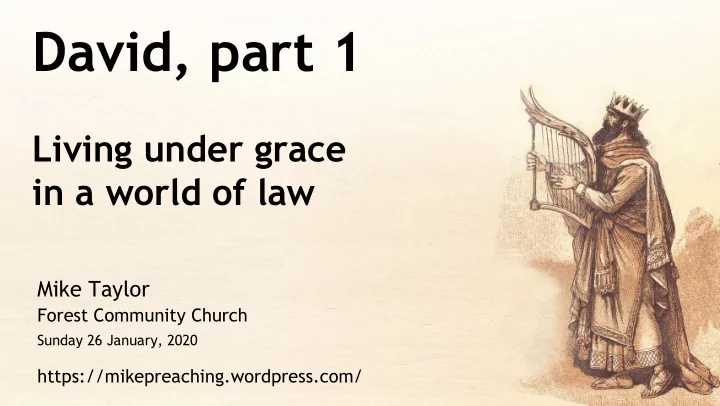
David, part 1 Living under grace in a world of law Mike Taylor - - PowerPoint PPT Presentation
David, part 1 Living under grace in a world of law Mike Taylor Forest Community Church Sunday 26 January, 2020 https://mikepreaching.wordpress.com/ Who was David? One of the key figures in the Old Testament: Abraham Moses David
Mike Taylor
Forest Community Church
Sunday 26 January, 2020
https://mikepreaching.wordpress.com/
One of the key figures in the Old Testament:
Abraham Moses David Elijah
The second king of the united kingdom of Israel and Judah.
136 chapters in total:
42 chapters (1 Samuel 16, though 2 Samuel, to 1 Kings 2) 19 chapters (1 Chronicles 11-29) partial repeat 73 psalms directly attributed 2 more psalms attributed in NT
136 chapters in total:
42 chapters (1 Samuel 16, though 2 Samuel, to 1 Kings 2) 19 chapters (1 Chronicles 11-29) partial repeat 73 psalms directly attributed 2 more psalms attributed in NT
Gives a clear three-dimensional picture.
“Now your kingdom must end, for the Lord has sought out a man after his own heart. The Lord has already appointed him to be the leader of his people, because you have not kept the Lord’s command.” — Samuel speaking to Saul, 1 Samuel 13:14.
“God removed Saul and replaced him with David, a man about whom God said, ‘I have found David son of Jesse, a man after my
— Paul preaching in Pisidian Antioch, Acts 13:22.
What exactly does this mean?
What exactly does this mean? One definition: The godly may trip seven times, but they will get up again. — Proverbs 24:16. But I want to take a broader view.
Stone age: up to 3300 BC
Stone age: up to 3300 BC Bronze age: 3300-1200 BC
Stone age: up to 3300 BC Bronze age: 3300-1200 BC Bronze age collapse: 1200-900 BC Iron age: from 900 BC
Stone age: up to 3300 BC Bronze age: 3300-1200 BC Bronze age collapse: 1200-900 BC Iron age: from 900 BC
David lived from about 1040-970 BC.
Tel Dan Stele (840 BC) Probably written by Hazael of Aram-Damascus. “I killed Jehoram son of Ahab king of Israel, and I killed Ahaziahu son of Jehoram king
set their towns into ruins and turned their land into desolation.”
Tel Dan Stele (840 BC) Probably written by Hazael of Aram-Damascus. “I killed Jehoram son of Ahab king of Israel, and I killed Ahaziahu son of Jehoram king
set their towns into ruins and turned their land into desolation.”
Primitive and alien:
Primitive and alien:
Treating women as property — multiple wives
Primitive and alien:
Treating women as property — multiple wives Toxic concept of honour — Ahithophel’s advice
Primitive and alien:
Treating women as property — multiple wives Toxic concept of honour — Ahithophel’s advice Brutality in warfare — no Geneva convention
Primitive and alien:
Treating women as property — multiple wives Toxic concept of honour — Ahithophel’s advice Brutality in warfare — no Geneva convention Unforgiveness — maybe (mis)learned from God's words
Primitive and alien:
Treating women as property — multiple wives Toxic concept of honour — Ahithophel’s advice Brutality in warfare — no Geneva convention Unforgiveness — maybe (mis)learned from God's words Human sacrifice in many societies
We need to see David against the backdrop of his world.
As David stood there among his brothers, Samuel took the flask of
Spirit of the Lord came powerfully upon David from that day on. — 1 Samuel 16:13. Because of this, he lives like a man under grace.
He is very far from perfect. We immediately think of Bathsheba.
He is very far from perfect. We immediately think of Bathsheba. And he was often merciless with enemies: David also conquered the land of Moab. He made the people lie down on the ground in a row, and he measured them off in groups with a length of rope. He measured off two groups to be executed for every one group to be spared. — 2 Samuel 8:2.
But there is a great deal to admire:
But there is a great deal to admire:
Trust in God (Goliath, 1 Samuel 17)
But there is a great deal to admire:
Trust in God (Goliath, 1 Samuel 17) Readiness to forgive Saul repeatedly (1 Samuel 24, 27)
But there is a great deal to admire:
Trust in God (Goliath, 1 Samuel 17) Readiness to forgive Saul repeatedly (1 Samuel 24, 27) Enthusiasm for worship (returning the Ark, 2 Samuel 6)
But there is a great deal to admire:
Trust in God (Goliath, 1 Samuel 17) Readiness to forgive Saul repeatedly (1 Samuel 24, 27) Enthusiasm for worship (returning the Ark, 2 Samuel 6) Sincere repentance when he sinned (Psalm 51)
But there is a great deal to admire:
Trust in God (Goliath, 1 Samuel 17) Readiness to forgive Saul repeatedly (1 Samuel 24, 27) Enthusiasm for worship (returning the Ark, 2 Samuel 6) Sincere repentance when he sinned (Psalm 51) Kindness towards (some) enemies (Mephibosheth, 2 Samuel 9)
But there is a great deal to admire:
Trust in God (Goliath, 1 Samuel 17) Readiness to forgive Saul repeatedly (1 Samuel 24, 27) Enthusiasm for worship (returning the Ark, 2 Samuel 6) Sincere repentance when he sinned (Psalm 51) Kindness towards (some) enemies (Mephibosheth, 2 Samuel 9) Gratitude to God (many psalms, e.g. Psalm 26:7)
“singing a song of thanksgiving and telling of all your wonders.”
As King David came to Bahurim, a man came out of the village cursing them. It was Shimei son of Gera, from the same clan as Saul’s family. He threw stones at the king and the king’s officers and all the mighty warriors who surrounded him. “Get out of here, you murderer, you scoundrel!” he shouted at David. […] David and his men continued down the road, and Shimei kept pace with them on a nearby hillside, cursing and throwing stones and dirt at David. — 2 Samuel 16:5-7, 13-14a.
As King David came to Bahurim, a man came out of the village cursing them. It was Shimei son of Gera, from the same clan as Saul’s family. He threw stones at the king and the king’s officers and all the mighty warriors who surrounded him. “Get out of here, you murderer, you scoundrel!” he shouted at David. […] David and his men continued down the road, and Shimei kept pace with them on a nearby hillside, cursing and throwing stones and dirt at David. The king and all who were with him grew weary along the way. — 2 Samuel 16:5-7, 13-14a.
As the king was about to cross the river, Shimei fell down before
the terrible thing your servant did when you left Jerusalem. May the king put it out of his mind. I know how much I sinned. That is why I have come here today, the very first person in all Israel to greet my lord the king.” …
Then Abishai son of Zeruiah said, “Shimei should die, for he cursed the Lord’s anointed king!” “Who asked your opinion, you sons of Zeruiah!” David exclaimed. “Why have you become my adversary today? This is not a day for execution, for today I am once again the king of Israel!” Then, turning to Shimei, David vowed, “Your life will be spared.” — 2 Samuel 19:18b-23.
“Remember Shimei son of Gera, the man from Bahurim in
swore by the Lord that I would not kill him. But that oath does not make him innocent. You are a wise man, and you will know how to arrange a bloody death for him.” — 1 Kings 2:8-9.
David was a mixture:
Filled with the Holy Spirit Very much a man of his time
David was a mixture:
Filled with the Holy Spirit Very much a man of his time
Was that a good enough excuse for him?
We are very much people of our time. Is that a good enough excuse for us?
We are very much people of our time. Is that a good enough excuse for us? Unless your righteousness is better than the righteousness of the teachers of religious law and the Pharisees, you will never enter the Kingdom of Heaven! — Matthew 5:20.
The Spirit came upon David, but he fills all of us: You are controlled by the Spirit if you have the Spirit of God living in you. (And remember that those who do not have the Spirit of Christ living in them do not belong to him at all.) — Romans 8:9.
The Spirit came upon David, but he fills all of us: You are controlled by the Spirit if you have the Spirit of God living in you. (And remember that those who do not have the Spirit of Christ living in them do not belong to him at all.) — Romans 8:9. That gives us better peer-support that David had
David's example of the kingship: Saul
The Spirit came upon David, but he fills all of us: You are controlled by the Spirit if you have the Spirit of God living in you. (And remember that those who do not have the Spirit of Christ living in them do not belong to him at all.) — Romans 8:9. That gives us better peer-support that David had
David's example of the kingship: Saul David’s vengeful army commander: Joab
We want to do better than David did, and rise above our culture.
We want to do better than David did, and rise above our culture.
Worship of wealth and contempt for the powerless
We want to do better than David did, and rise above our culture.
Worship of wealth and contempt for the powerless Bearing grudges
We want to do better than David did, and rise above our culture.
Worship of wealth and contempt for the powerless Bearing grudges Glorifying revenge
We want to do better than David did, and rise above our culture.
Worship of wealth and contempt for the powerless Bearing grudges Glorifying revenge Devaluing sex, love, commitment and relationships
We want to do better than David did, and rise above our culture.
Worship of wealth and contempt for the powerless Bearing grudges Glorifying revenge Devaluing sex, love, commitment and relationships Relentless negativity (even if disguised as humour)
We want to do better than David did, and rise above our culture.
Worship of wealth and contempt for the powerless Bearing grudges Glorifying revenge Devaluing sex, love, commitment and relationships Relentless negativity (even if disguised as humour)
Our culture is not an excuse.
Crucial point …
This is not “must try harder” but “must aim higher”.
This is not “must try harder” but “must aim higher”. Like David, we live in the good of God's grace. Unlike him, we do it in a way that transcends our culture.
Mike Taylor
Forest Community Church
Sunday 26 January, 2020
https://mikepreaching.wordpress.com/