
SLIDE 1
I nve sto r Pre se nta tio n
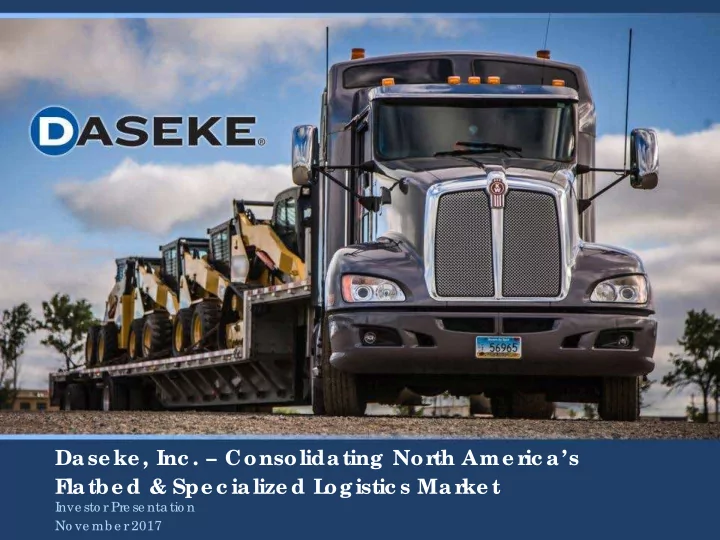
Dase ke , Inc . – Consolidating Nor th Ame r ic a’s F latbe d & Spe c ialize d L
- gistic s Mar
ke t
No ve mb e r 2017
Dase ke , Inc . Consolidating Nor th Ame r ic as F latbe d & - - PowerPoint PPT Presentation
Dase ke , Inc . Consolidating Nor th Ame r ic as F latbe d & Spe c ialize d L ogistic s Mar ke t I nve sto r Pre se nta tio n No ve mb e r 2017 Important Disclaimers Forward-Looking Statements This presentation includes
I nve sto r Pre se nta tio n
No ve mb e r 2017
1
Forward-Looking Statements This presentation includes “forward-looking statements” within the meaning of the “safe harbor” provisions of the United States Private Securities Litigation Reform Act of 1995. Forward-looking statements may be identified by the use of words such as "forecast," "intend," "seek," "target," “anticipate,” “believe,” “expect,” “estimate,” “plan,” “outlook,” and “project” and other similar expressions that predict or indicate future events or trends or that are not statements of historical matters. Projected financial information are forward-looking statements. Forward-looking statements, including those with respect to revenues, earnings, performance, strategies, prospects and other aspects of the business of Daseke, are based on current expectations that are subject to risks and uncertainties. A number of factors could cause actual results or outcomes to differ materially from those indicated by such forward-looking statements. These factors include, but are not limited to, general economic risks (such as downturns in customers’ business cycles and disruptions in capital and credit markets), driver shortages and increases in driver compensation or owner-operator contracted rates, loss of senior management or key
fluctuations in the price or availability of diesel fuel, increased prices for, or decreases in the availability of, new revenue equipment and decreases in the value of used revenue equipment, Daseke’s ability to generate sufficient cash to service all
proceedings, and insurance and claims expenses. For additional information regarding known material factors that could cause actual results to differ from those expressed in forward-looking statements, please see Daseke’s filings with the Securities and Exchange Commission, available at www.sec.gov, including Hennessy Capital Acquisition Corp. II’s definitive proxy statement dated February 6, 2017, particularly the section “Risk Factors—Risk Factors Relating to Daseke’s Business and Industry,” and Daseke’s Current Report on Form 8-K/A, filed with the SEC on March 16, 2017 and amended on May 4, 2017. You are cautioned not to place undue reliance upon any forward-looking statements, which speak only as
Acquisitions Daseke has a long history of, and intends to continue, acquiring strategic and complementary flatbed and specialized trucking companies. Negotiations and discussions with potential target companies are an integral part of the Company’s
acquisitions. Non-GAAP Financial Measures This presentation includes non-GAAP financial measures, including Adjusted EBITDA and Adjusted EBITDAR. Daseke defines Adjusted EBITDA as net income (loss) plus (i) depreciation and amortization, (ii) interest expense, including other fees and charges associated with indebtedness, net of interest income, (iii) income taxes, (iv) acquisition-related transaction expenses (including due diligence costs, legal, accounting and other advisory fees and costs, retention and severance payments and financing fees and expenses), (v) stock based compensation, (vi) non-cash impairments, (vii) losses (gains) on sales of defective revenue equipment out of the normal replacement cycle, (viii) impairments related to defective revenue equipment sold out of the normal replacement cycle, (ix) withdrawn initial public offering-related expenses, and (x) expenses related to the business combination that was consummated in February 2017 and related transactions. Adjusted EBITDAR is defined as Adjusted EBITDA plus tractor operating lease charges. You can find the reconciliation of these measures to net income (loss), the nearest comparable GAAP measure, elsewhere in the appendix of this presentation. We have not reconciled non-GAAP forward-looking measures to their corresponding GAAP measures because certain items that impact these measures are unavailable or cannot be reasonably predicted without unreasonable efforts. Daseke’s board of directors and executive management team use Adjusted EBITDA and Adjusted EBITDAR as key measures of its performance and for business planning. Adjusted EBITDA and Adjusted EBITDAR assist them in comparing Daseke’s operating performance over various reporting periods on a consistent basis because they remove from Daseke’s operating results the impact of items that, in their opinion, do not reflect Daseke’s core operating performance. Adjusted EBITDA and Adjusted EBITDAR also allow Daseke to more effectively evaluate its operating performance by allowing it to compare the results of operations against its peers without regard to its or its peers’ financing method or capital structure. Adjusted EBITDAR is used to view operating results before lease charges as these charges can vary widely among trucking companies due to differences in the way that trucking companies finance their fleet acquisitions. Daseke’s management does not consider these non-GAAP measures in isolation or as an alternative to financial measures determined in accordance with GAAP and instead relies primarily on Daseke’s GAAP results and uses non-GAAP measures supplementally. Daseke believes its presentation of Adjusted EBITDA and Adjusted EBITDAR is useful because they provide investors and industry analysts the same information that Daseke uses internally for purposes of assessing its core operating
limitations to using non-GAAP measures such as Adjusted EBITDA and Adjusted EBITDAR. Certain items excluded from Adjusted EBITDA and Adjusted EBITDAR are significant components in understanding and assessing a company’s financial performance, such as a company’s cost of capital, tax structure and the historic costs of depreciable assets. Adjusted EBITDA and Adjusted EBITDAR should not be considered measures of the income generated by Daseke’s business or discretionary cash available to it to invest in the growth of its business. Other companies in Daseke’s industry may define these non-GAAP measures differently than Daseke does, and as a result, it may be difficult to use these non-GAAP measures to compare the performance of those companies to Daseke’s performance. Industry and Market Data This presentation includes market data and other statistical information from third party sources, including independent industry publications, government publications and other published independent sources. Although Daseke believes these third party sources are reliable as of their respective dates, Daseke has not independently verified the accuracy or completeness of this information.
2
3
41% Adjusted EBITDA CAGR from 2009 to TTM Pro Forma 9/30/17 (1) Management Team Owns ~47% of the Company(5) – CEO Don Daseke has a Three-Year Lock-Up(6) Improving Industrial Freight & Logistics Fundamentals Robust Acquisition Pipeline with an Opportunity to Consolidate the Industry Largest Owner of Flatbed & Specialized Equipment in North America(2) <1% Market Share of $133 Billion Open Deck Transportation & Logistics Market(3) On Track to Achieve its 2017 Pro Forma Adjusted EBITDA Target of $140 Million(4)
(1)TTM Pro forma 9/30/17 Adjusted EBITDA is calculated by adding Daseke’s TTM Adjusted EBITDA with the Adjusted EBITDA of the four recently acquired companies (based on such companies’ internally prepared financial statements). Does not give effect to synergies. (2) CCJ Top 250, 2017. (3) FTR Associates, Inc., 2016. (4) 2017 pro forma Adjusted EBITDA will be calculated by adding Daseke’s actual Adjusted EBITDA in 2017 and the Adjusted EBITDA of any acquired business during 2017 for the period beginning on January 1, 2017 and ending on the acquisition date. (5) Does not give effect to the payout of 15 million potential earnout shares and assumes no exercise of outstanding warrants or conversion of convertible preferred to common stock. (6) Mr. Daseke intends to donate shares to educational institutions or charities; accordingly, 10% of Mr. Daseke’s shares are not be subject to the three-year lock-up but will instead be subject to a 180-day lock-up (from donation date) in the event of such donation.
4
$30 $898 2009 (First Year of Operations) TTM Pro Forma 9/30/17 (Includes 4 YTD Acquisitions)
$6 $103 2009 (First Year of Operations) TTM Pro Forma 9/30/17 (Includes 4 YTD Acquisitions)
Pro Forma Revenue Growth
($ in millions)
Pro Forma Adjusted EBITDA Growth
($ in millions)
(1) (1)(2)
(1) Calculated by adding Daseke’s TTM 9/30/17 figures with the acquired companies’ TTM 9/30/17 figures (based on such companies’ internally prepared financial statements). Does not give effect to synergies. (2)TTM PF Net loss of $24.9 million plus: depreciation and amortization of $85.6 million, interest of $32.4 million, provision for income taxes of $0.2 million, stock based compensation of $1.2 million, acquisition- related transaction expenses of $3.1 million, and merger transaction expenses of $5.2 million, results in TTM PF Adjusted EBITDA of $102.8 million
5 4
5
6
Joined Daseke in 2012
Former CFO for OneSource Virtual, Inc.
Former Managing Director of VCFO
Former CFO of Malibu Entertainment Worldwide, a former publicly-traded location-based entertainment company (AMEX)
Scott Wheeler Executive Vice President and CFO
Founded Daseke in 2008
Founder and Former Chairman and CEO of Walden Residential Properties, a former publicly-traded (NYSE) Real Estate Investment Trust
Certified Public Accountant
Don Daseke Chairman, President, and CEO
Angie Moss
Chief Accounting Officer and Senior Vice President
Derek Blount
Senior Vice President
John Michell
Vice President of Finance
Soumit Roy
General Counsel
Greg Hirsch
Senior Vice President
7
Flatbed Step Deck Over Dimensional Super Heavy Haul High Value Customized Flatbed Defense
8
1,000+ Trucks 29 companies <0.1% 100-999 Trucks 357 companies 0.7% <100 Trucks 51,506 companies 99.2%
(1) Source: FTR Associates, Inc., 2016.
9 14.5 20.2 39.5 6 16 26 36 46 Jan Feb Mar Apr May Jun Jul Aug Sep Oct Nov Dec 2016 2017 58.7 46 50 54 58 62 Jan-16 May-16 Sep-16 Jan-17 May-17 Sep-17
Favorable supply / demand dynamics
Sequential uptick in Flatbed Spot Rates throughout 2017
3‐6 month lag between Flatbed Spot Rates and Flatbed Contract Rates
ELD mandate to take effect December 2017 Flatbe bed d Spot pot Rate YoY
h as of
2017(2
(2)
Favorable Industry Tailwinds
21% Growth
ISM Manufacturing Index(1) Flatbed Load-to-Truck Ratio(2)
ISM Above 50 Signals Improving Manufacturing Conditions
Note: Flatbed Load-to-Truck Ratio represents the number of loads posted for every truck posted on DAT Load Boards. (1) Source: Institute for Supply Management. (2) Source: DAT, October 2017.
10
One of the fastest-growing U.S. trucking
companies,(1) having acquired and integrated 13 companies since 2008
Largest owner of open deck equipment(2) and
second largest provider(3) of flatbed & specialized logistics solutions in North America
Operates fleet of ~3,800 tractors(4) and ~8,200
trailers
Offers services across the U.S., Canada, and
Mexico
Over 3,500 employees 70+ locations $100 million liability insurance coverage(5)(6)
38% 62% Asset Right Operating Model Revenue by Segment Flatbed Specialized Asset-Based Revenue
Company
Equipment Asset-Light Revenue
Brokerage Owner Operator Logistics
(YTD Sep 2017) (YTD Sep 2017)
43% 57%
(1) Of the largest 50 U.S. trucking companies in 2015, according to Journal of Commerce, April 2016. (2) CCJ Top 250, 2017. (3) Measured by revenue, according to CCJ Top 250, 2017. (4) Includes owner-operator tractors. (5) Big Freight System’s liability insurance coverage is $100 million CAD, all others in USD. (6) The R&R Trucking’s liability insurance coverage is for $33 million.
11
Target Criteria Low Risk Consolidation Strategy
Acquire “not for sale” carriers
Recognized as a leader in the industry
2017 YTD acquisitions at average multiple of 5.4x(1)
First mover and logical choice for sellers
We retain quality drivers, long-term customers, and experienced management
Flatbed / Specialized
$40 – $200+ million in revenues
Top tier safety scores
Cultural fit
Long-term customer relationships
Additive customer base
Experienced management teams looking to stay with
Long-term proven track record of financial performance
(1) Calculated on the basis of the sum of cash consideration, stock consideration and the debt assumed divided by the 2016 Adjusted EBITDA of the acquired companies.
12
Adjusted EBITDA Growth
(1) Represents simple average of Adjusted EBITDA growth achieved at the companies acquired by Daseke (other than Smokey Point, for which Adjusted EBITDA with a sufficient level of reliability is not available for the year prior to its acquisition by Daseke) based on the companies’ Adjusted EBITDA for the year prior to Daseke’s acquisition as compared to the companies’ Adjusted EBITDA for the second year following Daseke’s acquisition. Growth achieved at Hornady Transportation and Bulldog Hiway Express, which were acquired in 2015, were calculated based on Adjusted EBITDA for 2016. This does not include 2017 acquisitions.
13
2016 Top Customers Revenue by Customer
(YTD Sep 2017)
~95% direct customer relationships(1)
No single customer accounted for greater than 8% of total revenues
Top 10 customer relationships average over 20 years(1)
(1) Based on FYE 2016.
14
Revenue Mix by End-Market
(YTD Sep 2017)
Metals Other Lumber Building Materials Heavy Equipment & Energy Aircraft Parts Concrete Products PVC Products
21% 20% 19% 18% 9% 7% 3% 2% 1%
High Security Cargo
15
Pure Play Flatbed & Specialized Logistics
(1) Daseke tractors do not go into Mexico, only trailers and freight. Tractors supplied by Mexican carrier partners. (2) As of 9/30/2017.
16
Adjusted EBITDA Growth Actionable Acquisition Pipeline(1)
($ in millions)
Achieving the Adjusted EBITDA Target would double the size of the Company by FYE 2019
4 transactions closed Year-to-Date
Focus on:
—
End-markets
—
Customers
—
Capabilities
—
Geographies
Proven robust, active, and actionable pipeline
$200 2016 $88 Pro Forma 2019T(2)
(1) Any acquisitions will be dependent on various conditions, and Daseke may not complete any acquisitions in its pipeline. (2) 2019 pro forma Adjusted EBITDA will be calculated by adding Daseke’s actual 2019 Adjusted EBITDA and the Adjusted EBITDA of any acquired business during 2019 for the period beginning on January 1, 2017 and ending on the acquisition date.
17
Adjusted EBITDA(3) Revenue
($ in millions) ($ in millions)
Net Capital Expenditures as a % of Revenue Free Cash Flow(3)(4)
($ in millions) ($ in millions)
(2) (1) (2) (5)
(1) Calculated by adding Daseke’s TTM 9/30/17 figures with the acquired companies’ TTM 9/30/17 figures (based on such companies’ internally prepared financial statements). Does not give effect to synergies. (2) Targets based on annualized run rate, including planned 2017 acquisitions, which is also aligned with earnout target. (3) See Appendix for reconciliation to most directly comparable GAAP measure. (4) Free Cash Flow defined as Adjusted EBITDA less net capital expenditures (capital expenditures less proceeds from equipment sales). (5) 2017 Net Capital Expenditures as a % of Revenue is expected to be 7% on a standalone basis (i.e., without giving effect to any planned acquisitions).
(2) (1)
$207 $543 $679 $652 $898 $979 2013 2014 2015 2016 PF TTM Q3 2017T $24 $70 $97 $88 $103 $140 2013 2014 2015 2016 PF TTM Q3 2017T $3 $0 $30 $57 $75 2013 2014 2015 2016 2017T 10% 13% 10% 5% 7% 3% 6% 9% 12% 15% 2013 2014 2015 2016 2017E
18
Sources of Capital as of September 30, 2017
Security Outstanding Common Stock Equivalent Common Shares 44.5 44.5 Warrants 35.0 2.6(2) Convertible Preferred 0.7 5.7(3)
– 5.0 Employee Stock Options 1.4(4) 0.4(4) RSUs 0.8 0.8 Fully Diluted Shares – 59.0
Capitalization Summary(1)
(in millions)
(1) Capitalization data based on securities outstanding as of September 30, 2017. (2) Based on treasury stock method with a stock price of $13.52 as of November 3, 2017. Each warrant represents half a share and on a share equivalent basis has a weighted average exercise price of $11.50. (3) Based on $65 million outstanding Series A Convertible Preferred as of September 30, 2017 with a conversion price of $11.50. (4) Based on treasury stock method for Director Group and Employee Group Stock Options of 0.2 million (weighted average exercise price of $9.98) and 1.3 million (weighted average exercise price of $9.97), respectively, with a stock price of $13.52 as of November 3, 2017. (5) 2017 pro forma Adjusted EBITDA will be calculated by adding Daseke’s actual Adjusted EBITDA in 2017 and the Adjusted EBITDA of any acquired business during 2017 for the period beginning on January 1, 2017 and ending on the acquisition date.
Planned Increase of the Senior Debt Facility Revolving Line of Credit Capacity: $70 million Balance Sheet Cash: $113 million
19
20
Daseke and Public Stockholders are Fully Aligned Through a Unique Earnout Structure Focused on Adjusted EBITDA Growth and Share Price Performance
Daseke pre-public merger stockholders, including Daseke’s management, are eligible to receive up to 15 million shares
share price targets Annualized Stock Adjusted EBITDA Stock Price Year Award Target(1) Target(2) 2017 Up to 5 million shares $140 million $12.00 2018 Up to 5 million shares $170 million $14.00 2019 Up to 5 million shares $200 million $16.00 Earnout Structure
(1) Earnout begins at >90% of target and increases pro rata up to the full 5 million shares at the target. For example, if $133 million annualized Adjusted EBITDA (giving effect to acquisitions during 2017) is achieved for fiscal year 2017, and the Stock Price Target is achieved during the year, 2.5 million shares would be issued in the earnout for 2017. For purposes of the earnout, “Annualized Adjusted EBITDA (giving effect to acquisitions)” is defined as consolidated net income (loss) of Daseke for the applicable year, plus consolidated net income of any business acquired by Daseke during such year for the period beginning on January 1 of such year and ending on the date of such acquisition, plus, in each case: (i) depreciation and amortization, (ii) interest expense, including other fees and charges associated with indebtedness, net of interest income, (iii) income taxes, (iv) acquisition-related transaction expenses, (v) non-cash impairments, (vi) losses (gains) on sales of defective revenue equipment out of the normal replacement cycle, (vii) impairments related to defective revenue equipment sold out of the normal replacement cycle, (viii) expenses related to the merger and related transaction, (ix) non-cash stock and equity compensation expense, and (x) costs paid or incurred in connection with being a public company. In addition, as a one-time only adjustment for purposes of calculating 2017 Adjusted EBITDA, up to $4.2 million of the 2017 equipment rental expenses of one of the businesses acquired during 2017 will be added to net income (loss). (2) For any 20 trading days within any consecutive 30 trading day period during such fiscal year.
21
Adjusted EBITDA and Free Cash Flow Reconciliation
($ in thousands)
2009 2013 2014 2015 2016 Net income (loss) $ (381) $ (2,976) $ 1,300 $ 3,263 $ (12,279) Depreciation and amortization 4,132 18,666 48,575 63,573 67,500 Interest income
(73) (69) (44) Interest expense 2,751 6,402 15,978 20,602 23,124 Provision for income taxes (47) 99 1,784 7,463 163 Acquisition-related transaction expenses
944 1,192 296 Impairment
Withdrawn initial public offering-related expenses
Transaction expenses
Other
Adjusted EBITDA $ 6,455 $ 23,905 $ 70,346 $ 97,304 $ 88,240 Net capital expenditures 548 20,725 70,678 66,969 31,669 Free Cash Flow $ 5,907 $ 3,180 $ (332) $ 30,335 $ 56,571 Year Ended December 31,