Dark Matter M DM D DM halo Nuclear recoil Milky Way Sven - - PowerPoint PPT Presentation

dark matter
SMART_READER_LITE
LIVE PREVIEW

Dark Matter M DM D DM halo Nuclear recoil Milky Way Sven - - PowerPoint PPT Presentation

Dark Matter M DM D DM halo Nuclear recoil Milky Way Sven Vahsen, University of Hawaii Ordinary Matter Ordinary matter consists of atoms Atoms consist of three types of elementary particles Up quark Down quark Electron


slide-1
SLIDE 1

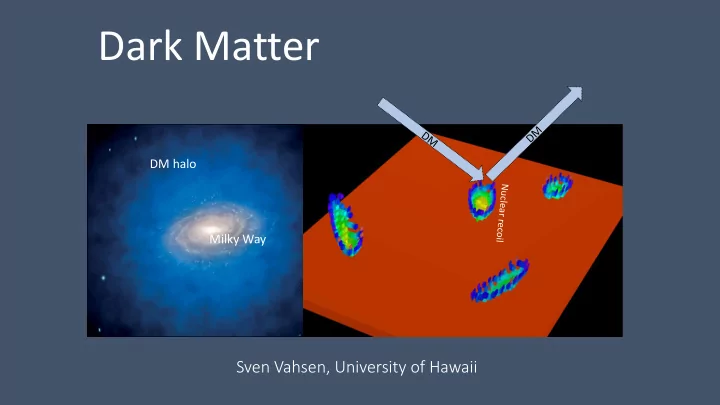
Dark Matter

DM halo Milky Way

Nuclear recoil

DM D M

Sven Vahsen, University of Hawaii
slide-2
SLIDE 2

Ordinary Matter

3/16/19 Punahou Master Class 2

  • Ordinary matter consists of

atoms

  • Atoms consist of three types of

elementary particles

– Up quark – Down quark – Electron

  • In radioactive decays, also the

electron neutrino is produced

– !"

slide-3
SLIDE 3

Ordinary Matter

3/16/19 3 Punahou Master Class

slide-4
SLIDE 4

Three generations of particles

  • “2nd and 3rd generation”

– Discovered with cosmic rays and man-made particle accelerators – Heavier and unstable – Abundant in early universe

mass 175 GeV (=proton masses). Discovered 1995.

3/16/19 4 Punahou Master Class

slide-5
SLIDE 5

What are the Force of Nature?

proton proton Photon

Even forces are due to elementary particles!

3/16/19 5 Punahou Master Class

slide-6
SLIDE 6

The Four Forces of Nature

  • Electromagnetic interaction
  • Strong nuclear force
  • Weak Nuclear force
  • Gravity
  • Four types of forces - each has it’s own force carrier particles

G

3/16/19 6 Punahou Master Class

slide-7
SLIDE 7

Putting it all together

  • Theoretically described

by “Standard Model” of particle physics since early 1970s

  • Standard Model

predicted Higgs Boson

H

mass

3/16/19 7 Punahou Master Class

slide-8
SLIDE 8

Questions:

How can you see matter? What is happening when you see… …the sun? …other students? …yourself in a mirror? …a dark object?

slide-9
SLIDE 9

Things we cannot see with photons

3/16/19 9

4.6% Ordinary Matter 23% Dark Matter 72% Dark Energy

  • Only 5% of energy in

the universe due to

  • rdinary matter

Punahou Master Class

slide-10
SLIDE 10

Question:

Is dark matter… dark?

slide-11
SLIDE 11

3/16/19 11

What does the Dark Matter consist of?

http://home.slac.stanford.edu/pressreleases/2006/20060821.htm

Atoms

Dark Matter!

Punahou Master Class

  • Standard Model particles cannot explain dark matter
  • We think dark matter may be a new type of elementary particle!
slide-12
SLIDE 12
  • We may need to extend the standard model

Supersymmetry

12

H

~ ~ ~ ~ ~ ~ ~ ~ ~ ~ ~ ~ ~ ~ ~ ~

H

~

Supersymmetry predicts new particles. Including dark matter particles!

3/16/19 12 Punahou Master Class

slide-13
SLIDE 13

How can we test this hypothesis?

  • 1. Produce dark matter with particle accelerators
  • 2. Try to directly detect dark matter
  • 3. Observe decays of dark matter into visible particle

3/16/19 13 Punahou Master Class

slide-14
SLIDE 14

The Large Hadron Collider (LHC)

  • Highest Energy Accelerator to date: Two beams of 7 TeV protons à E=14 TeV
  • 4 large detectors where protons collide
  • CMS and ATLAS: Search for the Higgs Boson & Physics beyond Standard Model
  • > 10,000 scientists and engineers from over 100 countries

CMS ALICE ATLAS LHCb

3/16/19 14 Punahou Master Class

slide-15
SLIDE 15
  • ATLAS surrounds one of several points where particles will collide.
  • ATLAS “checks” what comes out of these collisions every 25 ns
  • about 100 “snapshots” / second are written to disk

for detailed analysis by the collaboration.

The ATLAS detector*

* ATLAS = A Toroidal LHC apparatus

Length : ~ 46 m Radius : ~ 12 m Weight : ~ 7000 tons ~ 108 electronic channels ~ 3000 km of cables

3/16/19 15 Punahou Master Class

slide-16
SLIDE 16

Pixels: At the Heart of ATLAS

Detection of charged particles takes place in 1744 identical ATLAS Pixel Modules 6 cm Pixel 50 x 400 μm x46080 ATLAS

ATLAS Pixel Detector – Innermost tracking detector, surrounding beam pipe

1.3 m 1744 modules x 46080 pixels = 80 million channels! physicist 16 FE Chips ATLAS DETECTOR Length : ~ 46 m Radius : ~ 12 m Weight : ~ 7000 tons

3/16/19 16 Punahou Master Class

slide-17
SLIDE 17

How to transport a Muon System

Biggest detector in ATLAS

3/16/19 17 Punahou Master Class

slide-18
SLIDE 18

How to transport a pixel detector

Completed Detector Installed June 2007 Endcaps integrated at Berkeley Lab On the way to CERN! Barrel integrated at CERN Smallest detector in ATLAS

3/16/19 18 Punahou Master Class

slide-19
SLIDE 19
  • 7-TeV protons kept in orbit by superconducting magnets
  • 8.33T, cooled by superfluid Helium at 1.9K

… after installation 100 m under ground

LHC Construction

Lowering one of 1232 di-pole magnets

3/16/19 19 Punahou Master Class

slide-20
SLIDE 20

First Beams Circulated September 9th 2008

3/16/19 20 Punahou Master Class

slide-21
SLIDE 21

2012 Higgs Discovery!

Higgs announcement seminar on 4 July 2012 Nobel prize in 2013

! → ##

3/16/19 21 Punahou Master Class

slide-22
SLIDE 22

So far, we have not detected dark matter at the Large Hadron Collider…

slide-23
SLIDE 23

How can we test this hypothesis?

  • 1. Produce dark matter with particle accelerators
  • 2. Try to directly detect dark matter
  • 3. Observe decays of dark matter into visible particle

3/16/19 23 Punahou Master Class

slide-24
SLIDE 24

Are We Surrounded By Dark Matter?

3/16/19 24

dark matter halo? Milky Way

Punahou Master Class

slide-25
SLIDE 25

We can also try to directly detect Dark Matter

  • Huge detectors, Looking for 1 “blip”

per year!

  • Very clean, to avoid false detection

from radioactivity

  • Underground, to avoid false detection

from cosmic rays

3/16/19 Punahou Master Class

LUX detector 368 kg LXe Water shield W I M P , n , ! WIMP, n, ! " r a y " ray

25

slide-26
SLIDE 26

D3 - Directional Dark Matter Detector

3/16/19 26

Prototype detector at UH Manoa

I’m working on this!

Punahou Master Class

slide-27
SLIDE 27

3/16/19 Punahou Master Class 27

Nuclear recoil

Dark Matter D a r k M a t t e r

This is how I want to detect it!

3mm

slide-28
SLIDE 28

If this works, I’d like to build a dark matter telescope in the future, to see where the dark matter comes from!

3/16/19 28 Punahou Master Class

slide-29
SLIDE 29

Questions?

3/16/19 29 Punahou Master Class