DamClust: Assessment of multimodality : Assessment of multimodality - - PowerPoint PPT Presentation

damclust assessment of multimodality assessment of
SMART_READER_LITE
LIVE PREVIEW

DamClust: Assessment of multimodality : Assessment of multimodality - - PowerPoint PPT Presentation

DamClust: Assessment of multimodality : Assessment of multimodality DamClust ( has has damaver damaver & friends inside & friends inside ) ) ( Creates the complete graph by iteratively Clustering of multiple SAS models joining


slide-1
SLIDE 1

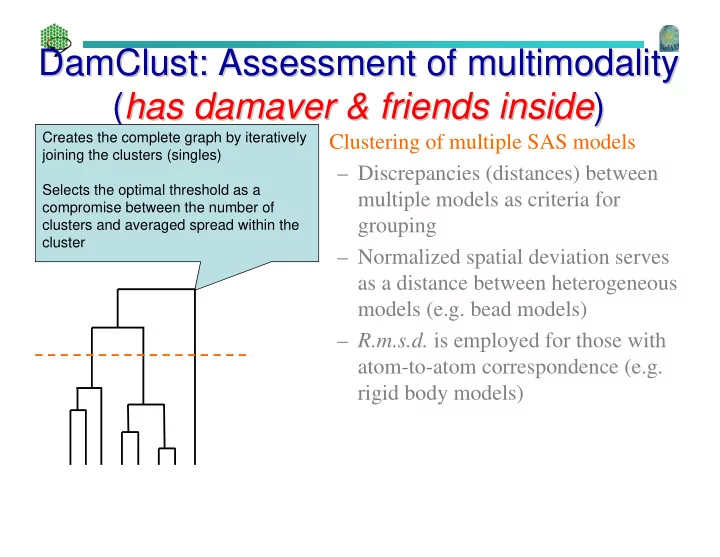
DamClust DamClust: Assessment of multimodality : Assessment of multimodality ( (has has damaver damaver & friends inside & friends inside) )

  • Clustering of multiple SAS models

– Discrepancies (distances) between multiple models as criteria for grouping – Normalized spatial deviation serves as a distance between heterogeneous models (e.g. bead models) – R.m.s.d. is employed for those with atom-to-atom correspondence (e.g. rigid body models)

Creates the complete graph by iteratively joining the clusters (singles) Selects the optimal threshold as a compromise between the number of clusters and averaged spread within the cluster

slide-2
SLIDE 2

EMBO Practical Course on Solution Scattering from Biological Macromolecules

Dummy Residues Model Dummy Residues Model

  • Proteins typically consist of folded polypeptide

chains composed of amino acid residues

  • At a resolution of 0.5 nm each amino acid can be

represented as one entity (dummy residue)

  • In GASBOR a protein is represented by an

ensemble of K DRs those are – Identical – Have no ordinal number – For simplicity are centered at the Cα positions

slide-3
SLIDE 3

EMBO Practical Course on Solution Scattering from Biological Macromolecules

= < … … >

DR DR Modelling Modelling: GASBOR : GASBOR

  • Finds

coordinates {ri}

  • f K DRs within the spherical

search volume

  • Scattering is computed using

the Debye (1915) formula

  • Requires polypeptide chain-

compatible arrangement of DRs

D.I. Svergun, M.V. Petoukhov, & M.H.J. Koch (2001) Biophys. J. 80, 2946-53

( ) ( ) ( )

∑∑

= =

=

K i K j ij ij j i DR

sr sr s g s g s I

1 1

sin

slide-4
SLIDE 4

EMBO Practical Course on Solution Scattering from Biological Macromolecules

GASBOR Restraints GASBOR Restraints

Excluded volume effects and local interactions lead to a characteristic distribution of nearest neighbors around a given residue in a polypeptide chain

Shell radius, nm 0.2 0.4 0.6 0.8 1.0 Number of neighbours 1 2 3 4 5 6

slide-5
SLIDE 5

EMBO Practical Course on Solution Scattering from Biological Macromolecules

DR DR modelling modelling program GASBOR program GASBOR

searches for a chain-like arrangement of dummy residues fitting the scattering data by minimizing

0.0 0.5 1.0 1.5 2.0 1 10 100 1000

s, nm-1 I, rel. units

experiment

  • calc. from p(r)
  • Symmetry can be taken into account; groups supported:

Pn, Pn2 (n=2..19), P23, P432 and icosahedral symmetry

5 10 15 0.0 0.5 1.0 1.5 2.0

distance r, nm

p(r), rel. units

Dmax

Long computational time for large proteins

f (X) = χ2 + ΣαiPi(X)

slide-6
SLIDE 6

EMBO Practical Course on Solution Scattering from Biological Macromolecules

GASBOR Summary GASBOR Summary

  • Task: Searches for a chain-like arrangement of dummy

residues fitting the scattering data.

  • Parameters: 3D coordinates of DRs describing Cα

positions.

  • Objects: Applicable for polypeptide chains (i.e. proteins

and their assemblies) with K ≲ 5000.

  • Capabilities: Fits the scattering curves at higher angles.

Takes into account symmetry and anisometry. Reciprocal and real space fitting options.

  • Limitations: Fits only SAXS data and applicable for

proteins only. CPU time is quadratically proportional to K.

  • Theoretical intensity:

computed using the Debye formula.

slide-7
SLIDE 7

GASBOR examples GASBOR examples

  • NEOCARZINOSTATIN, 113 AA: Patrice
  • GST homodimer with P2 symmetry, 240

AA per monomer: Kate

EMBO Practical Course on Solution Scattering from Biological Macromolecules

slide-8
SLIDE 8

EMBO Practical Course on Solution Scattering from Biological Macromolecules

MONSA (multiphase MONSA (multiphase modelling modelling) )

  • One can differentiate

between distinct parts

  • f the particle
  • Several curves are

required

  • Assuming the same

arrangement of the parts in different samples

DAMMIN/F shape determination

slide-9
SLIDE 9

EMBO Practical Course on Solution Scattering from Biological Macromolecules

MONSA (multiphase MONSA (multiphase modelling modelling) )

  • 1 phase = 1 component of a complex particle
  • For each phase, Rg, V and its scattering curve can be given
  • For each curve, contrast of each phase are specified

contrast variation and / or use of partial constructs

slide-10
SLIDE 10

Case1: protein Case1: protein-

  • RNA complex

RNA complex

EMBO Practical Course on Solution Scattering from Biological Macromolecules

252 AA protein (two domains) 67 nucleotides RNA Three curves in total: Free RNA Complex Free protein