
SLIDE 1
18TH INTERNATIONAL CONFERENCE ON COMPOSITE MATERIALS
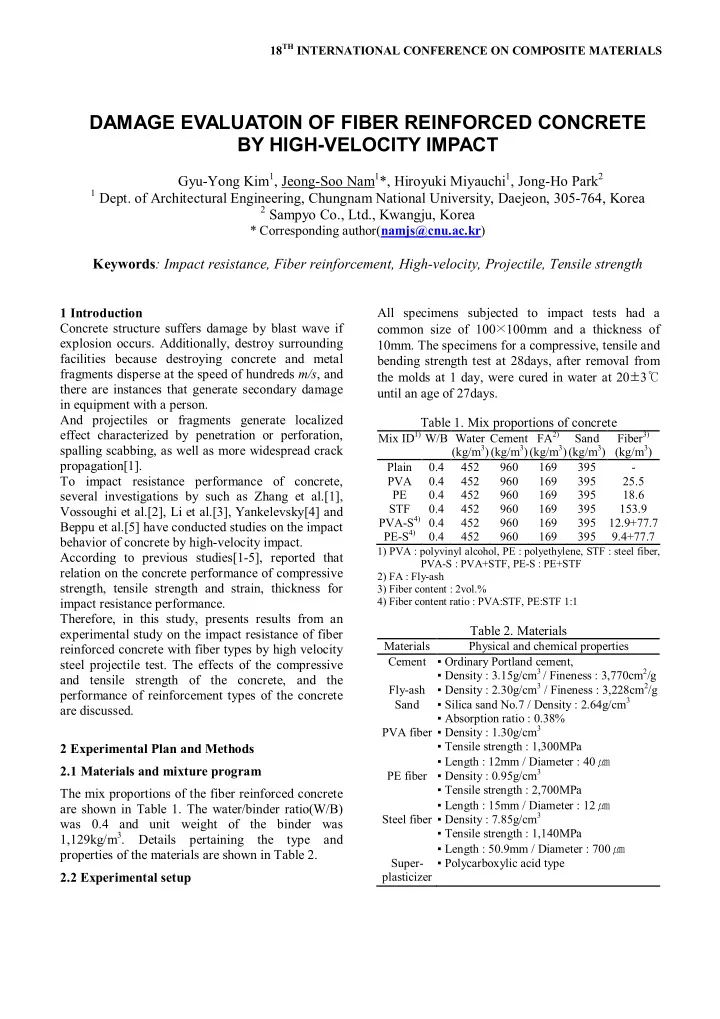
1 Introduction Concrete structure suffers damage by blast wave if explosion occurs. Additionally, destroy surrounding facilities because destroying concrete and metal fragments disperse at the speed of hundreds m/s, and there are instances that generate secondary damage in equipment with a person. And projectiles or fragments generate localized effect characterized by penetration or perforation, spalling scabbing, as well as more widespread crack propagation[1]. To impact resistance performance of concrete, several investigations by such as Zhang et al.[1], Vossoughi et al.[2], Li et al.[3], Yankelevsky[4] and Beppu et al.[5] have conducted studies on the impact behavior of concrete by high-velocity impact. According to previous studies[1-5], reported that relation on the concrete performance of compressive strength, tensile strength and strain, thickness for impact resistance performance. Therefore, in this study, presents results from an experimental study on the impact resistance of fiber reinforced concrete with fiber types by high velocity steel projectile test. The effects of the compressive and tensile strength of the concrete, and the performance of reinforcement types of the concrete are discussed. 2 Experimental Plan and Methods 2.1 Materials and mixture program The mix proportions of the fiber reinforced concrete are shown in Table 1. The water/binder ratio(W/B) was 0.4 and unit weight of the binder was 1,129kg/m3. Details pertaining the type and properties of the materials are shown in Table 2. 2.2 Experimental setup All specimens subjected to impact tests had a common size of 100×100mm and a thickness of
- 10mm. The specimens for a compressive, tensile and
bending strength test at 28days, after removal from the molds at 1 day, were cured in water at 20±3℃ until an age of 27days. Table 1. Mix proportions of concrete
Mix ID1) W/B Water (kg/m3) Cement (kg/m3) FA2) (kg/m3) Sand (kg/m3) Fiber3) (kg/m3) Plain 0.4 452 960 169 395
- PVA
0.4 452 960 169 395 25.5 PE 0.4 452 960 169 395 18.6 STF 0.4 452 960 169 395 153.9 PVA-S4) 0.4 452 960 169 395 12.9+77.7 PE-S4) 0.4 452 960 169 395 9.4+77.7
1) PVA : polyvinyl alcohol, PE : polyethylene, STF : steel fiber, PVA-S : PVA+STF, PE-S : PE+STF 2) FA : Fly-ash 3) Fiber content : 2vol.% 4) Fiber content ratio : PVA:STF, PE:STF 1:1
Table 2. Materials
Materials Physical and chemical properties Cement ▪ Ordinary Portland cement, ▪ Density : 3.15g/cm3 / Fineness : 3,770cm2/g Fly-ash ▪ Density : 2.30g/cm3 / Fineness : 3,228cm2/g Sand ▪ Silica sand No.7 / Density : 2.64g/cm3 ▪ Absorption ratio : 0.38% PVA fiber ▪ Density : 1.30g/cm3 ▪ Tensile strength : 1,300MPa ▪ Length : 12mm / Diameter : 40 ㎛ PE fiber ▪ Density : 0.95g/cm3 ▪ Tensile strength : 2,700MPa ▪ Length : 15mm / Diameter : 12 ㎛ Steel fiber ▪ Density : 7.85g/cm3 ▪ Tensile strength : 1,140MPa ▪ Length : 50.9mm / Diameter : 700 ㎛ Super- plasticizer ▪ Polycarboxylic acid type
DAMAGE EVALUATOIN OF FIBER REINFORCED CONCRETE BY HIGH-VELOCITY IMPACT
Gyu-Yong Kim1, Jeong-Soo Nam1*, Hiroyuki Miyauchi1, Jong-Ho Park2
1 Dept. of Architectural Engineering, Chungnam National University, Daejeon, 305-764, Korea 2 Sampyo Co., Ltd., Kwangju, Korea