D Answer 600 m/s C 0.003 m/s D [This object is a pull tab] - - PDF document

d
SMART_READER_LITE
LIVE PREVIEW

D Answer 600 m/s C 0.003 m/s D [This object is a pull tab] - - PDF document

Slide 1 / 40 Slide 2 / 40 8th Grade Forces and Motion Study Guide www.njctl.org Slide 3 / 40 1 A snail travels 10 m in 3000 seconds. What is the snail's average speed? 60000 m/s A 0.02 m/s B 600 m/s C 0.003 m/s D Slide 3 (Answer) /


slide-1
SLIDE 1

Slide 1 / 40

8th Grade

Forces and Motion

Study Guide www.njctl.org

Slide 2 / 40 1

A snail travels 10 m in 3000 seconds. What is the snail's average speed?

A

60000 m/s

B
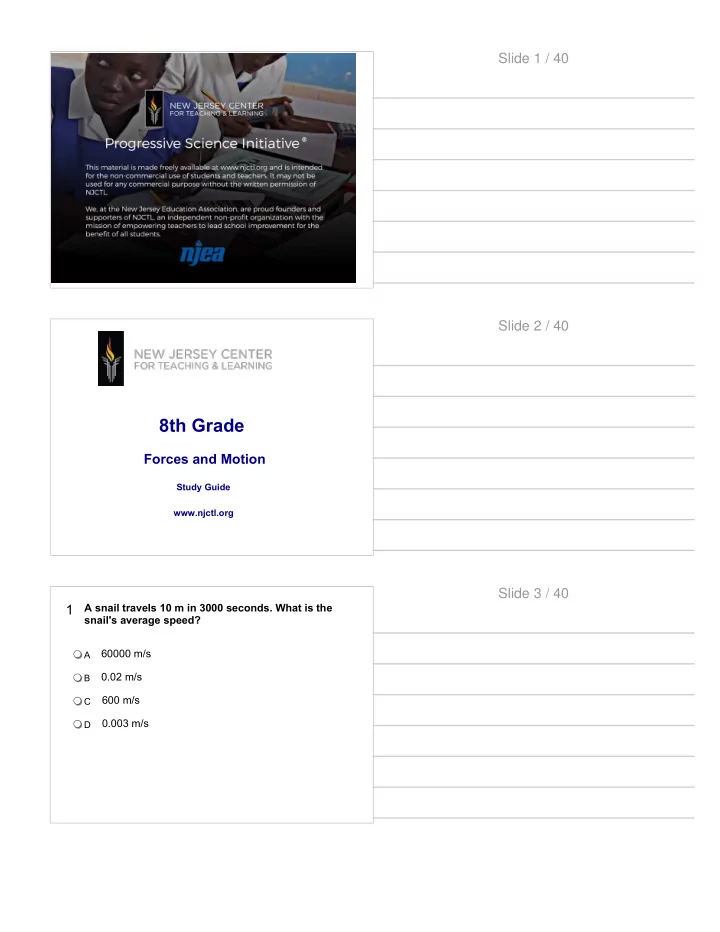
0.02 m/s

C

600 m/s

D

0.003 m/s

Slide 3 / 40

slide-2
SLIDE 2

1

A snail travels 10 m in 3000 seconds. What is the snail's average speed?

A

60000 m/s

B

0.02 m/s

C

600 m/s

D

0.003 m/s

[This object is a pull tab]

Answer

D

Slide 3 (Answer) / 40 2

A blimp travels at 3 m/s for 1000 s. What distance does the blimp cover in that time?

A

500 m/s

B

3000 m

C

4500 m/s

D

500 m

Slide 4 / 40 2

A blimp travels at 3 m/s for 1000 s. What distance does the blimp cover in that time?

A

500 m/s

B

3000 m

C

4500 m/s

D

500 m

[This object is a pull tab]

Answer

B

Slide 4 (Answer) / 40

slide-3
SLIDE 3

3 When your teacher times your mile run at 8.2

minutes, that means your speed was 0.12 mi/min. Was this your average speed or your instantaneous speed?

A Average Speed B Instantaneous Speed

Slide 5 / 40

3 When your teacher times your mile run at 8.2

minutes, that means your speed was 0.12 mi/min. Was this your average speed or your instantaneous speed?

A Average Speed B Instantaneous Speed

[This object is a pull tab]

Answer

avg speed = 8.2mi/min

Slide 5 (Answer) / 40

4 Does a speedometer measure the average speed or

the instantaneous speed?

A Average Speed B Instantaneous Speed

Slide 6 / 40

slide-4
SLIDE 4

4 Does a speedometer measure the average speed or

the instantaneous speed?

A Average Speed B Instantaneous Speed

[This object is a pull tab]

Answer

Instantaneous Speed

Slide 6 (Answer) / 40

5 A swordfish travels for two hours. The first hour he covers 110 kilometers, and the second hour he covers 110 kilometers. What is the average speed of the swordfish? A 55 km/h B 84 km/h C 110 km/h D 194 km/h

Hint: Remember that average speed is total distance travelled divided by total time

Slide 7 / 40

5 A swordfish travels for two hours. The first hour he covers 110 kilometers, and the second hour he covers 110 kilometers. What is the average speed of the swordfish? A 55 km/h B 84 km/h C 110 km/h D 194 km/h

Hint: Remember that average speed is total distance travelled divided by total time

[This object is a pull tab]

Answer

C

Slide 7 (Answer) / 40

slide-5
SLIDE 5

6 A dog walks outside to go the bathroom every day. If she walks outside at a speed of 3 meters per second and walks 150 meters before she uses the bathroom, how long does it take her? A 50 seconds B 2 minutes C 188 seconds D 90 seconds

Slide 8 / 40

6 A dog walks outside to go the bathroom every day. If she walks outside at a speed of 3 meters per second and walks 150 meters before she uses the bathroom, how long does it take her? A 50 seconds B 2 minutes C 188 seconds D 90 seconds

[This object is a pull tab]

Answer

A

Slide 8 (Answer) / 40

7 Carlos and Gina are riding on their horses to go into

  • town. They travel 140 meters in 14 seconds going
  • west. What is their velocity?

A 490 m/s west B 10 m/s west C 490 m/s D 10 m/s

Slide 9 / 40

slide-6
SLIDE 6

7 Carlos and Gina are riding on their horses to go into

  • town. They travel 140 meters in 14 seconds going
  • west. What is their velocity?

A 490 m/s west B 10 m/s west C 490 m/s D 10 m/s

[This object is a pull tab]

Answer

B

Slide 9 (Answer) / 40

8 A car travels 200 km/h west for 2 hours. The car then travels 150 km/h east for one hour. What is the car's position relative to its starting position? A 50 km west B 150 km west C 250 km west D 50 km east

Slide 10 / 40

8 A car travels 200 km/h west for 2 hours. The car then travels 150 km/h east for one hour. What is the car's position relative to its starting position? A 50 km west B 150 km west C 250 km west D 50 km east

[This object is a pull tab]

Answer

C

Slide 10 (Answer) / 40

slide-7
SLIDE 7

9

A nitro-methane powered top fuel dragster launches from rest to race against an opponent. Why did the car accelerate?

A

increased speed

B

decreased speed

C

changed direction

Slide 11 / 40 9

A nitro-methane powered top fuel dragster launches from rest to race against an opponent. Why did the car accelerate?

A

increased speed

B

decreased speed

C

changed direction

[This object is a pull tab]

Answer

A

Slide 11 (Answer) / 40

10 A driver hits the brakes to slow down at an

  • intersection. As the car's speed is decreasing it has

A positive acceleration B negative acceleration C no acceleration D more information is needed

Slide 12 / 40

slide-8
SLIDE 8

10 A driver hits the brakes to slow down at an

  • intersection. As the car's speed is decreasing it has

A positive acceleration B negative acceleration C no acceleration D more information is needed

[This object is a pull tab]

Answer

B

Slide 12 (Answer) / 40

11 Which of the following graphs depicts the

acceleration of a runner speeding up to pass someone. A B C

x

Y

Speed (m/s) Time (s) x

Y

Speed (m/s) Time (s)

x

Y

Speed (m/s) Time (s)

D

x

Y

Speed (m/s) Time (s)

Slide 13 / 40

11 Which of the following graphs depicts the

acceleration of a runner speeding up to pass someone. A B C

x

Y

Speed (m/s) Time (s) x

Y

Speed (m/s) Time (s)

x

Y

Speed (m/s) Time (s)

D

x

Y

Speed (m/s) Time (s)

[This object is a pull tab]

Answer

C

Slide 13 (Answer) / 40

slide-9
SLIDE 9

12 Which of the following speed vs time graphs corresponds to the position vs time graph shown in the graph below?

A B C

Slide 14 / 40

12 Which of the following speed vs time graphs corresponds to the position vs time graph shown in the graph below?

A B C

[This object is a pull tab]

Answer

A

Slide 14 (Answer) / 40

13 A ball is traveling down a hill at 4 m/s. If the ball increases in speed to 8 m/s in 4 seconds, what is the acceleration of the ball? A 4 m/s B 4 m/s/s C 1 m/s D 1 m/s/s

Slide 15 / 40

slide-10
SLIDE 10

13 A ball is traveling down a hill at 4 m/s. If the ball increases in speed to 8 m/s in 4 seconds, what is the acceleration of the ball? A 4 m/s B 4 m/s/s C 1 m/s D 1 m/s/s

[This object is a pull tab]

Answer

D

Slide 15 (Answer) / 40

14 Forces are all around us. Which of the following do you think are examples of forces? (choose all that apply) A Gravity B Friction C Muscles D Wind

Slide 16 / 40

14 Forces are all around us. Which of the following do you think are examples of forces? (choose all that apply) A Gravity B Friction C Muscles D Wind

[This object is a pull tab]

Answer

A & B

Slide 16 (Answer) / 40

slide-11
SLIDE 11

15 What is the SI unit for force? A Pounds B Kilograms C Newtons

Slide 17 / 40

15 What is the SI unit for force? A Pounds B Kilograms C Newtons

[This object is a pull tab]

Answer

C

Slide 17 (Answer) / 40 16 A +20 N force acts on a car and at the same time,

a -30 N force acts on the car. What is the net force acting on the car and is it balanced? A

  • 30 N unbalanced

B

  • 10 N unbalanced

C

  • 10 N balanced

D + 30 balanced

Slide 18 / 40

slide-12
SLIDE 12

16 A +20 N force acts on a car and at the same time,

a -30 N force acts on the car. What is the net force acting on the car and is it balanced? A

  • 30 N unbalanced

B

  • 10 N unbalanced

C

  • 10 N balanced

D + 30 balanced

[This object is a pull tab]

Answer

B

Slide 18 (Answer) / 40 17 The force of gravitation between an object and a

planet is increased as they move away from each

  • ther:

True False

Slide 19 / 40 17 The force of gravitation between an object and a

planet is increased as they move away from each

  • ther:

True False

[This object is a pull tab]

Answer

False

Slide 19 (Answer) / 40

slide-13
SLIDE 13

18 A 100 kg kid is on the moon, where g = 1.67 m/s2 .

What is the boy's weight? A 83.5 kg B 167 kg C 167 N D 29.9 N

Slide 20 / 40 18 A 100 kg kid is on the moon, where g = 1.67 m/s2 .

What is the boy's weight? A 83.5 kg B 167 kg C 167 N D 29.9 N

[This object is a pull tab]

Answer

C

Slide 20 (Answer) / 40

19 What is the net force acting on the object below?

7 N

  • 8 N
  • 10 N

Slide 21 / 40

slide-14
SLIDE 14

19 What is the net force acting on the object below?

7 N

  • 8 N
  • 10 N

[This object is a pull tab]

Answer

  • 11 N

Slide 21 (Answer) / 40

20 Is the object in equilibrium? Yes No

7 N

  • 8 N
  • 10 N

Slide 22 / 40

20 Is the object in equilibrium? Yes No

7 N

  • 8 N
  • 10 N

[This object is a pull tab]

Answer

No

Slide 22 (Answer) / 40

slide-15
SLIDE 15

21 What is the net force acting on the object below?

25 N

  • 15N
  • 10 N

Slide 23 / 40

21 What is the net force acting on the object below?

25 N

  • 15N
  • 10 N

[This object is a pull tab]

Answer

0 N

Slide 23 (Answer) / 40

22 Is the object in equilibrium? Yes No

25 N

  • 15N
  • 10 N

Slide 24 / 40

slide-16
SLIDE 16

22 Is the object in equilibrium? Yes No

25 N

  • 15N
  • 10 N

[This object is a pull tab]

Answer

Yes

Slide 24 (Answer) / 40

23 Acceleration due to gravity on Jupiter is 26.1 m/s2 . How much would a 25 kg person weigh on Jupiter?

Slide 25 / 40

23 Acceleration due to gravity on Jupiter is 26.1 m/s2 . How much would a 25 kg person weigh on Jupiter?

[This object is a pull tab]

Answer

653 N

Slide 25 (Answer) / 40

slide-17
SLIDE 17

24 Acceleration due to gravity on Earth's Moon is 1.67 m/s2 . How much would a 113 kg person weigh on Earth's Moon?

Slide 26 / 40

24 Acceleration due to gravity on Earth's Moon is 1.67 m/s2 . How much would a 113 kg person weigh on Earth's Moon?

[This object is a pull tab]

Answer

189 N

Slide 26 (Answer) / 40 25 Inertia is the reluctance any material object has

to change its state of motion. True False

Slide 27 / 40

slide-18
SLIDE 18

25 Inertia is the reluctance any material object has

to change its state of motion. True False

[This object is a pull tab]

Answer

True

Slide 27 (Answer) / 40 26 The law of inertia applies to:

A moving objects B nonmoving objects C both moving and nonmoving objects

Slide 28 / 40 26 The law of inertia applies to:

A moving objects B nonmoving objects C both moving and nonmoving objects

[This object is a pull tab]

Answer

C

Slide 28 (Answer) / 40

slide-19
SLIDE 19

27 Which object has the greatest inertia? A Car B Tennis Ball C Freight Train

Slide 29 / 40

27 Which object has the greatest inertia? A Car B Tennis Ball C Freight Train

[This object is a pull tab]

Answer

C

Slide 29 (Answer) / 40 28 A ball will accelerate and increase its velocity

when it feels an unbalanced force. True False

Slide 30 / 40

slide-20
SLIDE 20

28 A ball will accelerate and increase its velocity

when it feels an unbalanced force. True False

[This object is a pull tab]

Answer

True

Slide 30 (Answer) / 40 29 When the force acting on an object decreases,

the resulting acceleration will: A remain constant B increase C decrease

Slide 31 / 40 29 When the force acting on an object decreases,

the resulting acceleration will: A remain constant B increase C decrease

[This object is a pull tab]

Answer

C

Slide 31 (Answer) / 40

slide-21
SLIDE 21

30 When an object's mass is decreased but the

applied force stays the same, the resulting acceleration will: A remain constant B increase C decrease

Slide 32 / 40 30 When an object's mass is decreased but the

applied force stays the same, the resulting acceleration will: A remain constant B increase C decrease

[This object is a pull tab]

Answer

B

Slide 32 (Answer) / 40

31 You are riding your bicycle to the park to meet a few friends. As you ride, you apply a force of 40 N and accelerate at a rate of 0.4 m/s2 . What is the total mass of the bicycle and you? A 75 kg B 100 kg C 120 kg

Slide 33 / 40

slide-22
SLIDE 22

31 You are riding your bicycle to the park to meet a few friends. As you ride, you apply a force of 40 N and accelerate at a rate of 0.4 m/s2 . What is the total mass of the bicycle and you? A 75 kg B 100 kg C 120 kg

[This object is a pull tab]

Answer

B

Slide 33 (Answer) / 40 32 When you sit on a chair, the chair pushes back

with force equal to your weight. True False

Slide 34 / 40 32 When you sit on a chair, the chair pushes back

with force equal to your weight. True False

[This object is a pull tab]

Answer

True

Slide 34 (Answer) / 40

slide-23
SLIDE 23

33 Which of the following statements pertains to the third law of motion? A Action and Reaction pairs always act on the same object. B Mass is indirectly proportional to acceleration. C An object at rest will remain at rest unless acted on by an unbalanced force. D If a force occurs, action reaction forces are present.

Slide 35 / 40

33 Which of the following statements pertains to the third law of motion? A Action and Reaction pairs always act on the same object. B Mass is indirectly proportional to acceleration. C An object at rest will remain at rest unless acted on by an unbalanced force. D If a force occurs, action reaction forces are present.

[This object is a pull tab]

Answer

D

Slide 35 (Answer) / 40 34 How can a small toy have the same momentum as

a large car? A toy has large speed B both car and toy are at rest C toy has no mass D A & B

Slide 36 / 40

slide-24
SLIDE 24

34 How can a small toy have the same momentum as

a large car? A toy has large speed B both car and toy are at rest C toy has no mass D A & B

[This object is a pull tab]

Answer

D

Slide 36 (Answer) / 40 35 If a 3 kg toy truck is moving at 4 m/s, what is the

toy's momentum? A 3 m/s B 2 kgm/s C 12 kgm/s D 12 m/s

Slide 37 / 40 35 If a 3 kg toy truck is moving at 4 m/s, what is the

toy's momentum? A 3 m/s B 2 kgm/s C 12 kgm/s D 12 m/s

[This object is a pull tab]

Answer

C

Slide 37 (Answer) / 40

slide-25
SLIDE 25

36 What two factors does momentum depend on? A mass and volume B mass and acceleration C mass and velocity D mass and force

Slide 38 / 40

36 What two factors does momentum depend on? A mass and volume B mass and acceleration C mass and velocity D mass and force

[This object is a pull tab]

Answer

C

Slide 38 (Answer) / 40 37 The law of conservation of momentum states that

the total momentum after a collision increases from its value before the collision. True False

Slide 39 / 40

slide-26
SLIDE 26

37 The law of conservation of momentum states that

the total momentum after a collision increases from its value before the collision. True False

[This object is a pull tab]

Answer

False

Slide 39 (Answer) / 40

38 According to Newton's 3rd law, action reaction pairs are equal and opposite to each other. Why do these paired forces sometimes cause different motions if they are equal?

Slide 40 / 40

38 According to Newton's 3rd law, action reaction pairs are equal and opposite to each other. Why do these paired forces sometimes cause different motions if they are equal?

[This object is a pull tab]

Answer

because they act on different

  • bjects

Slide 40 (Answer) / 40