CYTOMINE A rich internet application for remote visualization, - - PowerPoint PPT Presentation

cytomine a rich internet application for remote
SMART_READER_LITE
LIVE PREVIEW

CYTOMINE A rich internet application for remote visualization, - - PowerPoint PPT Presentation

CYTOMINE A rich internet application for remote visualization, collaborative annotation, and automated analysis of whole slide images Raphal Mare GIGA Bioinformatics Core Facility Systems and Modeling, Dept. EE&CS University of


slide-1
SLIDE 1

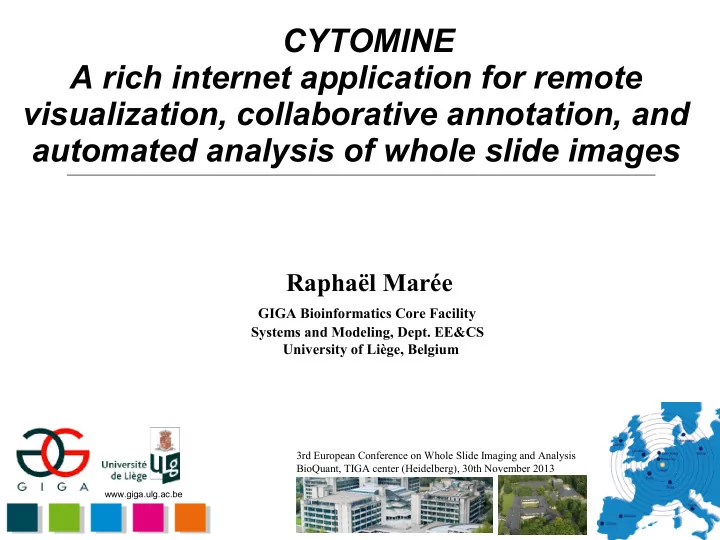
CYTOMINE A rich internet application for remote visualization, collaborative annotation, and automated analysis of whole slide images

Raphaël Marée

GIGA Bioinformatics Core Facility Systems and Modeling, Dept. EE&CS University of Liège, Belgium

3rd European Conference on Whole Slide Imaging and Analysis BioQuant, TIGA center (Heidelberg), 30th November 2013

www.giga.ulg.ac.be

slide-2
SLIDE 2

Our Cytomine software relies on...

  • Whole-slide scanners to convert glass slides into images

+

  • Modern web development tools & open-source libraries

+

  • Recent algorithms in machine learning and image analysis

+

  • High-performance computing and mass storage equipments

(+/- 500 person-years)

slide-3
SLIDE 3

Software features : Organize and centralize on the web

Create and manage multiple projects : – Upload images to centralized server or keep data local (distributed image tile servers) – Support for various formats (TIFF, JP2000, Aperio SVS, Hamamatsu NDPI, 3DHistech MRXS, Leica SCN, Roche BIF...) – Users with authentification (e.g. LDAP), access rights, and roles – Specific ontologies with user-defined, vocabulary terms

...

slide-4
SLIDE 4

– Explore large (>gigabyte pixel) images at multiple resolutions – GoogleMaps/OpenStreetmap browsing style (zoom in/out, pyramid tile-based)

Software features : Visualize

1 tissue slice = 35000 x 30000 pixels (0.23µm/pixel) 4 fluo channels 83000 x 100 000 pixels = 4 x 16GB image

slide-5
SLIDE 5

– Annotate images using various drawing tools, with user-specific layers – Describe ROIs with ontology terms (term suggestion using CBIR) – Describe images and ROIs with any key-value properties or text description – Build up pathology atlases and gather annotation statistics

Software features : Annotate

slide-6
SLIDE 6

– Visual search of regions of interest

Software features : Search

Marée et al., Incremental indexing and distributed image search using shared randomized vocabularies, Proc. MIR 2010

slide-7
SLIDE 7

– Share images through simple URLs – Share annotations through simple URLs & e-mail mechanisms

Software features : Share

http://beta.cytomine.be/#tabs-image-83151073-86503947- http://beta.cytomine.be/#share-annotation/92024416

slide-8
SLIDE 8

Software features : Live broadcast

slide-9
SLIDE 9

– Integrate third-party softwares through web services with HTTP requests and import/export data through JSON messages

– http://beta.cytomine.be/api/project.json – http://beta.cytomine.be/api/annotation.json?&project=60&term=4777&users=14,16 – http://beta.cytomine.be/api/annotation/75499.json – http://beta.cytomine.be/api/annotation/75499/crop.jpg?zoom=0 – http://beta.cytomine.be/#tabs-image-67-58147-75499

  • Software parameters and results are recorded in the centralized database

to ease traceability and reproducibility

Software features : Extend and reproduce

slide-10
SLIDE 10

– Generic machine-learning based image recognition (without user-defined rules nor explicit features)

Marée et al. (2013). Extremely Randomized Trees and Random Subwindows for Image Classification, Annotation, and Retrieval. Invited chapter in A., Criminisi & J., Shotton (Eds.), Decision Forests in Computer Vision and Medical Image Analysis, Advances in Computer Vision and Pattern Recognition, pp. 125-142. Springer.

– Built-in interfaces for algorithm evaluation and collaborative proofreading

Software features : Analyze and proofread

Marée et al. (2014). A hybrid human-computer approach for large-scale image based measurements using web services and machine learning. To appear in Proc. IEEE International Symposium on Biomedical Imaging (ISBI)

slide-11
SLIDE 11

Applications

slide-12
SLIDE 12

LUNG tumor tissue quantification

(ongoing collaboration with D. Cataldo, N. Rocks, at LBTD, GIGA)

What is the impact of condition X/Y/... on lung tumor onset and progression ? . ...

...

Condition X Condition Y

... . . .

slide-13
SLIDE 13

Tens or hundreds of glass slides to be quantified per study...

...

slide-14
SLIDE 14

Treated with X

40K x 30K pixels

To appear in Proc. IEEE ISBI 2014

distributed processing

Hybrid human-computer workflow

slide-15
SLIDE 15

Hybrid human-computer workflow

cartilage bronchus red-blood adenocarcinoma blood vessel inflammatory cells necrosis

  • 1. Manual region contouring and labelling to provide training examples
slide-16
SLIDE 16

VS

  • 2. Automatic training of image recognition model based on training examples

Hybrid human-computer workflow

slide-17
SLIDE 17

Hybrid human-computer workflow

  • 3. Batch processing of slides

Reviewing slides

slide-18
SLIDE 18
  • 3. Automatic segmentation of tumors in new slide images

One image ~ 40 000 x 30 000 pixels Tile-based pixel classification (tumor / nontumor) + contour processing

Hybrid human-computer workflow

slide-19
SLIDE 19
  • 3. Proofreading automatic segmentations

Hybrid human-computer workflow

slide-20
SLIDE 20
  • 4. Export statistics

Hybrid human-computer workflow

> 500 whole-slide images analyzed with > 20 000 validated tumoral islets

Roles of polarized neutrophils on lung tumour development in an orthotopic lung tumour mouse model

Rocks et al., European Respiratory Society Annual Congress, 2013

slide-21
SLIDE 21
  • 4. Recognition performances : biologist's metrics : what is the impact on daily workload ?

(statistics obtained for 5 slides using WinOMeter)

Hybrid human-computer workflow

To appear in Proc. IEEE ISBI 2014

Proofreading algorithm through WiFi connection vs Flood fill algorithm on local computer

slide-22
SLIDE 22

Other applications : tumor/necrosis (H&E)

(ongoing work with C. Pequeux at LBTD, GIGA)

VS

slide-23
SLIDE 23

Other applications : tumor/necrosis (IHC)

(ongoing work with Ph. Martinive, N. Leroi at LBTD, GIGA)

VS

slide-24
SLIDE 24

RNAscope spot counting, breast tumors (C. Josse, GIGA) IHC positive cell counting, nephrology (F.Jouret, GIGA)

Other applications : counting

H&E nucleus counting (R. Longuespée, GIGA) Follicule counting, ovarian (C. Munaut, GIGA)

slide-25
SLIDE 25

Other applications : diagnostic cytology

(fine-needle aspiration of the thyroïd, ongoing work with I.Salmon at ULB)

slide-26
SLIDE 26

Summary

CYTOMINE : a rich internet application

– Uses generic software design, web services, and machine learning – Fosters collaboration between pathologists, life scientists, and computer scientists

  • Eases sharing of whole slides and annotations
  • Speeds up large-scale image quantifications
  • Offers mechanisms to integrate novel algorithms / image formats

– ~ 100 users, 150 projects, > 12K images, > 125K annotations

10 20 30 40 50 60 70 80 2011 2012 2013

Nbre cumulé d'utilisateurs

20 40 60 80 100 120 140 160 2011 2012 2013

Nbre cumulé de projets

2000 4000 6000 8000 10000 12000 14000 2011 2012 2013

Nbre cumulé d'images

20000 40000 60000 80000 100000 120000 2011 2012 2013

Nbre cumulé d'annotations manuelles

1000 2000 3000 4000 5000 6000 7000 2012 2013

Nbre cumulé de jobs

5000 10000 15000 20000 25000 2012 2013

Nbre cumulé d'annotations automatique validées

slide-27
SLIDE 27

Future work

– Improve algorithm robustness and further speedup workflows – Development for histology/anatomopathology training courses

slide-28
SLIDE 28

Future work

– Improve algorithm robustness and further speedup workflows – Development for histology/anatomopathology training courses – Working together ?

slide-29
SLIDE 29

Acknowledgments

  • Systems and Modeling (GIGA-Research / Montefiore Institute): Loïc Rollus,

Benjamin Stévens, Gilles Louppe, Olivier Stern, Nathalie Jeanray, Vincent Botta, Pierre Geurts, Louis Wehenkel

  • CYTOMINE software beta-testing, etc. : Didier Cataldo, Natacha Rocks, Fabienne

Perin, Christine Fink, Sandrine Bekaert, Myriam Remmelink, Caroline Degand, Isabelle Salmon, Sandrine Rorive, Audrey Voncken, Jessica Aceto, Yoann Curé, Benoist Pruvot, Marc Muller, Natacha Leroi, ... Raphaël Marée is funded by GIGA FEDER grant and the CYTOMINE (2010-2014) research grant n° 1017072 of the Wallonia (DGO6). Benjamin Stévens is funded by SMASH spin-off grant n° 1217606 of the Wallonia

www.montefiore.ulg.ac.be/~maree/ www.cytomine.be

slide-30
SLIDE 30

Related publications

– Marée et al., "A rich internet application for remote visualization and collaborative annotation of digital slide images in histology and cytology". BMC Diagnostic Pathology, 8(Suppl 1):S26, 30th September 2013 – Marée et al. (2013). Extremely Randomized Trees and Random Subwindows for Image Classification, Annotation, and Retrieval. Invited chapter in A., Criminisi & J., Shotton (Eds.), Decision Forests in Computer Vision and Medical Image Analysis, Advances in Computer Vision and Pattern Recognition,

  • pp. 125-142. Springer.

– Marée et al. (2014). A hybrid human-computer approach for large-scale image based measurements using web services and machine learning. To appear in Proc. IEEE International Symposium on Biomedical Imaging (ISBI)