Cyclospora Outbreak Investigation in Lambton County: Utilization of - - PowerPoint PPT Presentation

cyclospora outbreak investigation in lambton county
SMART_READER_LITE
LIVE PREVIEW

Cyclospora Outbreak Investigation in Lambton County: Utilization of - - PowerPoint PPT Presentation

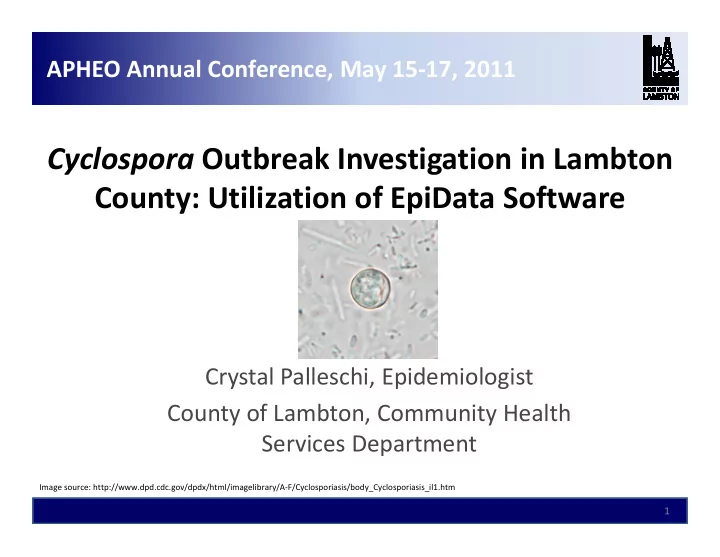
APHEO Annual Conference, May 15-17, 2011 Cyclospora Outbreak Investigation in Lambton County: Utilization of EpiData Software Crystal Palleschi, Epidemiologist County of Lambton, Community Health Services Department Image source:


slide-1
SLIDE 1

Cyclospora Outbreak Investigation in Lambton County: Utilization of EpiData Software

APHEO Annual Conference, May 15-17, 2011 Crystal Palleschi, Epidemiologist County of Lambton, Community Health Services Department

1

Image source: http://www.dpd.cdc.gov/dpdx/html/imagelibrary/A-F/Cyclosporiasis/body_Cyclosporiasis_il1.htm

slide-2
SLIDE 2
  • Background
  • Methods

– EpiData Entry & Analysis Results

Overview

  • Results
  • Conclusions

2

slide-3
SLIDE 3
  • Cyclospora cayetanensis is a protozoan parasite that

infects the upper small bowel

  • Cyclospora is not endemic in Canada
  • Previous outbreaks in N.A. have been associated with

ingestion of imported fresh produce

Background

ingestion of imported fresh produce

  • Cyclospora is transmitted through food or water

contaminated by human feces

  • Oocysts require days to weeks outside the host to

sporulate and become infectious

  • Incidence in Lambton County is low (0-1 cases/year)

3

slide-4
SLIDE 4
  • On May 28, 2010 we were notified of six individuals

who were experiencing gastroenteric symptoms

  • All had attended “The Big Sister’s Chef’s Challenge” on

May 12, 2010 Event involved sampling 10 dishes prepared by 10

Background

  • Event involved sampling 10 dishes prepared by 10

different caterers/restaurateurs

  • Up to 400 attendees, including staff and volunteers
  • On June 2, 2010 all six were confirmed positive for

Cyclospora infection

4

slide-5
SLIDE 5
  • Surveillance
  • Environmental Investigation
  • Epidemiological Investigation

– Developed an outbreak questionnaire

Methods

– Developed an outbreak questionnaire – Case Definition – Data input into EpiData Entry – Analysis run using EpiData Analysis – Analysis re-run by OAHPP using STATA, included multivariate analysis

5

slide-6
SLIDE 6
  • Only essential fields were

input from questionnaires

  • Single person dedicated

to data entry

Data Entry

to data entry

  • Most fields coded 0/1 for

quick entry

  • Paper questionnaires

forwarded to epidemiologist for reference

6

slide-7
SLIDE 7

Simple Code:

  • freq ill /c /r
  • tables ill sex /c
  • tables ill agegrp /c
  • Epicurve ill onset /ti="As of June 17, 2010, 10:00am" /ytext="Number Ill" /yinc=4
  • missingvalue f1 f2 f3 f4 f5 f6 f7 f8 f9 f10 /9

Data Analysis

  • missingvalue f1 f2 f3 f4 f5 f6 f7 f8 f9 f10 /9
  • tables ill f1 f2 f3 f4 f5 f6 f7 f8 f9 f10 /ct /ar /ex
  • missingvalue f11 f12 f13 f14 f15 f16 f17 f18 f19 f20 /9
  • tables ill f11 f12 f13 f14 f15 f16 f17 f18 f19 f20 /ct /ar /ex
  • missingvalue f21 f22 f23 f24 f25 f26 f27 f28 /9
  • tables ill f21 f22 f23 f24 f25 f26 f27 f28 /ct /ar /ex
  • select ill=1
  • freq hospital admit /c /r
  • select
  • freq test /c /r

7

slide-8
SLIDE 8
  • 3-4 page report generated

and shared with staff, MOHLTC, OAHPP, CFIA, etc.

Data Analysis

8

slide-9
SLIDE 9

May 12th Event June 2nd: Outbreak Declared June 4th: Analysis (n=233) June 14th: Analysis (n=281) June 18th: OAHPP Analysis (n=286)

Timeline

Interviews conducted (n=292) Over 770 phone calls received

May 28th: Notified

  • f 6-8 ill

persons June 3rd: Analysis (n=128) June 8th: Analysis (n=272) June 17th: Analysis (n=292) June 21st: Outbreak Closed 9

Food Samples Submitted (n=13)

slide-10
SLIDE 10

Results

  • 292 interviews conducted

– 210 ill, 82 well – 43 lab confirmed, 167 probable – 285 attended event, 7 leftovers

10

  • Hospitalizations

– 23 reported a hospital visit – 7 admitted to hospital

  • No fatalities reported
slide-11
SLIDE 11

Results

11

slide-12
SLIDE 12

Results

Exposed Not Exposed Unadjusted Food Item Ill Total AR (%) Ill Total AR (%) RR p-value Coffee and Jerk Chicken 164 235 69.8 36 47 76.6 0.91 0.348 Mexican Empanuadas 191 264 72.3 15 24 62.5 1.16 0.306 Fireball Chicken Sticks 177 248 71.4 26 35 74.3 0.96 0.720 Stuffed Mushroom Caps 180 250 72.0 27 39 69.2 1.04 0.721

12

Stuffed Mushroom Caps 180 250 72.0 27 39 69.2 1.04 0.721 Chicken Summer Roll 191 266 71.8 11 18 61.1 1.17 0.333 Red Wine Risotto Arancinis 183 254 72.0 17 25 68.0 1.06 0.668 Yia Yia Lamb 165 225 73.3 39 61 63.9 1.15 0.150 Roasted Garlic Chevre 175 243 72.0 23 35 65.7 1.10 0.441 Cool Pesto Crunch 207 278 74.5 11 0.0 ∞* 0.000 Thai Chicken and Shrimp 154 209 73.7 49 75 65.3 1.13 0.169

slide-13
SLIDE 13

Results

  • Epidemiological evidence suggested one dish: Cool

Pesto Crunch

  • Further evidence from 7 ill individuals eating

leftovers of this dish

13

  • 13 food samples submitted to CFIA; all negative,

indeterminate or unfit for testing

  • Cool Pesto Crunch contained fresh basil from Costa

Rica; grab samples tested negative

slide-14
SLIDE 14

Conclusions

  • Difficult to obtain lab confirmation of food source

due to long incubation period

  • Unknown why outbreak was limited to this event
  • Successful collaboration at the local, provincial and

14

  • Successful collaboration at the local, provincial and

national levels

  • Demonstrates the impact of international trade and

risks of importing produce

  • Emphasizes the importance of special events policies
slide-15
SLIDE 15

Conclusions - EpiData

  • Quick and efficient entry and analysis
  • Designate staff for data entry
  • Enter only essential information required for analysis
  • Minimal training required

15

  • Minimal training required
  • APHEO educational sessions & materials valuable
  • Demonstrates that a small health unit can respond to

a large outbreak

slide-16
SLIDE 16

Acknowledgements

  • Ministry of Health and Long Term Care
  • Ontario Agency for Health Protection and Promotion
  • Public Health Agency of Canada
  • Canadian Food Inspection Agency

16

  • Canadian Food Inspection Agency
  • Toronto Public Health Lab
  • London Public Health Lab
  • Community Health Services Department
  • Local restaurants/caterers
slide-17
SLIDE 17

Questions? Thank you! Questions?

17