SLIDE 1
SLIDE 2
Cuneiform writing had over 560 signs
SLIDE 3
Egyptian hieroglyphics were simpler and used only 20 or 30 different symbols that could be combined to make words.
SLIDE 4
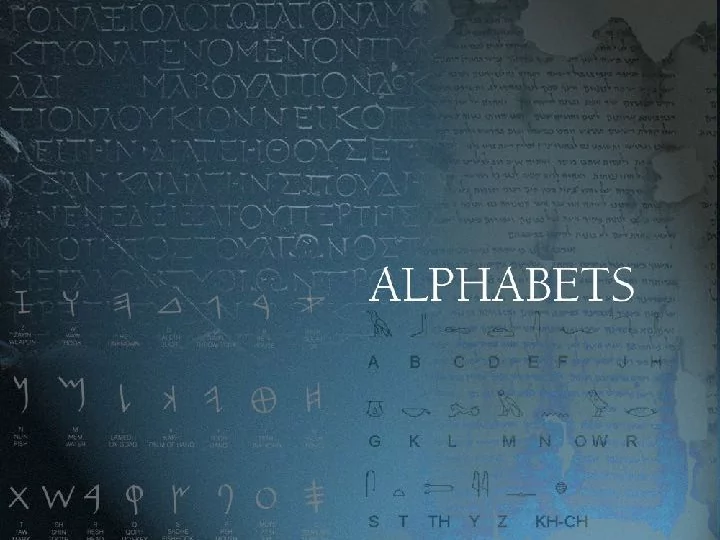
The Alphabet The Egyptian system used pictographs for sounds made in speech.
SLIDE 5
Minoan civilization on the island of Crete also developed an early alphabet.
SLIDE 6
The Phaistos Disk As many as 241 symbols are stamped in clay in what is believed to be a written alphabet.
SLIDE 7
Phaistos Disk side A side B
SLIDE 8
Phaistos Disk detail
SLIDE 9
Phaistos Disk detail
SLIDE 10
Phoenicians were seafaring merchants who sailed the Mediterranean Sea.
SLIDE 11
Phoenicians linked settlements throughout the region and helped spread cuneiform and hieroglyphic writing.
SLIDE 12
Phoenician trade routes included ancient Rome, Greece, Mesopotamia, Egypt, and North Africa.
SLIDE 13
Phoenician script Also called the North Semitic script, it read from right to left and became the predecessor of the Aramaic Alphabet.
SLIDE 14
Aramaic script
SLIDE 15
Hebrew script
SLIDE 16
Arabic script
SLIDE 17
Sanskrit script
SLIDE 18
Phoenician > Greek > Latin (Roman)
SLIDE 19
> Cyrillic Phoenician > Greek > Latin (Roman)
SLIDE 20
Ancient Greek Empire during the 4th century under Alexander the Great.
Greek culture brought a demand for works of literature such as philosophy, poetry, and drama.
SLIDE 21
Greek The Greeks adopted the Phoenician alphabet, but modified it, making the letters more geometrically structured.
SLIDE 22 Greek stela were erected as markers along the lands conquered by the army. They were inscribed with the elegant Greek letterforms to commemorate Greek battles. Soon, an oral culture no longer had the capacity to contain and document knowledge and information:
- Military armies used writing
to communicate and inform
- Officials needed documents
- Demand rose for Greek
philosophical works
SLIDE 23
Papyrus was in short supply and decayed easily.
SLIDE 24
The Dead Sea Scrolls
SLIDE 25 Parchment King Eumenes II of Ancient Greece developed the process of making parchment to
placed on shipments of papyrus from Egypt.
SLIDE 26
Parchment
SLIDE 27
Parchment
SLIDE 28
Parchment
SLIDE 29
Etruscan civilization
SLIDE 30
The Roman Empire by 117 CE
SLIDE 31
Latin script The Romans adopted the Latin script which the Etruscans had modeled after the Greek alphabet.
SLIDE 32
Trajan’s Column One of the most beautiful inscriptions adorns Trajan’s Column in Rome – a monument to a famous Roman general.
SLIDE 33
Trajan’s Column The column features remarkable reliefs of battle scenes.
SLIDE 34
The Romans perfected the Greek letterforms by adding chiseled serifs to Latin letters at the base of Trajan’s column.
SLIDE 35
The Latin script was carved in capitalis monumentalis – which later influenced renaissance roman type.
SLIDE 36
The codex vs. the scroll
SLIDE 37
The codex was easier to read and more portable than scrolls.
SLIDE 38 The codex was preferred by Christians who regarded scrolls as
- pagan. Their parchment pages held paint and metals nicely.
SLIDE 39
The codex exists in these Central American stone tablets and some have been found bound together.
SLIDE 40
Hangul script The Korean monarch Sejong developed the Hangul script in 1446 by decree to overcome the great difficulty in learning the Chinese writing system. It is the only Asian writing system based on an alphabet . It was scientifically designed to depict sounds made from speech using the positions made by the mouth and tongue.
SLIDE 41
Hangul consists of 14 consonants and 10 vowels that combine to write words arranged in individual square blocks.
SLIDE 42