cultures improves patient management Martin McHugh Clinical - - PowerPoint PPT Presentation

cultures improves patient
SMART_READER_LITE
LIVE PREVIEW

cultures improves patient management Martin McHugh Clinical - - PowerPoint PPT Presentation

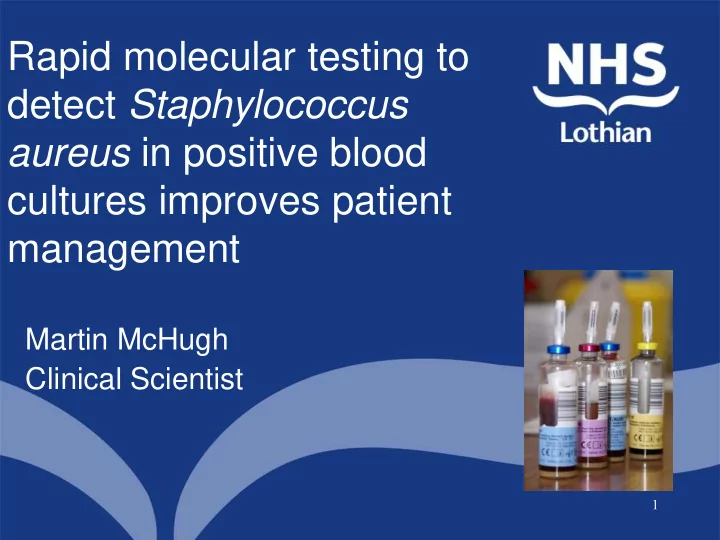
Rapid molecular testing to detect Staphylococcus aureus in positive blood cultures improves patient management Martin McHugh Clinical Scientist 1 Staphylococcal Bacteraemia SAB is an important burden on healthcare (31 per 100,000 AOBDs

slide-1
SLIDE 1

Rapid molecular testing to detect Staphylococcus aureus in positive blood cultures improves patient management

Martin McHugh Clinical Scientist

1

slide-2
SLIDE 2

2

Staphylococcal Bacteraemia

  • SAB is an important burden on healthcare (31 per

100,000 AOBDs 2013-14),1 reflected in HEAT targets

  • Proportion due to MRSA is decreasing but MSSA

remains a problem

  • Delay in appropriate antibiotics associated with worse
  • utcomes2

– Start empiric therapy and rationalise when culture results available

  • Most blood cultures with GPCC on Gram are CoNS

– Often contaminants not requiring Abx

1HPS (2014) Scottish S. aureus bacteraemia surveillance report 2van Hal et al (2012) Clin Microbiol Rev

slide-3
SLIDE 3

3

Xpert MRSA/SA BC Assay

  • Automated DNA extraction and real-time PCR
  • Detects S. aureus (spa) and methicillin resistance

(SCCmec and mecA) in positive blood culture fluid

  • Internal controls to verify assay efficiency
  • Around 10 min hands-on time and 62 min on machine
  • Kit Insert

– 58 MRSA, 120 MSSA, 268 non-SA samples

  • MRSA 98.3% sensitive, 99.4% specific
  • MSSA 100% sensitive, 98.6% specific

– Lots of studies agree with these figures

slide-4
SLIDE 4

4

18-24 h ≥ 24 h ~70 min

Sample collected, sent to lab Loaded onto BacT Alert Gram film, media put up – Morphology Latex, MALDI, MRSA selective agar – ID and presumptive MRSA/MSSA Full sensitivities – Final report Xpert assay – MRSA/MSSA

slide-5
SLIDE 5

5

Study Aims

1. Determine the accuracy of rapid molecular testing for MRSA/MSSA in positive blood cultures with GPCC 2. Compare turn around time (TAT) with standard methods 3. Does this strategy alter patient management?

slide-6
SLIDE 6

6

Inclusion/Exclusion Criteria

  • Submitted to lab medicine Quality Improvement Team as

a service evaluation

– Recruitment 22/12/14 – 30/01/15

  • Inclusion Criteria

– Positive blood culture with Gram positive cocci in clusters

  • Exclusion criteria

– Mixed organisms on Gram film – Charcoal-containing blood culture bottle – Blood culture positive over the weekend – Patient tested in previous 2 weeks (unless requested by clinician)

slide-7
SLIDE 7

7

Lab Processing

  • Bottle flags positive, Gram by BMS
  • If eligible, take 500 μl bottle fluid
  • (Centrifuge 3,000 rpm for 2 min)
  • 50 μL added to 2 mL elution reagent
  • Vortex and add whole volume to cartridge
  • Load on GeneXpert
  • Result manually added to APEX record and passed to duty medic
slide-8
SLIDE 8

8

Accuracy of Rapid Molecular Testing

Test Result MRSA MSSA S. aureus not detected Invalid Culture 1 9 71

  • Xpert

1 9 64 7

  • 80 samples from 79 patients
  • 100% sensitive & specific for MRSA/MSSA
  • Performance comparable to literature
slide-9
SLIDE 9

Lab Turn Around Time

1.3 h 3.1 h 24.7 h 48.7 h Median:

  • Time from flagged to Apex result entry

9

slide-10
SLIDE 10

10

Clinical Utility

a Not available: data not recorded (17), Xpert failed (7), patient deceased (2)

Management not changed Antibiotic s Started Antibiotics avoided Antibiotics changed Antibiotics stopped No data Total 38 8 5 2 1 26a 80

  • PCR result ~21 h earlier than culture
  • From 54 instances with data, management was improved based on PCR

result in 16 (30 %) cases

  • Although management unchanged in 38 cases, medics felt more

confident having the PCR result

  • Rapid results reduced medical report time
slide-11
SLIDE 11

11

Financial Implications

  • Routine blood culture = £15
  • Xpert test = £32
  • Need to balance lab costs with potential savings in
  • ther areas

– Reduce unnecessary antibiotic use

  • Less side effects, C.diff, resistance?

– Better management of SABs

  • Improve patient outcomes, inpatient stay, transmission?
slide-12
SLIDE 12

12

Conclusions

  • Xpert MRSA/SA BC Assay performed well and

was simple to do

  • Could rationalise management ~21 h earlier

– This was done in 30% of cases

  • PCR improved patient and time management

– Potential for positive knock-on effects out with lab medicine should be studied further

slide-13
SLIDE 13

13

Acknowledgements

  • Kate

Templeton

  • Lab staff
  • Clinical Staff
  • Ben

Parcell

  • Fiona MacKenzie
  • Service Evaluation of

Rapid Molecular Diagnostics Group

slide-14
SLIDE 14

14

Questions?