Cultural Perceptions and Couple Relations in Mainland China - - PowerPoint PPT Presentation

cultural perceptions and couple relations in mainland
SMART_READER_LITE
LIVE PREVIEW

Cultural Perceptions and Couple Relations in Mainland China - - PowerPoint PPT Presentation

Cultural Perceptions and Couple Relations in Mainland China Professor Agn gnes Koon-chui i LA LAW, PhD PhD Qich ichuang Soc ocial l Ser ervice e Ce Center, Guangzhou, Ch Chin ina Cen enter for Social Work Education and Res esearch,


slide-1
SLIDE 1

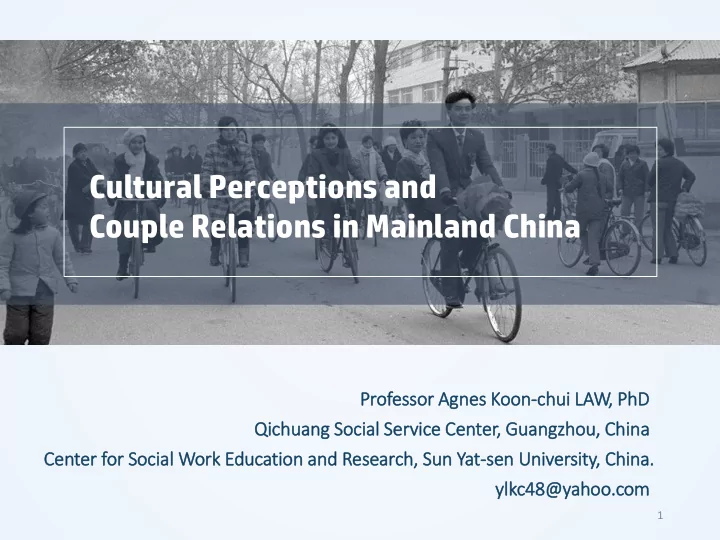
Cultural Perceptions and Couple Relations in Mainland China

Professor Agn gnes Koon-chui i LA LAW, PhD PhD Qich ichuang Soc

  • cial

l Ser ervice e Ce Center, Guangzhou, Ch Chin ina Cen enter for Social Work Education and Res esearch, Sun Yat-sen University, China. ylk lkc48@yahoo.com

1

slide-2
SLIDE 2

Trends: Average ag age at t marria iage

National (1990) National (2010) Guangzhou (2010) Guangzhou (2016) Male 23.6 25.9 27.4 30.8 Female 22.0 23.9 25.1 28.2

2

slide-3
SLIDE 3

National (2000) National (2010) Guangdong (2010) Guangdong (2016) Male % 640.2760m 682.3291m 43.3817m 57.6348m 51.5% 51.3% 50.9% 52.4% Female % 602.3363m 650.4818m 41.8433m 52.3552m 48.5% 48.7% 49.1% 47.6%

Sex ratio of f married people

3

slide-4
SLIDE 4

National (2000) National (2010)

20-24 31.70% 24.82% 25-29 82.34% 70.04% 35-39 95.39% 93.03% 40-44 94.97% 94.07%

Ra Ratio of f married people in in ea each age gr group

4

slide-5
SLIDE 5

National (2000) National (2010) Guangdong (2010) Guangzhou (2010)

AVG 0.90% 1.38% 0.81% 1.23% City 1.41% 2.00% 0.91% Town 0.92% 1.33% 0.68% Village 0.69% 1.07% 0.70% Di Divorce rate of

  • f people

le ag aged 15 15 an and ab above

5

slide-6
SLIDE 6

National (2000) National (2010) Primary level 80.46% 82.20% Post-secondary 67.11% 55.39%

Educatio ional le level of f married peo eople

6

slide-7
SLIDE 7

The number of marriages has been decreasing continuously nationwide for the last three years: 2016 11.33m registered, 13% less than 2014 (www.hkej.com 24/1/2018)

Dela laying marriage

7

slide-8
SLIDE 8

 Decreasing birth rate  In 2016, 17.86m newborn vs 2017, 17.23m,

3.5% lower

 In 2017

7.24m first children 8.83m second children

 Indicating an upsurge for having a second child

(www.hkej.com 24/1/2018)

Abolishing th the one-child policy

8

slide-9
SLIDE 9

 Family is the most important social unit in the support

network of Chinese society.

 Traditional patriarchal values are implicit in many social,

economic and political aspects.

 Sustaining the family clan and its name, with male as the heir

if possible, is significant.

 Man’s role: in charge of affairs outside of the family  Woman’s role: in charge of household chores inside of the

family

Tradit itio ional l valu lues affectin ing couple le rela latio ionship ip

9

slide-10
SLIDE 10

Matching family backgrounds of the couple, in terms of:

 Financial power of the two families  Social status of the two families  Educational backgrounds of the couple  Women prefer to marry up the social ladder  Men prefer to marry on the same rung of the ladder or

downwards

Pre Pre-condit itio ion for r marr rria iage: fin inancia ial l se securit ity

10

slide-11
SLIDE 11

(www.xinhuanet.com)

Pre Pre-open door r era: : weddin ing ceremony

11

slide-12
SLIDE 12

(www.xinhuanet.com)

Pre Pre-open door r era: : receiv ivin ing the brid ride

12

slide-13
SLIDE 13

A wedding at Zhongshan, Guangdong (Tencent News Web 11/1/2016)

Sh Showin ing off weddin ing gift ifts: : in in the form rm of gold ld

13

slide-14
SLIDE 14

Shouguang Daily 23/4/2011

Sh Showin ing off wealt lth at the weddin ing

14

slide-15
SLIDE 15

Weddin ing gift ifts: : in in the form rm of cash

15

slide-16
SLIDE 16

Décor r of the bedroom of the newly lyweds

16

slide-17
SLIDE 17

Receiv ivin ing the brid ride

17

slide-18
SLIDE 18

Receiving cash and golden ornaments as gifts in return.

Honorin ing the parents

18

slide-19
SLIDE 19

Weddin ing banquet

 Good wishes of the relatives

and friends: be prosperous, buy a flat and a car soon, have a baby soon….

19

slide-20
SLIDE 20

Property

Left: Mother-in-law: ‘No property, no talk’(Fang.com) Right: Mother-in-law: ‘No property, no wedding’(www.nanhunnvjia.com

20

slide-21
SLIDE 21

In In-la law rela latio ionship ips

L: Mother and daughter-in-law: fighting for control of the son/husband R: Mother and daughter-in-law: fighting over trivial household matters

21

slide-22
SLIDE 22

Aft fter sc school: l: grandparents and parents at t th the sc school l gate

(edu.shenchuang.com 30/09/2013)

22

slide-23
SLIDE 23

Child ildrearin ing by grandparents

(js.people.com.cn 02/09/2015)

23

slide-24
SLIDE 24

In Intergeneratio ional l child ildrearin ing

24

slide-25
SLIDE 25

‘Left-over’ women

 To avoid being stigmatized as too-old, left-over

women, young women are eager to get married as soon as possible. Men are also eager to get married in order to please the parents and for family succession.

 Legally, getting married beyond the age of 23 for a

woman or 25 for a man is considered “late”.

25

slide-26
SLIDE 26

Th The One-chil ild Poli licy

 In order to control population growth, the one child policy per married

couple in urban areas had been enforced since the late 1970s.

 Social issues arising:

01

The child becomes the focus of attention and care of the two families, especially as both husband and wife are single children of their parents.

02 Family succession is an important goal of the couple, as well as of their

parents.

03 Academic achievement of the single child is of primary importance.

26

slide-27
SLIDE 27

Transit itio ion to the two-chil ild polic licy

This policy has invoked new social issues:

 Intergenerational conflict over whether the

couple should have a second child, especially if the first child is a girl.

 Dispute between the couple over whether to

have a second child, considering the age, health

  • f the wife and family income.

 In view of the rising ageing population and relatively low birth rate (1.6),

the government decided in 2015 to relinquish the one-child policy and allow married couples in urban areas to have two children.

27

slide-28
SLIDE 28

Case – We want a so son

 Five years ago, Ling left her home village to seek work in

Guangzhou, the capital city of Guangdong Province.

 She met her boyfriend, who is also from the rural area. Soon

she got pregnant. Her boyfriend’s parents claimed that if the child was a boy, they could get married. Not wanting to have an abortion, she took the chance, but gave birth to a girl. The boyfriend then disappeared and cut off all connection with her.

28

slide-29
SLIDE 29

Case – Married to one’s equal

 Ming, a single child, with good academic ability, eventually

became a paediatrician. She married a lawyer three months after they were introduced to each other. She is now 33, and her husband 39, and they have a one-year-old daughter.

 The husband is always away on business trips and shows little

interest in family life. He resents her calling him when he is at work, as it would make him lose face in front of his colleagues. He thinks the wife should take care of the family independently.

29

slide-30
SLIDE 30

Case – A sp spoil iled so son

 Six months ago, Wah married a man who, being the only son,

has his daily needs and requirements attended to by his parents, down to the last detail.

 The husband is always absent from home and has been having

an extramarital relationship with another young girl. The parents-in-law told Wah that if she wishes to divorce their son, they will compensate her, as they have done so previously when their son got into trouble with other women, such as arranging an abortion and paying for the expenses.

30

slide-31
SLIDE 31

Case – Patria iarchal l domin inance

 A couple, both university graduates, married a few years ago.

Before marriage, the husband always shared the same bedroom with his parents.

 After the wife had given birth to a baby boy, the parents

moved into their bedroom, saying that the air conditioner in their room was out of order. The wife strongly objected. But the husband compromised, allowing them to move in. Only after a fierce fight with the daughter-in-law did the father-in- law move back to his own room.

31

slide-32
SLIDE 32

Case – Fighting for an heir for one’s family

 A couple are both lecturers at a university. The wife is a single

child of a rather well-off family. The husband has a brother. So the wife’s family demanded that their grandchild should bear their family name as their heir. The wife gave birth to a baby girl and named her after the wife’s family. The two-child policy was enacted when the first daughter was 10. The couple tried to have a second child.

 When she was already seven months pregnant, and guessing it

was also a girl, the father of the wife urged her to have an abortion and try for another pregnancy. The young mother refused and gave birth to a second baby girl.

32

slide-33
SLIDE 33

Case – Fig ightin ing for r an heir ir

 Another similar case. A couple came from a village that has a

strong preference for sons. When the young couple, also university lecturers, gave birth to a son, both families wanted the grandchild to bear their family name. The husband’s family threatened that their son would divorce her. So the wife gave in, letting their daughter use the husband’s surname.

 For health reasons, the wife, aged 38, was medically advised

not to have another child. Her own parents would not give up, but constantly encouraged her to try for another baby, hoping to have a child to bear their family name.

33

slide-34
SLIDE 34

Materia ial l condit itio ions versus psycholo logic ical l and emotio tional l condit itio ions

 Getting married is a much felt social pressure for young people

and their parents. When the young man and woman are beyond their late 20s, they are pressed to make a hasty decision to marry any seemingly suitable candidate.

 Insufficient understanding and acceptance of each other’s

personalities, values, and lifestyles are likely to induce relational conflicts and communication difficulties between the couple and with their in-laws at a later stage.

34

slide-35
SLIDE 35

Parental l domin inance over r couple le rela latio ions

 Parents often play a dominant role in structuring couple

relationships, including choosing a spouse, the format of the wedding, where to reside, when to buy a property and what type of property, how to raise a child and whether or not to have a second child.

 To have the understanding and support of parents of both

sides in childrearing practices is a vital factor for a harmonious couple relationship and intergenerational relationship.

35

slide-36
SLIDE 36

Preference for r so son over r daughter

 The strong preference for son over

daughter has had a profound effect on the social, economic and political

  • system. It is widely accepted that men

tend to have higher social status and greater economic and political power.  Having a son as heir is not only a matter of cultural significance, but it is also believed that he will bring tangible benefits to the family.

36

slide-37
SLIDE 37

So Socia ial l pressures rela latin ing to chil ildrearin ing

 ‘To win at the starting line of the race’ is a motto of

childrearing.

 The families of both sides would readily exhaust their

available means to help the couple buy a property with access to a good school, and to pay for additional educational facilities and coaching after school.

 The academic achievement of the child is valued as the

most important life goal for the parents, as well as the

  • child. Character building and vocational or practical ability

are often neglected.

37

slide-38
SLIDE 38

Refle lections

 Drastic social change has led to many incongruent social

consequences, and impacted on the institutions of the family and marriage.

 Traditional agrarian, patriarchal values are incompatible with the

expectations of the younger generation, especially those with better education and career aspirations.

 More young people are attempting to explore alternative ideas

about marriage and love, and to establish their marital relationship

  • n an egalitarian basis.

 Eliminating gender stereotypes, promoting awareness of gender

equality, and reexamining the criteria for quality of life are part of the new social agenda to be pursued in the long term.

38

slide-39
SLIDE 39

39