CSXT Emergency Response for May 2010 Flood Repairs 11 th Annual - - PowerPoint PPT Presentation

csxt emergency response for may 2010 flood repairs
SMART_READER_LITE
LIVE PREVIEW

CSXT Emergency Response for May 2010 Flood Repairs 11 th Annual - - PowerPoint PPT Presentation

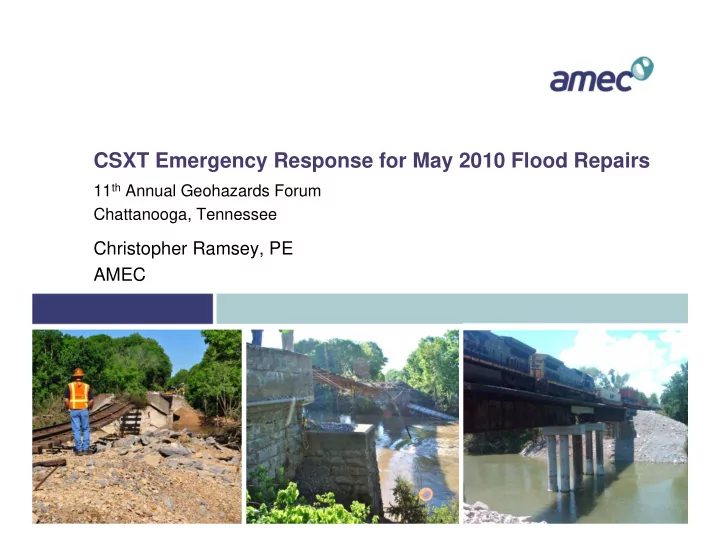
CSXT Emergency Response for May 2010 Flood Repairs 11 th Annual Geohazards Forum Chattanooga, Tennessee Christopher Ramsey, PE AMEC Project Overview Record rainfalls affecting greater Nashville. Some areas recorded greater than 19 inches of


slide-1
SLIDE 1

CSXT Emergency Response for May 2010 Flood Repairs

11th Annual Geohazards Forum Chattanooga, Tennessee

Christopher Ramsey, PE AMEC

slide-2
SLIDE 2

2

Project Overview

  • Record rainfalls affecting greater Nashville.

Some areas recorded greater than 19 inches of rain over May 1 & 2, 2010

  • Tailwaters of the Cumberland River flood due to

the unprecedented precipitation event

  • CSX Transportation lines in the Kingston

Springs area west of Nashville along the Harpeth River, and beyond, are damaged and in need of repair

  • CSXT selects a team of engineers and

contractors, which included AMEC, to inspect, permit, re-design & repair over 200 miles of track which extended from Nashville to Memphis

slide-3
SLIDE 3

3

Project Overview, cont’d

  • Over 37,000 feet of railroad track required repair of some kind
  • Several culverts were washed out which then had to be restored,

cleaned or upgraded

  • Two bridges, which supported track over the Harpeth River were

damaged.

  • Both bridges were 3 span structures. One was completely washed out,

including loss of 2 center piers. The other had one span washed away. Bridges affected were located at mileposts (MP) 17.4 & 23.5

slide-4
SLIDE 4

4

Project Overview, cont’d

  • The project team collaborated to determine the best solution that would

restore rail traffic in a rapid and safe manner

  • The team sought out available equipment and materials prior to

commencing design

  • Items such as available pre-fabricated steel spans, drilled shaft steel

casing and appropriate foundation equipment were evaluated for suitability

slide-5
SLIDE 5

5

Milepost 17.4 assesment

  • MP17.4 constructed in 1878 and rebuilt in 1930, 2 piers and 2

abutments consisting of stone masonry bearing on bedrock

  • All three spans washed down stream, both piers were forced over due

to flood waters

  • West embankment and roadbed damaged
slide-6
SLIDE 6

6

Milepost 17.4 assessment, cont’d

slide-7
SLIDE 7

7

Milepost 17.4 assessment, cont’d

slide-8
SLIDE 8

8

Milepost 17.4 assessment, cont’d

slide-9
SLIDE 9

9

Milepost 17.4 assessment, cont’d

slide-10
SLIDE 10

10

Milepost 23.5 assessment

  • MP 23.5 is a three span bridge totaling approximately 296 feet, with

eastern most span washed out

  • Both approach embankments damaged with severe roadbed damage

mainly to the east

  • Constructed in 1922, consisting of stone masonry piers and

abutments bearing on bedrock

slide-11
SLIDE 11

11

Milepost 23.5 assessment, cont’d

slide-12
SLIDE 12

12

Milepost 23.5 assessment, cont’d

slide-13
SLIDE 13

13

Milepost 23.5 assessment, cont’d

slide-14
SLIDE 14

14

Milepost 23.5 assessment, cont’d

slide-15
SLIDE 15

15

Site Investigation

  • Preliminary plan is to install two new piers at MP17.4 and one new

pier at MP23.5

  • Drill one boring, including rock core, at each bridge site
  • Boring at MP17.4 site drilled just downstream at approximately center
  • f total span. Boring at MP23.5 site drilled on location of proposed

replacement pier

slide-16
SLIDE 16

16

The Repair Plan, MP17.4

  • Utilize steel spans available for immediate delivery and tailor design

based on that availability

  • Permanently cased, rock bearing, steel reinforced drilled shafts for

new pier supports

  • Drilled shafts also sized based on availability of material, specifically

casing sizes

slide-17
SLIDE 17

17

The Repair Plan, MP17.4 (as conceived)

  • Single element was used to extend from base
  • f pier cap into bedrock
  • Single piece of steel casing placed into drilled

rock socket

  • Reinforcing steel cage placed and the element

was concreted

  • Annulus between casing and bedrock socket

was grouted

slide-18
SLIDE 18

18

The Repair Plan, MP17.4 (as constructed)

  • Single element was used to extend from base of pier cap into bedrock
  • Temporary casing, left in place, used through shot rock fill bench to

bedrock

  • Single piece of steel casing

placed into drilled rock socket and welded to temporary casing

  • Annulus between casing and

bedrock socket was grouted

  • Reinforcing steel cage placed

and the element was concreted

slide-19
SLIDE 19

19

Milepost 17.4 Repair

slide-20
SLIDE 20

20

Milepost 17.4 Repair

slide-21
SLIDE 21

21

Milepost 17.4 Repair, cont’d

slide-22
SLIDE 22

22

Milepost 17.4 Repair cont’d

slide-23
SLIDE 23

23

Milepost 17.4 Repair cont’d

slide-24
SLIDE 24

24

The Repair Plan, MP23.5

  • Same approach taken, to utilize steel spans available for immediate

delivery and tailor design based on that availability

  • Span too large for any available material, so an intermediate pier was

installed

  • Permanently cased, rock bearing, steel reinforced drilled shafts for new

pier support

  • Relatively lighter load, so drilled shaft casing sizes were readily

available

slide-25
SLIDE 25

25

Milepost 23.5 Repair

slide-26
SLIDE 26

26

Milepost 23.5 Repair cont’d

slide-27
SLIDE 27

27

Project Summary

  • Rail traffic was restored in just 21 calendar days after initial inspection
  • AMEC coordinated with concerned agencies such as USACE, TDEC

and US Coast Guard to discuss environmental permitting requirements

  • HDR, Inc. performed superstructure design while AMEC design the

foundations

  • AMEC aided design and inspection of localized slope and culvert

failures along the Bruceton and Henderson Subdivisions

  • The project team worked together to provide a comprehensive solution

after a crippling catastrophe

slide-28
SLIDE 28

28

Project Summary, cont’d

  • ACEC of Tennessee Engineering Excellence Grand Award winner,

Special Project Category

  • Quotes from Award Judges:
  • “The complexities of a disaster, coupled with pressure from the client for

a high quality and rapid repair, requires a level of rigor that surpasses the “normal” engineering project. In this case, superb orchestration of construction, design and permitting, which were all running parallel paths, resulted in the 21 day return to service of the CSX mainline rail.”

  • “Special consideration for disaster response, engineering design

decisions, mobilization & construction/repair all contributed to make this project unique and worthy of the Engineering Excellence Award.”

slide-29
SLIDE 29

29

Bridge 17.4, Finished

slide-30
SLIDE 30

30

Bridge 17.4, Finished

slide-31
SLIDE 31

31

Bridge 23.5, Finished

slide-32
SLIDE 32

32

Bridge 23.5, Finished

slide-33
SLIDE 33

33

Bridge 23.5, Finished

slide-34
SLIDE 34

34

Questions?