CSE-571 Grid maps or scans Probabilistic Robotics [Lu & - - PowerPoint PPT Presentation

cse 571
SMART_READER_LITE
LIVE PREVIEW

CSE-571 Grid maps or scans Probabilistic Robotics [Lu & - - PowerPoint PPT Presentation

Types of SLAM-Problems CSE-571 Grid maps or scans Probabilistic Robotics [Lu & Milios, 97; Gutmann, 98: Thrun 98; Burgard, 99; Konolige & Gutmann, 00; Thrun, 00; Arras, 99; Haehnel, 01;] Mapping Landmark-based [Leonard et


slide-1
SLIDE 1

1

CSE-571 Probabilistic Robotics

Mapping

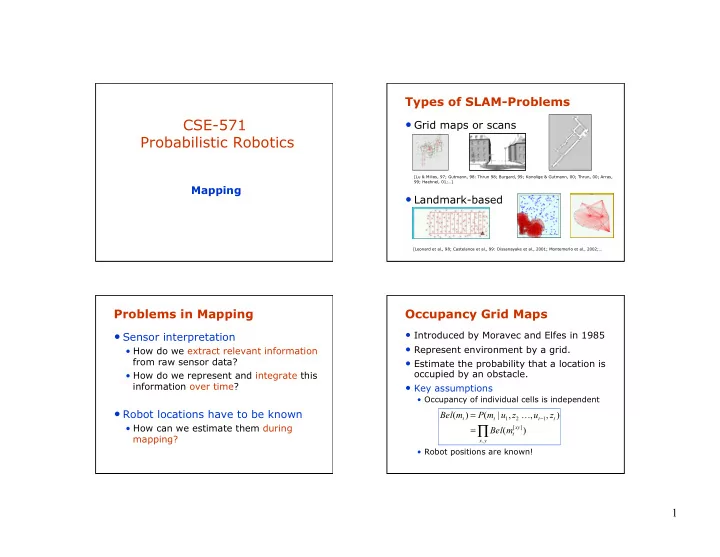
Types of SLAM-Problems

  • Grid maps or scans

[Lu & Milios, 97; Gutmann, 98: Thrun 98; Burgard, 99; Konolige & Gutmann, 00; Thrun, 00; Arras,

99; Haehnel, 01;…]

  • Landmark-based

[Leonard et al., 98; Castelanos et al., 99: Dissanayake et al., 2001; Montemerlo et al., 2002;…

Problems in Mapping

  • Sensor interpretation
  • How do we extract relevant information

from raw sensor data?

  • How do we represent and integrate this

information over time?

  • Robot locations have to be known
  • How can we estimate them during

mapping?

Occupancy Grid Maps

  • Introduced by Moravec and Elfes in 1985
  • Represent environment by a grid.
  • Estimate the probability that a location is
  • ccupied by an obstacle.
  • Key assumptions
  • Occupancy of individual cells is independent
  • Robot positions are known!

= =

− y x xy t t t t t

m Bel z u z u m P m Bel

, ] [ 1 2 1

) ( ) , , , | ( ) ( …

slide-2
SLIDE 2

2 Updating Occupancy Grid Maps

Bel(mt

[xy]) = η p(zt | mt [xy])

p(mt

[xy] | mt−1 [xy],ut−1)Bel(mt−1 [xy]) mt−1

[ xy]

  • Idea: Update each individual cell

using a binary Bayes filter.

  • Additional assumption: Map is static.

Bel(mt

[xy]) = η p(zt | mt [xy])Bel(mt−1 [xy])

Inverse Sensor Model for Occupancy Grid Maps

Combination of linear function and Gaussian:

( ) ( ) ( ) ( )

] [ 1 ] [ ] [ ] [

log , | log

xy t xy t t t xy t xy t

m B m

  • dds

x z m

  • dds

m B

+ − =

Incremental Updating

  • f Occupancy Grids (Example)

Alternative: Simple Counting

  • For every cell count
  • hits(x,y): number of cases where a beam ended

at <x,y>

  • misses(x,y): number of cases where a beam

passed through <x,y>

  • Assumption: P(occupied(x,y)) = P(reflects(x,y))

) , misses( ) , hits( ) , hits( ) (

] [

y x y x y x m Bel

xy

+ =

slide-3
SLIDE 3

3 Resulting Map Obtained with Ultrasound Sensors

Occupancy Grids: From scans to maps

Tech Museum, San Jose

CAD map

  • ccupancy grid map

K.M. Wurm, A. Hornung,

  • M. Bennewitz, C. Stachniss, W. Burgard

University of Freiburg, Germany

OctoMap

A Probabilistic, Flexible, and Compact 3D Map Representation for Robotic Systems

http://octomap.sf.net

slide-4
SLIDE 4

4 Robots in 3D Environments

Flying robots Humanoid robots Outdoor navigation Mobile manipulation

3D Map Requirements

§ Full 3D Model

§ Volumetric representation § Free-space § Unknown areas (e.g. for exploration)

§ Updatable

§ Probabilistic model (sensor noise, changes in the environment) § Update of previously recorded maps

3D Map Requirements

§ Flexible

§ Map is dynamically expanded § Multi-resolution map queries

§ Compact

§ Memory efficient § Map files for storage and exchange

Map Representations

Pointclouds

§ Pro: § No discretization of data § Mapped area not limited § Contra: § Unbounded memory usage § No direct representation of free or unknown space

slide-5
SLIDE 5

5 Map Representations

3D voxel grids

§ Pro: § Probabilistic update § Constant access time § Contra: § Memory requirement

§ Extent of map has to be known § Complete map is allocated in memory

Map Representations

2.5D Maps

§ 2D grid § Height value(s) in each cell

§ Pro: § Memory efficient § Contra: § Not completely probabilistic § No distinction between free and unknown space

Map Representations

Octrees

§ Tree-based data structure § Recursive subdivision of space into octants § Volumes allocated as needed § Multi-resolution

Map Representations

Octrees

§ Pro: § Full 3D model § Probabilistic § Flexible, multi-resolution § Memory efficient § Contra: § Implementation can be tricky (memory, update, map files, …)

slide-6
SLIDE 6

6 OctoMap Framework

§ Based on octrees § Probabilistic representation of occupancy including unknown § Supports multi-resolution map queries § Lossless compression § Compact map files § Open source implementation as C++ library available at http://octomap.sf.net

Probabilistic Map Update

§ Occupancy modeled as recursive binary Bayes filter [Moravec ‘85] § Efficient update using log-odds notation

Probabilistic Map Update

§ Clamping policy ensures updatability [Yguel ‘07] § Update of inner nodes enables multi- resolution queries

0.08 m 0.64 m 1.28 m

Lossless Map Compression

§ Lossless pruning of nodes with identical children § High compression ratios esp. in free space

[Kraetzschmar 04]

slide-7
SLIDE 7

7 Map Files

§ Maximum-likelihood map stored as compact bitstream § Occupied, free, and unknown areas § Very moderate space requirements (usually less than 2 MB)

Examples

§ Cluttered office environment

Map resolution: 2 cm

Examples: Office Building

§ Freiburg, building 079

Examples: Large Outdoor Areas

§ Freiburg computer science campus

(292 x 167 x 28 m³, 20 cm resolution)

slide-8
SLIDE 8

8 Examples: Tabletop Adding Color Memory Usage

Freiburg campus outdoor dataset FR-079 dataset

Memory Usage

slide-9
SLIDE 9

9 Insert time for 100,000 beams OctoMap Implementation

§ Open source C++ library § Fully documented § Can be easily adapted to your projects § ROS integration § Includes OpenGL viewer § Already used by several other researchers http://octomap.sf.net

SIGNED DISTANCE FUNCTIONS

CSE 571

Distance Function

slide-10
SLIDE 10

10 Signed Distance Function Projective Distance Function Projective Truncated Distance Function Projective Truncated Signed Distance Function