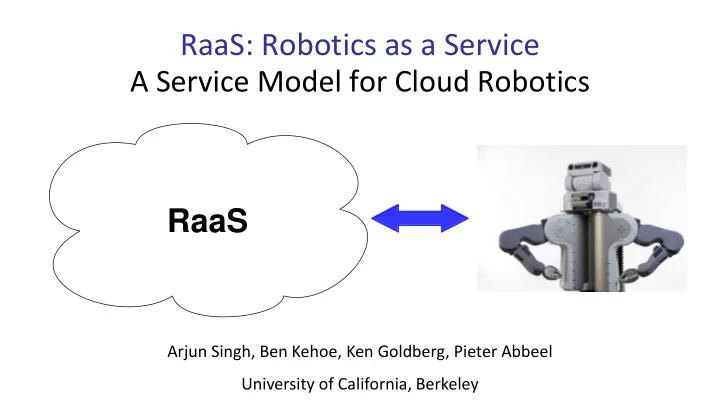
RaaS: Robotics as a Service A Service Model for Cloud Robotics RaaS - - PowerPoint PPT Presentation
RaaS: Robotics as a Service A Service Model for Cloud Robotics RaaS Arjun Singh, Ben Kehoe, Ken Goldberg, Pieter Abbeel University of California, Berkeley Example Use Case Objects coming down conveyer belt Identify each object, pick it
Example Use Case
- Objects coming down
conveyer belt
- Identify each object, pick it
up, and place into correct bin
- Low-level control
- Object recognition
- Grasp planning
- Motion planning
Drawing: Ketrina Yim
How to Solve It with ROS
- Acquire computing hardware
- Install ROS and relevant
packages
- Execute and maintain
software and computing hardware
Drawing: Ketrina Yim
Pros and Cons of ROS
- Huge positive impact on
robotics (especially sharing)
- Core great for messaging, low-
level control – components that make a robot operating system
- Asking it to do too much
- All code for everything robotics
related
Packages required for full ROS installation Packages required for barebones ROS installation
Pros and Cons of ROS
- Intimidating for non-roboticists
- Nontrivial to set up secure distributed networking with ROS --
need to understand VPNs, have control over network environment, etc.
- Dependencies can turn into a nightmare (especially with multiple
ROS versions)
Computing Environment has Changed
- ROS design started in 2006 – a lot
has changed!
- Cloud computing: Easy access to
vast numbers of machines
- Software engineering: Service-
- riented architectures and
Software as a Service
- E.g. Google Docs vs. Microsoft Office
Example Services – Motion Planning
Motion Planning Service
Start State Goal State Output Trajectory
Example Services – Object Recognition
Object Recognition Service
Input Scene Detected Objects and Poses
Object Recognition Motion Planning 1 Grasp Planning Motion Planning 2
RaaS
Algorithm Developers Algorithm Users
Object Dataset 1 Object Dataset 2
Data Collectors
Object Recognition Motion Planning 1 Grasp Planning Motion Planning 2
RaaS
Algorithm Developers Algorithm Users
Object Recognition Motion Planning 1 Grasp Planning Motion Planning 2
RaaS
Algorithm Developers
Our Idea: Robotics as a Service (RaaS)
- Publish algorithms as
services
- Consume services on
your robot
- Collaborative data
collection
Related Work
Rapyuta (www.rapyuta.org/) Robotics Platform as a Service Rocon (www.robotconcert.org/) Higher-level orchestration Goldberg et al. 1995 Networked robotics Arumugam et al. 2010 Cloud computing for robots Ciocarlie et al. 2010 Big data for robotics Kuffner 2010 Cloud-enabled robots Remy and Blake 2011 Service-oriented robotics Blake et al. 2011 Service-oriented robotics Waibel et al. 2011 Shared knowledge
Cloud Robotics
MoveIt! (Sucan and Chitta) Motion planning GraspIt! (Ciocarlie and Miller) Grasp planning OpenCV (Bradski) Computer vision OpenRAVE (Diankov) Motion planning Ladon (www.ladonize.org) Web service framework
Commercial Products
Mashape Index of service APIs PiCloud Move computation into cloud
Open-Source Tools
Why RaaS?
Limited Resources Code Sharing Encapsulation Parallelism Common Interfaces
Why RaaS?
- Some robotic platforms have limited onboard
computation (e.g. Baxter)
- Can’t run sophisticated robotics algorithms
- Need offboard computation – use the cloud or buy
computers
- Services give a straightforward way to move
computation to the cloud
Photo: David Yellen for IEEE Spectrum
Limited Resources Code Sharing Encapsulation Parallelism Common Interfaces
Why RaaS?
- Spend months working on your algorithm, finally finish it,
and you want to share it
- Need to figure out what all the dependencies are
- Need to document how to install everything
- Need to document how to use your code
- Don’t have time for any of these
- Packaged service: only worry about API users interact with
Limited Resources Code Sharing Encapsulation Parallelism Common Interfaces
Why RaaS?
- Robotics requires integrating many
different components
- Vision, NLP, control, messaging, planning,
grasping, etc. – each alone is complex
- Huge number of dependencies –
something is bound to conflict
- Services force encapsulation of
components
- Use object detection and planning
systems without worrying about conflicts
Limited Resources Code Sharing Encapsulation Parallelism Common Interfaces
Object Detection: Dependency A 1.0 Dependency B 2.1 Dependency C 2.5 Motion Planning: Dependency B 2.1 Dependency C 3.2 Object Detection: Dependency A 1.0 Dependency B 2.1 Dependency C 2.5 Motion Planning: Dependency B 2.1 Dependency C 3.2
- Service: natural
interface for parallelizing computation
- Insulates user from
managing parallelism
- Automatically run
multiple instances of a service on multiple machines
Why RaaS?
Limited Resources Code Sharing Encapsulation Parallelism Common Interfaces
- Easy benchmarking and comparison
- Use common interfaces when defining services
- E.g. object recognition systems
- Input: Image
- Output: List of object identities
- Can’t expect researchers to implement interfaces at a library level
- Swap out services
Why RaaS?
Limited Resources Code Sharing Encapsulation Parallelism Common Interfaces
RaaS Workflow
Object Recognition Motion Planning 1 Grasp Planning Motion Planning 2
RaaS
Algorithm Developers
RaaS Workflow – Algorithm Developers
- Write your usual code
- Wrap with service
code
- Create Amazon
Machine Image (AMI)
- Publish your service
RaaS Workflow – Algorithm Developers
Install dependencies + code Create Amazon Machine Image
Launch Machine on Amazon EC2
RaaS Workflow – Algorithm Developers
- Make creating a web service as simple as possible
- Ignore HTTP, serialization, encoding, webservers, etc.
- Rich set of types available for service methods
- Strings, floats, integers, binary blobs, raw files, timestamps, durations,
poses, transformations, vectors, matrices, images, point clouds
- Create your own
- Can serve ROS nodes as web services
RaaS Workflow – Algorithm Users
RaaS
Algorithm Users
Motion Planning 1 Grasp Planning Object Recognition Motion Planning 2 Grasp Planning
Object Recognition Service
Input Scene Detected Objects and Poses
Client Code: Service Definition:
RaaS Workflow – Algorithm Users
- Choose services
- Launch machines in
the cloud
- Connect to machine
and use services
- Detect objects in
images, plan motions, etc.
RaaS Workflow – Algorithm Users
- Compare different algorithms implementing the same interface
by changing a single URL
- Again, ignore serialization, encoding/decoding, HTTP, etc. – use
like an ordinary function call
- Use web-service-based ROS Nodes as if they were local ROS
Nodes
How to Solve It with RaaS
- No need to worry about
computing hardware
- Install barebones ROS – (i.e.
- nly messaging, low-level
control, etc.)
- Use object recognition,
motion planning, grasp planning services from RaaS
- RaaS complements ROS
Drawing: Ketrina Yim
Collaborative Data Collection – Example
- Ten camera rig with
controllable turntable
- High quality 3d models from
about 600 images in 5 minutes
- f human time
- Ship us an object, we upload
model to cloud, you can recognize it in images
Roadmap
- Service framework
implemented for Python
- Service directory
implemented for EC2
- Need to polish up rough
edges and automate tedious steps
(Almost) Complete (pre-alpha) Future Work
- Linux containers rather than
Amazon Machine Images
- Can then run services anywhere – in
your lab or in the cloud
- Infrastructure for other
programming languages
- Data collection APIs