CSE 332: Sorting HW 4 due Wednesday no new HW out this week - - PDF document

cse 332 sorting
SMART_READER_LITE
LIVE PREVIEW

CSE 332: Sorting HW 4 due Wednesday no new HW out this week - - PDF document

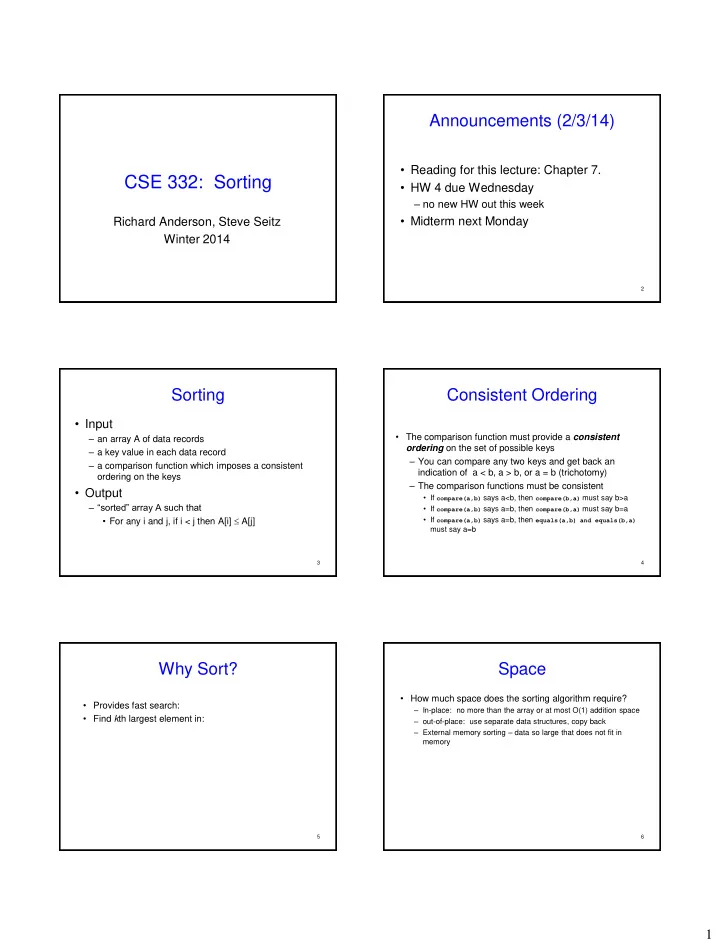
Announcements (2/3/14) Reading for this lecture: Chapter 7. CSE 332: Sorting HW 4 due Wednesday no new HW out this week Midterm next Monday Richard Anderson, Steve Seitz Winter 2014 2 Sorting Consistent Ordering Input


slide-1
SLIDE 1

1

CSE 332: Sorting

Richard Anderson, Steve Seitz Winter 2014

2

Announcements (2/3/14)

  • Reading for this lecture: Chapter 7.
  • HW 4 due Wednesday

– no new HW out this week

  • Midterm next Monday

3

Sorting

  • Input

– an array A of data records – a key value in each data record – a comparison function which imposes a consistent

  • rdering on the keys
  • Output

– “sorted” array A such that

  • For any i and j, if i < j then A[i]  A[j]

4

Consistent Ordering

  • The comparison function must provide a consistent
  • rdering on the set of possible keys

– You can compare any two keys and get back an indication of a < b, a > b, or a = b (trichotomy) – The comparison functions must be consistent

  • If compare(a,b) says a<b, then compare(b,a) must say b>a
  • If compare(a,b) says a=b, then compare(b,a) must say b=a
  • If compare(a,b) says a=b, then equals(a,b) and equals(b,a)

must say a=b

5

Why Sort?

  • Provides fast search:
  • Find kth largest element in:

6

Space

  • How much space does the sorting algorithm require?

– In-place: no more than the array or at most O(1) addition space – out-of-place: use separate data structures, copy back – External memory sorting – data so large that does not fit in memory

slide-2
SLIDE 2

2

7

Stability

A sorting algorithm is stable if:

– Items in the input with the same value end up in the same order as when they began.

Input Adams 1 Black 2 Brown 4 Jackson 2 Jones 4 Smith 1 Thompson 4 Washington 2 White 3 Wilson 3 Unstable sort Adams 1 Smith 1 Washington 2 Jackson 2 Black 2 White 3 Wilson 3 Thompson 4 Brown 4 Jones 4 Stable Sort Adams 1 Smith 1 Black 2 Jackson 2 Washington 2 White 3 Wilson 3 Brown 4 Jones 4 Thompson 4 [Sedgewick]

8

Time

How fast is the algorithm?

– requirement: for any i<j, A[i] < A[j] – This means that you need to at least check on each element at the very minimum

  • Complexity is at least:

– And you could end up checking each element against every other element

  • Complexity could be as bad as:

The big question: How close to O(n) can you get?

9

Sorting: The Big Picture

Simple algorithms: O(n2) Fancier algorithms: O(n log n) Comparison lower bound: (n log n) Specialized algorithms: O(n) Handling huge data sets Insertion sort Selection sort … Heap sort Merge sort Quick sort (avg) … Bucket sort Radix sort External sorting

Demo (with sound!)

  • http://www.youtube.com/watch?v=kPRA0W1kECg

10 11

Selection Sort: idea

1. Find the smallest element, put it 1st 2. Find the next smallest element, put it 2nd 3. Find the next smallest, put it 3rd 4. And so on …

12

Try it out: Selection Sort

  • 31, 16, 54, 4, 2, 17, 6
slide-3
SLIDE 3

3

13

Selection Sort: Code

void SelectionSort (Array a[0..n-1]) { for (i=0; i<n; ++i) { j = Find index of smallest entry in a[i..n-1] Swap(a[i],a[j]) } }

Runtime: worst case : best case : average case :

14

Bubble Sort

  • Take a pass through the array

– If neighboring elements are out of order, swap them.

  • Repeat until no swaps needed
  • Wost & avg case: O(n2)

– pretty much no reason to ever use this algorithm

15

Insertion Sort

1. Sort first 2 elements. 2. Insert 3rd element in order.

  • (First 3 elements are now sorted.)

3. Insert 4th element in order

  • (First 4 elements are now sorted.)

4. And so on…

16

How to do the insertion?

Suppose my sequence is: 16, 31, 54, 78, 32, 17, 6 And I’ve already sorted up to 78. How to insert 32?

17

Try it out: Insertion sort

  • 31, 16, 54, 4, 2, 17, 6

18

Insertion Sort: Code

void InsertionSort (Array a[0..n-1]) { for (i=1; i<n; i++) { for (j=i; j>0; j--) { if (a[j] < a[j-1]) Swap(a[j],a[j-1]) else break } }

Runtime: worst case : best case : average case : Note: can instead move the “hole” to minimize copying, as with a binary heap.

slide-4
SLIDE 4

4

Insertion Sort vs. Selection Sort

  • Same worst case, avg case complexity
  • Insertion better best-case

– preferable when input is “almost sorted”

  • one of the best sorting algs for almost sorted case (also for

small arrays)

19 20

Sorting: The Big Picture

Simple algorithms: O(n2) Fancier algorithms: O(n log n) Comparison lower bound: (n log n) Specialized algorithms: O(n) Handling huge data sets Insertion sort Selection sort … Heap sort Merge sort Quick sort (avg) … Bucket sort Radix sort External sorting

21

Heap Sort: Sort with a Binary Heap

Worst Case Runtime:

In-place heap sort

– Treat the initial array as a heap (via buildHeap) – When you delete the ith element, put it at arr[n-i]

  • It’s not part of the heap anymore!

10/21/2013 22

4 7 5 9 8 6 10 3 2 1 sorted part heap part arr[n-i]= deleteMin() 5 7 6 9 8 10 4 3 2 1 sorted part heap part

23

AVL Sort

Worst Case Runtime:

24

“Divide and Conquer”

  • Very important strategy in computer science:

– Divide problem into smaller parts – Independently solve the parts – Combine these solutions to get overall solution

  • Idea 1: Divide array in half, recursively sort left and right

halves, then merge two halves  known as Mergesort

  • Idea 2 : Partition array into small items and large items,

then recursively sort the two sets  known as Quicksort

slide-5
SLIDE 5

5

25

Mergesort

  • Divide it in two at the midpoint
  • Sort each half (recursively)
  • Merge two halves together

8 2 9 4 5 3 1 6

26

Mergesort Example

8 2 9 4 5 3 1 6 8 2 1 6 9 4 5 3 8 2 9 4 5 3 1 6 2 8 4 9 3 5 1 6 2 4 8 9 1 3 5 6 1 2 3 4 5 6 8 9 Merge Merge Merge Divide Divide Divide 1 element 8 2 9 4 5 3 1 6

27

Merging: Two Pointer Method

  • Perform merge using an auxiliary array

2 4 8 9 1 3 5 6

Auxiliary array

28

Merging: Two Pointer Method

  • Perform merge using an auxiliary array

2 4 8 9 1 3 5 6 1

Auxiliary array

29

Merging: Two Pointer Method

  • Perform merge using an auxiliary array

2 4 8 9 1 3 5 6 1 2 3 4 5

Auxiliary array

30

Merging: Finishing Up

i j target Starting from here… i j target Left finishes up

copy

i j target

first copy this… …then this

  • r

Right finishes up

slide-6
SLIDE 6

6

31

Merging: Two Pointer Method

  • Final result

1 2 3 4 5 6 8 9 1 2 3 4 5 6

Auxiliary array

Complexity? Stability?

32

Merging

Merge(A[], Temp[], left, mid, right) { Int i, j, k, l, target i = left j = mid + 1 target = left while (i < mid && j < right) { if (A[i] < A[j]) Temp[target] = A[i++] else Temp[target] = A[j++] target++ } if (i > mid) //left completed// for (k = left to target-1) A[k] = Temp[k]; if (j > right) //right completed// k = mid l = right while (k > i) A[l--] = A[k--] for (k = left to target-1) A[k] = Temp[k] }

33

Recursive Mergesort

MainMergesort(A[1..n], n) { Array Temp[1..n] Mergesort[A, Temp, 1, n] } Mergesort(A[], Temp[], left, right) { if (left < right) { mid = (left + right)/2 Mergesort(A, Temp, left, mid) Mergesort(A, Temp, mid+1, right) Merge(A, Temp, left, mid, right) } }

What is the recurrence relation?

34

Mergesort: Complexity

35

Iterative Mergesort

Merge by 1 Merge by 2 Merge by 4 Merge by 8

36

Iterative Mergesort

Merge by 1 Merge by 2 Merge by 4 Merge by 8 Merge by 16 copy

Iterative Mergesort reduces copying Complexity?

slide-7
SLIDE 7

7

37

Properties of Mergesort

  • In-place?
  • Stable?
  • Sorted list complexity?
  • Nicely extends to handle linked lists.
  • Multi-way merge is basis of big data sorting.
  • Java uses Mergesort on Collections and on

Arrays of Objects.

38

Quicksort

Quicksort uses a divide and conquer strategy, but does not require the O(N) extra space that MergeSort does. Here’s the idea for sorting array S:

  • 1. Pick an element v in S. This is the pivot value.
  • 2. Partition S-{v} into two disjoint subsets, S1 and S2

such that:

  • elements in S1 are all  v
  • elements in S2 are all  v
  • 3. Return concatenation of QuickSort(S1), v,

QuickSort(S2) Recursion ends when Quicksort( ) receives an array of length 0 or 1.

39

The steps of Quicksort

13 81 92 43 65 31 57 26 75

S

select pivot value

13 81 92 43 65 31 57 26 75

S1 S2

partition S

13 43 31 57 26

S1

81 92 75 65

S2

QuickSort(S1) and QuickSort(S2)

13 43 31 57 26 65 81 92 75

S

Presto! S is sorted

[Weiss] 40

Quicksort Example

4 2 3 1 6 9 8 1 9 3 4 6 1 2 3 4 6 8 9 1 2 3 4 5 6 8 9 Conquer Conquer Conquer Divide Divide Divide 1 element 4 6 3 8 1 9 2 5 5 8 2 4 3 3 4

41

Pivot Picking and Partitioning

The tricky parts are:

  • Picking the pivot

– Goal: pick a pivot value so that |S1| and |S2| are roughly equal in size.

  • Partitioning

– Preferably in-place – Dealing with duplicates

42

Picking the Pivot

slide-8
SLIDE 8

8

43

8 1 4 9 6 3 5 2 7 1 2 3 4 5 6 7 8 9 1 4 9 7 3 5 2 6 8

Median of Three Pivot

Choose the pivot as the median of three. Place the pivot and the largest at the right and the smallest at the left.

medianOf3Pivot(…)

44

Quicksort Partitioning

  • Partition the array into left and right sub-arrays such that:

– elements in left sub-array are  pivot – elements in right sub-array are  pivot

  • Can be done in-place with another “two pointer method”

– Sounds like mergesort, but here we are partitioning, not sorting… – …and we can do it in-place.

45

Partioning In-place

1 4 9 7 3 5 2 6 8 i j 1 4 9 7 3 5 2 6 8 i j 1 4 2 7 3 5 9 6 8 i j 1 4 9 7 3 5 2 6 8 i j

Setup: i = start and j = end of un-partioned elements: Advance i until element  pivot: Advance j until element  pivot: If j > i, then swap:

46

Partioning In-place

1 4 2 5 3 7 9 6 8

i j

1 4 2 5 3 7 9 6 8

i j

1 4 2 5 3 6 9 7 8

i j

S1  pivot pivot S2  pivot

1 4 2 7 3 5 9 6 8

i j

1 4 2 7 3 5 9 6 8

i j

1 4 2 5 3 7 9 6 8

i j

Advance i : Advance j : i > j, swap in pivot, partition done! Advance i : Advance j : Swap :

47

Partition Pseudocode

Partition(A[], left, right) { v = A[right]; // Assumes pivot value currently at right i = left; // Initialize left side, right side pointers j = right-1; // Do i++, j-- until they cross, swapping values as needed while (1) { while (A[i] < v) i++; while (A[j] > v) j--; if (i < j) { Swap(A[i], A[j]); i++; j--; } else break; } Swap(A[i], A[right]); // Swap pivot value into position return i; // Return the final pivot position }

Complexity for input size n?

48

Quicksort Pseudocode

Quicksort(A[], left, right) { if (left < right) { medianOf3Pivot(A, left, right); pivotIndex = Partition(A, left+1, right-1); Quicksort(A, left, pivotIndex – 1); Quicksort(A, pivotIndex + 1, right); } }

Putting the pieces together:

slide-9
SLIDE 9

9

49

QuickSort: Best case complexity

Quicksort(A[], left, right) { if (left < right) { medianOf3Pivot(A, left, right); pivotIndex = Partition(A, left+1, right-1); Quicksort(A, left, pivotIndex – 1); Quicksort(A, pivotIndex + 1, right); } }

50

Quicksort(A[], left, right) { if (left < right) { medianOf3Pivot(A, left, right); pivotIndex = Partition(A, left+1, right-1); Quicksort(A, left, pivotIndex – 1); Quicksort(A, pivotIndex + 1, right); } }

QuickSort: Worst case complexity

51

QuickSort: Average case complexity

Turns out to be O(n log n). See Section 7.7.5 for an idea of the proof. Don’t need to know proof details for this course.

52

8 6 6 6 6 6 6 6 6 1 2 3 4 5 6 7 8 9 6 6 6 6 6 6 6 6 8

Many Duplicates?

An important case to consider is when an array has many duplicates.

medianOf3Pivot(…)

53

Partitioning with Duplicates

6 6 6 6 6 6 6 6 8 i j 6 6 6 6 6 6 6 6 8 i j 6 6 6 6 6 6 6 6 8 i j 6 6 6 6 6 6 6 6 8 i j

Setup: i = start and j = end of un-partioned elements: Advance i until element  pivot: Advance j until element  pivot: If j > i, then swap:

54

Partitioning with Duplicates

6 6 6 6 6 6 6 6 8 i j

Advance i,j:

6 6 6 6 6 6 6 6 8 i j 6 6 6 6 6 6 6 6 8 i j 6 6 6 6 6 6 6 6 8 i j 6 6 6 6 6 6 6 6 8 i j

Advance i,j: Advance i,j: Swap: Swap:

6 6 6 6 6 6 6 6 8

Finish:

i j

slide-10
SLIDE 10

10

55

Partitioning with Duplicates:Take Two

6 6 6 6 6 6 6 6 8 i j 6 6 6 6 6 6 6 6 8 6 6 6 6 6 6 6 6 8 i j

Start i = start and j = end of un-partioned elements: Advance i until element > pivot (and in bounds): Finish:

i j

Is this better? Advance j until element < pivot (and in bounds):

6 6 6 6 6 6 6 6 8 i j

56

Partitioning with Duplicates: Upshot

It’s better to stop advancing pointers when elements are equal to pivot, and then just do swaps. Complexity of quicksort on an array of identical values? Can we do better?

57

Important Tweak

Quicksort(A[], left, right) { if (right – left ≥ CUTOFF) { medianOf3Pivot(A, left, right); pivotIndex = Partition(A, left+1, right-1); Quicksort(A, left, pivotIndex – 1); Quicksort(A, pivotIndex + 1, right); } else { InsertionSort(A, left, right); } }

CUTOFF = 10 is reasonable.

Insertion sort is actually better than quicksort on small arrays. Thus, a better version of quicksort:

58

Properties of Quicksort

  • O(N2) worst case performance, but

O(N log N) average case performance.

  • Pure quicksort not good for small arrays.
  • No iterative version (without using a stack).
  • “In-place,” but uses auxiliary storage because of

recursive calls.

  • Stable?
  • Used by Java for sorting arrays of primitive

types.