SLIDE 1
cse 311: foundations of computing Spring 2015
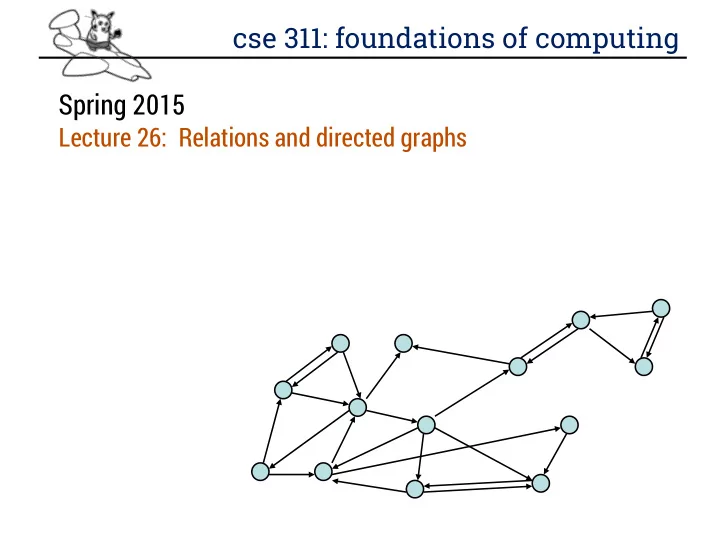
Lecture 26: Relations and directed graphs
SLIDE 2
relations Let A and B be sets. A binary relation from A to B is a subset of A B Let A be a set. A binary relation on A is a subset of A A
SLIDE 3
relations you already know! ≥ on ℕ That is: {(x,y) : x ≥ y and x, y ℕ} < on ℝ That is: {(x,y) : x < y and x, y ℝ} = on ∑* That is: {(x,y) : x = y and x, y ∑*}
⊆ on P(U) for universe U
That is: {(A,B) : A ⊆ B and A, B P(U)}
SLIDE 4
examples R1 = {(a, 1), (a, 2), (b, 1), (b, 3), (c, 3)} R2 = {(x, y) | x ≡ y (mod 5) } R3 = {(c1, c2) | c1 is a prerequisite of c2 } R4 = {(s, c) | student s had taken course c }
SLIDE 5
properties of relations
Let R be a relation on A. R is reflexive iff (a,a) R for every a A R is symmetric iff (a,b) R implies (b, a) R R is antisymmetric iff (a,b) R and a b implies (b,a) ∉ R R is transitive iff (a,b) R and (b, c) R implies (a, c) R
SLIDE 6
combining relations
Let R be a relation from A to B. Let S be a relation from B to C. The composition of R and S, S ∘ R is the relation from A to C defined by: S ∘ R = {(a, c) | b such that (a,b) R and (b,c) S} Intuitively, a pair is in the composition if there is a “connection” from the first to the second.
SLIDE 7
examples
(a,b) Parent iff b is a parent of a (a,b) Sister iff b is a sister of a When is (x,y) Sister ∘ Parent? When is (x,y) Parent ∘ Sister?
S ∘ R = {(a, c) | b such that (a,b) R and (b,c) S}
SLIDE 8
examples
Using the relations: Parent, Child, Brother, Sister, Sibling, Father, Mother, Husband, Wife express: Uncle: b is an uncle of a Cousin: b is a cousin of a
SLIDE 9
examples
Using the relations: Parent, Child, Brother, Sister, Sibling, Father, Mother, Husband, Wife express: Uncle: b is an uncle of a Uncle = Brother ∘ Parent Cousin: b is a cousin of a Cousin = Child ∘ Sibling ∘ Parent
SLIDE 10
powers of a relation
𝑆2 = 𝑆 ∘ 𝑆 = { 𝑏, 𝑑 ∣ ∃𝑐 such that 𝑏, 𝑐 ∈ 𝑆 and 𝑐, 𝑑 ∈ 𝑆 } 𝑆0 = { 𝑏, 𝑏 ∣ 𝑏 ∈ 𝐵} 𝑆1 = 𝑆 𝑆𝑜+1 = 𝑆𝑜 ∘ 𝑆
SLIDE 11
powers of a relation
𝑆2 = 𝑆 ∘ 𝑆 = { 𝑏, 𝑑 ∣ ∃𝑐 such that 𝑏, 𝑐 ∈ 𝑆 and 𝑐, 𝑑 ∈ 𝑆 } Parent2 = GrandParent 𝑆0 = { 𝑏, 𝑏 ∣ 𝑏 ∈ 𝐵} 𝑆0 is always equality 𝑆1 = 𝑆 𝑆𝑜+1 = 𝑆𝑜 ∘ 𝑆
SLIDE 12
matrix represenation
Relation 𝑆 on 𝐵 = {𝑏1, … , 𝑏𝑞}
{(1, 1), (1, 2), (1, 4), (2,1), (2,3), (3,2), (3, 3), (4,2), (4,3)}
1 2 3 4 1 1 1 1 2 1 1 3 1 1 4 1 1
SLIDE 13
directed graphs
Path: v0, v1, …, vk, with (vi, vi+1) in E
Simple Path Cycle Simple Cycle
G = (V, E) V – vertices E – edges, ordered pairs of vertices
SLIDE 14
representation of relations
Directed Graph Representation (Digraph)
{(a, b), (a, a), (b, a), (c, a), (c, d), (c, e) (d, e) }
a d e b c
SLIDE 15
representation of relations
Directed Graph Representation (Digraph)
{(a, b), (a, a), (b, a), (c, a), (c, d), (c, e) (d, e) }
a d e b c
SLIDE 16
representation of relations
Directed Graph Representation (Digraph)
{(a, b), (a, a), (b, a), (c, a), (c, d), (c, e) (d, e) }
a d e b c
SLIDE 17
relational composition using digraphs
If 𝑇 = 2,2 , 2,3 , 3,1 and 𝑆 = { 1,2 , 2,1 , 1,3 } Compute 𝑇 ∘ 𝑆
SLIDE 18
relational composition using digraphs
If 𝑇 = 2,2 , 2,3 , 3,1 and 𝑆 = { 1,2 , 2,1 , 1,3 } Compute 𝑇 ∘ 𝑆
SLIDE 19
relational composition using digraphs
If 𝑇 = 2,2 , 2,3 , 3,1 and 𝑆 = { 1,2 , 2,1 , 1,3 } Compute 𝑇 ∘ 𝑆
SLIDE 20
paths in relations and graphs
Let R be a relation on a set A. There is a path of length n from a to b if and only if (a,b) Rn A path in a graph of length n is a list of edges with vertices next to each other.
SLIDE 21
connectivity in graphs
Let R be a relation on a set A. The connectivity relation R* consists of the pairs (a,b) such that there is a path from a to b in R.
Note: The book uses the wrong definition of this quantity. What the text defines (ignoring k=0) is usually called R+
Two vertices in a graph are connected iff there is a path between them.
SLIDE 22
properties of relations (repeated)
Let R be a relation on A. R is reflexive iff (a,a) R for every a A R is symmetric iff (a,b) R implies (b, a) R R is transitive iff (a,b) R and (b, c) R implies (a, c) R
SLIDE 23
transitive-reflexive closure
Add the minimum possible number of edges to make the relation transitive and reflexive. The transitive-reflexive closure of a relation R is the connectivity relation R*
SLIDE 24
transitive-reflexive closure
Add the minimum possible number of edges to make the relation transitive and reflexive. The transitive-reflexive closure of a relation R is the connectivity relation R*
SLIDE 25
transitive-reflexive closure
Add the minimum possible number of edges to make the relation transitive and reflexive. The transitive-reflexive closure of a relation R is the connectivity relation R*
SLIDE 26
n-ary relations
Let A1, A2, …, An be sets. An n-ary relation on these sets is a subset of A1 A2 ⋯ An.
SLIDE 27
relational databases
Student_Name ID_Number Office GPA Knuth 328012098 022 4.00 Von Neuman 481080220 555 3.78 Russell 238082388 022 3.85 Einstein 238001920 022 2.11 Newton 1727017 333 3.61 Karp 348882811 022 3.98 Bernoulli 2921938 022 3.21 STUDENT
SLIDE 28
relational databases
Student_Name ID_Number Office GPA Course Knuth 328012098 022 4.00 CSE311 Knuth 328012098 022 4.00 CSE351 Von Neuman 481080220 555 3.78 CSE311 Russell 238082388 022 3.85 CSE312 Russell 238082388 022 3.85 CSE344 Russell 238082388 022 3.85 CSE351 Newton 1727017 333 3.61 CSE312 Karp 348882811 022 3.98 CSE311 Karp 348882811 022 3.98 CSE312 Karp 348882811 022 3.98 CSE344 Karp 348882811 022 3.98 CSE351 Bernoulli 2921938 022 3.21 CSE351
What’s not so nice?
STUDENT
SLIDE 29
relational databases
ID_Number Course 328012098 CSE311 328012098 CSE351 481080220 CSE311 238082388 CSE312 238082388 CSE344 238082388 CSE351 1727017 CSE312 348882811 CSE311 348882811 CSE312 348882811 CSE344 348882811 CSE351 2921938 CSE351
Better
Student_Name ID_Number Office GPA Knuth 328012098 022 4.00 Von Neuman 481080220 555 3.78 Russell 238082388 022 3.85 Einstein 238001920 022 2.11 Newton 1727017 333 3.61 Karp 348882811 022 3.98 Bernoulli 2921938 022 3.21 STUDENT TAKES
SLIDE 30
database operations: projection
Find all offices: ΠOffice STUDENT
Office 022 555 333
Find offices and GPAs: ΠOffice,GPA STUDENT
Office GPA 022 4.00 555 3.78 022 3.85 022 2.11 333 3.61 022 3.98 022 3.21
SLIDE 31
database operations: selection
Find students with GPA > 3.9 : σGPA>3.9(STUDENT)
Student_Name ID_Number Office GPA Knuth 328012098 022 4.00 Karp 348882811 022 3.98
Retrieve the name and GPA for students with GPA > 3.9: ΠStudent_Name,GPA(σGPA>3.9(STUDENT))
Student_Name GPA Knuth 4.00 Karp 3.98
SLIDE 32
database operations: natural join
Student_Name ID_Number Office GPA Course Knuth 328012098 022 4.00 CSE311 Knuth 328012098 022 4.00 CSE351 Von Neuman 481080220 555 3.78 CSE311 Russell 238082388 022 3.85 CSE312 Russell 238082388 022 3.85 CSE344 Russell 238082388 022 3.85 CSE351 Newton 1727017 333 3.61 CSE312 Karp 348882811 022 3.98 CSE311 Karp 348882811 022 3.98 CSE312 Karp 348882811 022 3.98 CSE344 Karp 348882811 022 3.98 CSE351 Bernoulli 2921938 022 3.21 CSE351 Student ⋈ Takes