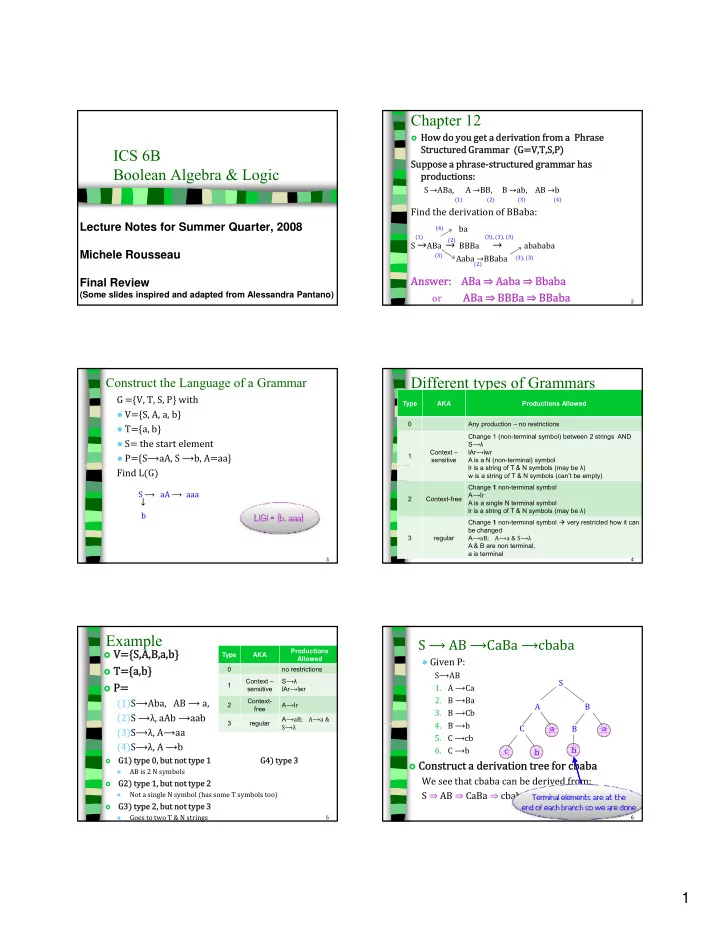
Chapter 12 How do you get a derivation from a Phrase Structured - - PDF document

chapter 12
SMART_READER_LITE
LIVE PREVIEW

Chapter 12 How do you get a derivation from a Phrase Structured - - PDF document

Chapter 12 How do you get a derivation from a Phrase Structured Grammar GV,T,S,P ICS 6B Suppose a phrasestructured grammar has Boolean Algebra & Logic productions: S ABa, A BB, B ab, AB b 1


slide-1
SLIDE 1

1

ICS 6B Boolean Algebra & Logic

Lecture Notes for Summer Quarter, 2008 Michele Rousseau Final Review

(Some slides inspired and adapted from Alessandra Pantano)

Chapter 12

How do you get a derivation from a Phrase

Structured Grammar GV,T,S,P Suppose a phrase‐structured grammar has productions:

S ABa, A BB, B ab, AB b

1 2 3 4

Find the derivation of BBaba:

ba S ABa BBBa

  • abababa

Aaba BBaba

Answer: ABa Aaba Bbaba

  • r

ABa BBBa BBaba

4 3 1 2 3, 3, 3 3, 3 2

2

Construct the Language of a Grammar

G V, T, S, P with

  • VS, A, a, b
  • Ta, b
  • S the start element
  • PSaA, S b, Aaa

Find LG

  • b

L(G) = {b, aaa}

S aA aaa

3

Different types of Grammars

Type AKA Productions Allowed Any production – no restrictions 1 Context – sensitive Change 1 (non-terminal symbol) between 2 strings AND Sλ lArlwr A is a N (non-terminal) symbol l i t i f T & N b l ( b λ) lr is a string of T & N symbols (may be λ) w is a string of T & N symbols (can’t be empty) 2 Context-free Change 1 non-terminal symbol Alr A is a single N terminal symbol lr is a string of T & N symbols (may be λ) 3 regular Change 1 non-terminal symbol very restricted how it can be changed AaB; Aa & Sλ A & B are non terminal, a is terminal

4

Example

VS,A,B,a,b Ta,b P

1SAba, AB a, 2S λ, aAb aab

Type AKA Productions Allowed no restrictions 1 Context – sensitive Sλ lArlwr 2 Context- free Alr 3 regular AaB; Aa &

3Sλ, Aaa 4Sλ, A b

  • G1 type 0, but not type 1

G4 type 3

  • AB is 2 N symbols
  • G2 type 1, but not type 2
  • Not a single N symbol has some T symbols too
  • G3 type 2, but not type 3
  • Goes to two T & N strings

3 regular Sλ

5

S AB CaBa cbaba

  • Given P:

SAB

  • 1. A Ca
  • 2. B Ba
  • 3. B Cb

4 B b S A B

  • 4. B b
  • 5. C cb
  • 6. C b

Construct a derivation tree for cbaba

We see that cbaba can be derived from: S AB CaBa cbaba

C a B a c b b Terminal elements are at the end of each branch so we are done

6
slide-2
SLIDE 2

2

Vending Maching I/O and States

Possible inputs Possible outputs

Nickel 5 nothing N O‐button O Nickel 5 A‐button A OJ A

Possible states initial state s0 no money in the machine state s1 5c in the machine state s2 10c in the machine state s315 in the machine

7

….

Remember Vending Machine

Table

Transition – f(s,i)

5 O A States s0 s2 s1 s3 s1 s3 s2 s3 10c 5c 15c s1 s0 s2 s0 s1 s0 s2 s0

Output – g(s,i)

5 O A N N N 5 N N N OJ N N N AJ

Inputs Outputs 5Nickel N Nada O O‐btn 5 Nickel A‐A‐Btn OJ AJ

O, N

Directed Graph

s0 s1 s2 s3

Start

5, N 5, N 5, N 5, 5 O, N O, N O, OJ A, N A, N A, N A, AJ

It is important to know how to go from one to the other

O

8

States s0

Going from Graph to Table

s0 s1 s3

0 0 1,0

Transition– f(s,i)

1 s1 s0

Output – g(s,i)

1 1 s2 s1 s3 Also, be able to determine output

Example What is the output of 1110? 0001

s2

0,0 1,1

s1 s3 s2 s0 s2 s1 1 1 1

Also be able to do this with automaton

9

What strings are recognized by the following machine

Only 1 final state s3 Think of all possible paths that

  • riginate at s0 and end at s3

We can loop as many times s0 s1 s3 O O start We can loop as many times

as we want, and then we must follow

s2

O 0 ; 1

s0 s1 s3

This says the strings recognized by the machine are all of the form On 11, with n0

start

10

Given a automaton determine L(M)

M: There’s only 1 final state s2. So we look

s0 s1 s2 s3

Start

1 0,1 0,1 1 O

y 2 for paths from s0 to s OR

LM 0,01

s0 s2

1

s0 s1 s2

1

11

How is a Non-Deterministic automaton different?

Final states: s2, s3

s0, s2 s3

Inputs

1 States s0 s s3

O O O,1 start 1

s0 s1 s0 s0,s2, s2 s0,s2 s1 ,s3 s1 s2 s1 s3 s2

1 O 1

Notice that the transition function with state s2 and input 0 produces the empty set of states: fs2 , 0 does not give any next state

slide-3
SLIDE 3

3

Chapter 1

Determine whether this proposition is a

tautology: p q q p p p q

T T T F

p q

F F F T

q p q

F T F F T T

Also know how to prove equivalences

and how to show using identities know the identities

F F T F T T F T T T T F T T

13

Chapter 1:

In the questions below write the statement in the form “If …,

then ….” “The team wins if the quarterback can pass.” If the quarterback can pass, then the team wins. Write the contrapositive, converse, and inverse of the following: “You sleep late if it is Saturday” following: You sleep late if it is Saturday Contrapositive: q p If you do not sleep late, then it is not Saturday. Converse: q p If you sleep late, then it is Saturday. Inverse: p q If it is not Saturday, then you do not sleep late.

14

English to Logical Expressions

Fx: x is a fleegle Sx: x is a snurd Tx: x is a thingamabob Ufleegles, snurds, thingamabobs “ Everything is a fleegle” ∀ x Fx ∃x Fx “ Nothing is snurd” ∀ x Sx ∃x Sx “ All fleegles are snurds” ∀ x Fx Sx ∀ x Fx Sx ∀ x Fx Sx ∃xFx Sx

15

CHAPTER 2

Remember the Cartesian Product? Let A1,2 , B a,b,c, C y,z What is A x B x C

A x B x C 1,a,y, 1,a,z, 1,b,y, 1,b,z, 1,c,y, 1,c,z,

2,a,y, 2,a,z, 2,b,y, 2,b,z, 2,c,y, 2,c,z Thus A x B x C is all possible ordered tuples (a,b,c) where a A , b B , and c C

16

Operations on Sets

U 0, 1, 2, 3, 4, 5, 6, 7, 8, 9, 10 A 1, 2, 3, 4, 5 B 4, 5, 6, 7, 8 A B A B 1, 2, 3, 4, 5, 6, 7, 8 4 5 A B Ac Bc A ‐ B B ‐ A AB 4, 5 0, 6, 7, 8, 9, 10 0, 1, 2, 3, 9, 10 1, 2, 3 6, 7, 8 1, 2, 3, 6, 7, 8

17

Inverse Functions (Example)

a b c d

A B

f

X W V

a b c d

A B

X W V

f‐1

d

Y

d

Y

A bijection is called invertible because you can define the inverse function. To be invertible it must be a bijection.

18
slide-4
SLIDE 4

4

Composition Example

If fxx2 and gx2x1 Then fgxf 2x1

a b c d

A B C

X Y W V

g f

j i h

2x1 2 2x21

Y

a b c d

j i h

A C

f g

19

Chapter 8 - Relations

Consider the relations on 1,2,3,4 Know which are reflexive Symmetric Transitive: R 1 1 1 2 2 1 2 2 3 4 4 1 4 4 3 & 5 2 & 3 4, 5,6 R11,1,1,2,2,1,2,2,3,4,4,1,4,4 R21,1,1,2,2,1 R31,1,1,2,1,4,2,1,2,2,3,3,4,1,4,4 R42,1,3,1,3,2,4,1,4,2,4,3 R51,1,1,2,1,3,2,1,2,2,2,3,3,3,4,4 R63,4

20

Transitivity

Consider the relations on 1,2,3,4

R51,1,1,2,1,3,2,1,2,2,2,3,3,3,4,4

xy yz xz 1 2 y y 2, 1 1, 3 2, 3 1, 2 2, 3 1, 3 4 3

21

Express the relation R1 as a matrix A1.2.3.4. B1,2,3,4 R11,1,1,2,2,1,2,2,3,4,4,1,4,4

Think of the a, b pairs and remember that ARows

and B Cols Express the relation R1 as a matrix A1.2.3.4. B1,2,3,4 R11,1,1,2,2,1,2,2,3,4,4,1,4,4

Think of the a, b pairs and remember that ARows

and B Cols

Using Matrices to represent Relations

B A

1,1 1, 2 1,3 1,4 2,1 2, 2 2,3 2,4 3,1 3, 2 3,3 3,4 4,1 4, 2 4,3 4,4 1,1 1, 2 1,3 1,4 2,1 2, 2 2,3 2,4 3,1 3, 2 3,3 3,4 4,1 4, 2 4,3 4,4

Is R1 Reflexive? Is R1 Symmetric? Is R1 Antisymmetric?

[ ]

MR1

1 2 3 4 1 2 3 4

B

1 1 0 0 1 1 0 0 0 0 0 1 1 0 0 1

Put a 1 in each of the Corresponding locations

No No No

22

Join and Meet - Matrices

For any two binary n x n matrices A & B We define A B and AB to be the n x n binary matrices whose ij element is given by: A join Bij Aij Bij & A meet B A B respectively A meet Bij Aij Bij, respectively

[ ]

A

1 1 0 0 [ ]

B

1 0 1 0 [ ]

A B

1 1 1 0 0 1 0 0

[ ]

1 1 1 0

  • A B

[ ]

A

1 1 0 0 [ ]

B

1 0 1 0 [ ]

A B

1 1 1 0 0 1 0 0

[ ]

1 0 0 0

  • A B
23

Boolean Product Example

A B23

[ ]

A

a11 a12 a13 a21 a22 a23 a31 a32 a33 [ ]

B

b11 b12 b13 b21 b22 b23 b31 b32 b33

  • 2nd Row in A

3rd Col in B

[ ]

a31 a32 a33 [ ] b31 b32 b33

1 1 1

Check if there is a 1 appearing in the corresponding positions

  • gives 0 because

(01) (10) (10

24
slide-5
SLIDE 5

5

Some Notations - Composition

Note: The Matrix representing the composition S R = MR MS For Matrices: MS R = MR MS

MR2 MR R MR MR MR MRn MR R … RMR MR … MR MR

2 n times n times n Note the Ordering

25

Example

Find the Matrix Representing MR

2

[ ]

MR =

0 1 0 1 1 1 0 0

[ ]

MR [ ] MR [ ]

1 1 1 1 1 0 1 0

=

[ ]

0 1 0 1 1 1 0 0 0 1 0 1 1 1 0 0

MR =

2

MR

2 26

Digraph means “directed graph”

  • Means there is an arrow on the arcs connecting

the vertices indicating direction

For example:

Represent Relations using Digraphs

Ra,b, b,d, c,c, d,b R1,2, 2,2, 3,1,3,4 4,3

Every diagraph represents a relation R on a set A b d

a

c 2 4 1 3

27

Finding properties from Digraphs

Reflexive? Irreflexive?

b d

a

c No ‐ missing loops at a, b, c No it has a loop at d

Irreflexive? Symmetric? Antisymmetric? Asymmectric? Transitive?

No ‐ it has a loop at d No ‐ single directions at b,c and c,d No ‐ edges a,b and b,d go both directions Neither Irreflexive or Antisymmectric No – there is an edge a,b and b,c but no a,c

28

Finding Closures from a Digraph

To find the reflexive closure

  • add loops.

To find the symmetric closure

  • add arcs in the opposite direction.

To find the transitive closure ‐ if there is a

path from a to b

  • add a direct arc from a to b.

Note: Reflexive and Symmetric closures are easy Transitive can be complicated

29

And with a Matrix

To find the reflexive closure

  • Put 1’s on the diagonal.

To find the symmetric closure

  • Take the transpose MT of the connection

matrix MR

30
slide-6
SLIDE 6

6

Transitive Closures: Diagraphs

Constructing R* R R2 . . . Rn using Digraphs: Given R draw the corresponding diagraph D Then compute R end points of paths of length 1 in D Rend points of paths of length 1 in D. R2endpoints of paths of length 2 in D

. . .

Rnendpoints of paths of length n in D

Then compute R* R R2 . . . Rn

this is the transitive closure of R.

31

Example: Digraphs

Aa,b,c,d Ra,b,b,c,c,d The digraph of R is:

We get R2 a, c, b, d

a b d c N=4 ñ so you go to R4

R3 a, d R4 Then R* R R2 R3 R4 a,b,b,c,c,d,a,c,b,d,a,d

b a d c

32
  • Trans. Closure: Binary Matrices

Constructing R* R R2 . . . Rn using Binary Matrices Given A and the relation R on A, construct the matrix MR associated to R. Then build the powers R MR MR MR

2

R R R

R MR MR MR MR

. . .

R MR MR … MR The matrix associated to R* R R2 . . . Rn is MR MR MR … MR Once we get MR it is very easy to write down R*

3 n * 2 n *

N Times

33

Example: Matrices

Aa,b,c,d Ra,b,b,c,c,d [ ] MR

0 1 0 0 0 0 1 0 0 0 0 1 0 0 0 0

[ ]

0 1 0 0 0 0 1 0 0 0 0 1

MR

[ ]

0 1 0 0 0 0 1 0 0 0 0 1

  • [ ]

0 0 1 0 0 0 0 1 0 0 0 0

2 [ ]

0 0 0 0 [ ] 0 0 0 0 [ ] 0 0 0 0

MR

3

MR MR

2[ ]

0 1 0 0 0 0 1 0 0 0 0 1 0 0 0 0

[ ]

0 0 1 0 0 0 0 1 0 0 0 0 0 0 0 0

[ ]

0 0 0 1 0 0 0 0 0 0 0 0 0 0 0 0 Note the order

34

Example: Matrices (2)

  • MR

4

MR MR

3[ ]

0 1 0 0 0 0 1 0 0 0 0 1 0 0 0 0

  • [ ]

0 0 0 1 0 0 0 0 0 0 0 0 0 0 0 0 [ ] 0 0 0 0 0 0 0 0 0 0 0 0 0 0 0 0

So we get: MR MR MR MR MR which gives R* a,b,b,c,c,d,a,c,b,d,a,d

*

2 3 4 35

Equivalence Relations

RST Reflexive, Symmetric, Transitive

EQUIVALENCE CLASSES:

It is easy to recognize equivalence Classes using digraphs.

b a a b c a

Rank=2

aa,c, ca.c. bb

Rank=3

b c a

aa, bb. cc

36
slide-7
SLIDE 7

7

Partitions

The equivalence classes of an equivalence

relation R partition the set A into disjoint, nonempty subsets whose union is the entire set

Let S be a set 1,2,3,4,5 Let S be a set 1,2,3,4,5 Which are partitions of S?

T11,2, T23, T34,5 T11,2,3, T22,4, T35 T11, T22,3, T44 Yes No No

37

POSETs

Partial order that is RAT ‐ Reflexive, Antisymmetric, Transitive If two sets are always related

it is a total order

1

The elements 1,3 are incomparable because 1, 3 R and 3, 1 R so A,R is not a total ordered set.

2

3

1

38

Hasse Diagram

Construct the Hasse diagram of A1, 2, 3, R

Thus R1,1,1,2,1,3,2,2,2,3,3,3

Step 1:Draw the Digraph With arrows pointing up Step 2: Remove loops

1

2

3

p g p Step 4: Remove arrows Step 3: Eliminate redundant transitive arcs

39

Hasse Diagram to a Digraph-- Find Ordered Pairs

d c

Okay, so what do we know about

this diagram

We know it is antisymmetric

  • and that the arrows point up

We know it is reflexive

Know Bounds and Lattices

a

b We also know it is transitive Now that we have the diagraph R

is easy to find Ra,a,a,b,a,c,a,d,b,b,b,c, b,d,c,c,d,d

40

Chapter 11: Find a Boolean function from a circuit

Find the Boolean function represented by the circuit:

x y x y z z y x

So this circuit represents the boolean function Fx,y,z

z z y z y z

z y x

41

Find a circuit that performs a given function

Suppose you have a majority voting system with 3

  • individuals. Design a circuit that determines

whether a proposal passes. Let x y z be the votes of 3 people The proposal Let x,y,z be the votes of 3 people. The proposal passes if at least 2 people vote yes. So, Fx,y,z1 if xy1 or xz1 or yz1. Equivalently, Fx,y,z1 if xy1 or xz1 or yz1 Then we can represent F by Fx,y,z xyyzxz

42
slide-8
SLIDE 8

8

Draw a circuit that produces Fx,y,z xy xz yz

y xy x z xz x z yz y xy xz yz

43