SLIDE 1
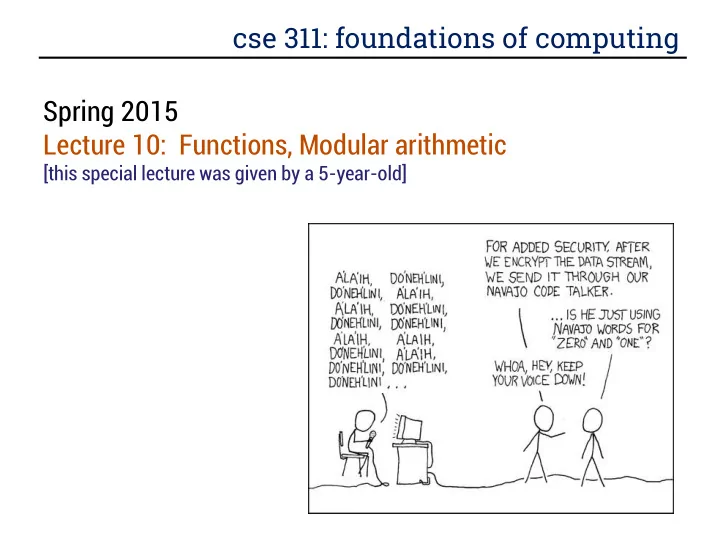
cse 311: foundations of computing Spring 2015 Lecture 10: Functions, Modular arithmetic
[this special lecture was given by a 5-year-old]
SLIDE 2 a little recap
So far:
- Propositional logic
- Logic to build circuits
- Predicates and quantifiers
- Proof systems and logical inference
- Basic set theory
[optional] Proof review session on Wed @ 6pm in EE 105
SLIDE 3
empty domains
Question: If the domain of discourse is empty and 𝑄 is a predicate, what is the truth value of: ∃𝑦 𝑄(𝑦) ∀𝑦 𝑄(𝑦)
SLIDE 4 functions
A funct unctio ion from 𝐵 to 𝐶:
- Every element of 𝐵 is assigned to exactly one element of 𝐶.
- We write 𝑔 ∶ 𝐵 → 𝐶.
- “Image of 𝑌 under 𝑔” = "𝑔 𝑌 ”
= 𝑦 ∶ ∃𝑧 𝑧 ∈ 𝑌 ∧ 𝑦 = 𝑔 𝑧
main of 𝑔 is 𝐵
- Cod
- domai
- main of 𝑔 is 𝐶
- Image
age of 𝑔 = Image of domain under 𝑔 = all the elements pointed to by something in the domain.
SLIDE 5
image
𝐵 𝐶
a b c d e 1 2 3 4
Image({a}) = Image({a, e}) = Image({a, b}) = Image(A) =
SLIDE 6 injections and surjections
A fu func nctio ion 𝑔 ∶ 𝐵 → 𝐶 is one
to-on
inject ctiv ive) e) if every output corresponds to at most one input, i.e. 𝑔 𝑦 = 𝑔 𝑦′ ⇒ 𝑦 = 𝑦′ for all 𝑦, 𝑦′ ∈ 𝐵. A fun unction
- n 𝑔 ∶ 𝐵 → 𝐶 is onto (or, sur
urject ectiv ive) e) if every output gets hit, i.e. for every 𝑧 ∈ 𝐶, there exists 𝑦 ∈ 𝐵 such that 𝑔 𝑦 = 𝑧.
SLIDE 7
is this function one-to-one? is it onto?
a b c d e 1 2 3 4 5 6
𝐵 𝐶
It is one-to-one, because nothing in B is pointed to by multiple elements of A. It is not onto, because 5 is not pointed to by anything.
SLIDE 8
QUIZ!
𝑦 ↦ 𝑦2 𝑦 ↦ 𝑦3 − 𝑦 𝑦 ↦ 𝑓𝑦 𝑦 ↦ 𝑦3 One-to-one (?) Onto (?) Do Domai ain: n: Real als
SLIDE 9
a harder quiz
Dear HBO, this is a slide about digital watermarking.
SLIDE 10 “number theory” (and applications to computing)
[fascinating, deep, weird area of mathematics that no one understands, but the basics are easy and really useful]
- Many significant applications
– Cryptography [this is how SSL works] – Hashing – Security – Error-correcting codes [this is how your bluray player works]
SLIDE 11
thanks, java
public class Test { final static int SEC_IN_YEAR = 364*24*60*60; public static void main(String args[]) { System.out.println( “I will be alive for at least ” + SEC_IN_YEAR * 101 + “ seconds.” ); } }
Prints : “I will be alive for at least -186619904 seconds.”
SLIDE 12 modular arithmetic Arithmetic thmetic over
te domain: main: Math with wrap around
SLIDE 13
divisibility
Integers a, b, with a ≠ 0. We say that a divides b iff there is an integer k such that b = k a. The notation a | b denotes “a divides b.”
SLIDE 14
division theorem Let a be an integer and d a positive integer. Then there are unique integers q and r, with 0 ≤ r < d, such that a = d q + r. q = a div d r = a mod d
Note: r ≥ 0 even if a < 0. Not quite the same as a % d.
SLIDE 15
arithmetic mod 7
a +7 b = (a + b) mod 7 a 7 b = (a b) mod 7
+ 1 2 3 4 5 6 1 2 3 4 5 6 1 1 2 3 4 5 6 2 2 3 4 5 6 1 3 3 4 5 6 1 2 4 4 5 6 1 2 3 5 5 6 1 2 3 4 6 6 1 2 3 4 5
X
1 2 3 4 5 6 1 1 2 3 4 5 6 2 2 4 6 1 3 5 3 3 6 2 5 1 4 4 4 1 5 2 6 3 5 5 3 1 6 4 2 6 6 5 4 3 2 1
SLIDE 16
modular congruence
Let a and b be integers, and m be a positive integer. We say a is congruent to b modulo m if m divides a – b. We use the notation a ≡ b (mod m) to indicate that a is congruent to b modulo m.
SLIDE 17
modular arithmetic: examples
A ≡ 0 (mod 2)
This statement is the same as saying “A is even”; so, any A that is even (including negative even numbers) will work.
1 ≡ 0 (mod 4)
This statement is false. If we take it mod 1 instead, then the statement is true.
A ≡ -1 (mod 17)
If A = 17x – 1 = 17x + 16 for an integer x, then it works. Note that (m – 1) mod m = ((m mod m) + (-1 mod m)) mod m = (0 + -1) mod m = -1 mod m
SLIDE 18
modular arithmetic can haz sense
Theorem: Let a and b be integers, and let m be a positive integer. Then a ≡ b (mod m) if and only if a mod m = b mod m.
Proof: Suppose that a ≡ b (mod m). By definition: a ≡ b (mod m) implies m | (a – b) which by definition implies that a – b = km for some integer k. Therefore a = b + km. Taking both sides modulo m we get a mod m = (b+km) mod m = b mod m
SLIDE 19
modular arithmetic can haz sense
Proof: Suppose that a mod m = b mod m. By the division theorem, a = mq + (a mod m) and b = ms + (b mod m) for some integers q,s. a – b = (mq + (a mod m)) – (mr + (b mod m)) = m(q – r) + (a mod m – b mod m) = m(q – r) since a mod m = b mod m Therefore m | (a-b) and so 𝑏 ≡ 𝑐 (mod 𝑛)
Theorem: Let a and b be integers, and let m be a positive integer. Then a ≡ b (mod m) if and only if a mod m = b mod m.
SLIDE 20
consistency of addition
Let m be a positive integer. If a ≡ b (mod m) and c ≡ d (mod m), then a + c ≡ b + d (mod m) Suppose a ≡ b (mod m) and c ≡ d (mod m). Unrolling definitions gives us some k such that a – b = km, and some j such that c – d = jm. Adding the equations together gives us (a + c) – (b + d) = m(k + j). Now, re-applying the definition of mod gives us a + c ≡ b + d (mod m).
SLIDE 21
consistency of multiplication
Let m be a positive integer. If a ≡ b (mod m) and c ≡ d (mod m), then ac ≡ bd (mod m) Suppose a ≡ b (mod m) and c ≡ d (mod m). Unrolling definitions gives us some k such that a – b = km, and some j such that c – d = jm. Then, a = km + b and c = jm + d. Multiplying both together gives us ac = (km + b)(jm + d) = kjm2 + kmd + jmb + bd Rearranging gives us ac – bd = m(kjm + kd + jb). Using the definition of mod gives us ac ≡ bd (mod m).
SLIDE 22
example
Let 𝑜 be an integer. Prove that 𝑜2 ≡ 0 (mod 4) or 𝑜2 ≡ 1 (mod 4)