CSE 1030 What is Aggregation ? Yves Lesp erance Aggregation is a - - PowerPoint PPT Presentation

cse 1030 what is aggregation yves lesp erance
SMART_READER_LITE
LIVE PREVIEW

CSE 1030 What is Aggregation ? Yves Lesp erance Aggregation is a - - PowerPoint PPT Presentation

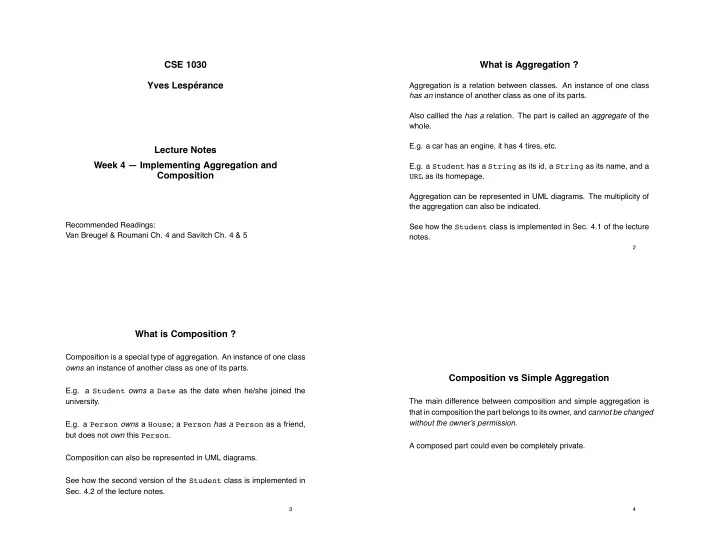
CSE 1030 What is Aggregation ? Yves Lesp erance Aggregation is a relation between classes. An instance of one class has an instance of another class as one of its parts. Also callled the has a relation. The part is called an aggregate of the


slide-1
SLIDE 1

CSE 1030 Yves Lesp´ erance Lecture Notes Week 4 — Implementing Aggregation and Composition

Recommended Readings: Van Breugel & Roumani Ch. 4 and Savitch Ch. 4 & 5

What is Aggregation ?

Aggregation is a relation between classes. An instance of one class has an instance of another class as one of its parts. Also callled the has a relation. The part is called an aggregate of the whole. E.g. a car has an engine, it has 4 tires, etc. E.g. a Student has a String as its id, a String as its name, and a URL as its homepage. Aggregation can be represented in UML diagrams. The multiplicity of the aggregation can also be indicated. See how the Student class is implemented in Sec. 4.1 of the lecture notes.

2

What is Composition ?

Composition is a special type of aggregation. An instance of one class

  • wns an instance of another class as one of its parts.

E.g. a Student owns a Date as the date when he/she joined the university. E.g. a Person owns a House; a Person has a Person as a friend, but does not own this Person. Composition can also be represented in UML diagrams. See how the second version of the Student class is implemented in

  • Sec. 4.2 of the lecture notes.

3

Composition vs Simple Aggregation

The main difference between composition and simple aggregation is that in composition the part belongs to its owner, and cannot be changed without the owner’s permission. A composed part could even be completely private.

4

slide-2
SLIDE 2

This becomes an issue when the part is mutable, e.g. Date for Student. If an accessor returns a reference to the actual part, the client can mutate it. This is the case even if the attribute, e.g. joinDate is private. This results in a privacy leak. To avoid this, the accessor can return a copy of the part rather than the original. The client can then mutate the copy, but not the original part.

5

A privacy leak also occurs if a mutator or constructor assigns a mutable

  • bject that the client has a reference to to an owned attribute, e.g.

Date for Student. Then the client can still mutate the object, without the owner’s permis- sion. To avoid this, the mutator/constructor can make a copy of the object before assigning it to the owned attribute. Then the client does not have a reference to the copy of the object in the owned attribute, so it cannot mutate it.

6

In summary, to implement composition where the owned part is a mu- table object: 1) we make the attribute for the owned part private; 2) we make the mutators/constructors make a copy of the argument

  • bject and assign this copy to the attribute; and

3) we make the accessors return a copy of the owned attribute object.

7

Deep vs Shallow Copying

When making a copy of an object that owns other mutable objects, it is important to make copies of the parts as well, so that the copy and the

  • riginal do not share parts.

This is called making a deep copy. If you only copy the references to the parts, you are making a shallow copy, and the copy and the original share the parts. Then mutating one part mutates the other.

8

slide-3
SLIDE 3

Collections

In many case, an object has a whole collection of components, e.g. a Portfolio has a collection of Investments (seen in Java By Ab- straction), a Course has a collection of Students, a Student has a collection of Courses it has taken. In math, the main corresponding structuring mechanism is sets. In Java, there are several mechanisms to deal with collections, in par- ticular, arrays and the classes in the Collection Fremework. Can use UML class diagrams to represent having a collection of com- ponents. The multiplicity of has-a relationship can be *, i.e. 0 or more compo- nents.

9

The Collection Framework

Interface Set<T> implemented by HashSet<T> and TreeSet<T>;

  • rder does not matter and no duplicates.

Interface List<T> implemented by ArrayList<T> and LinkedList<T>;

  • rder matters and duplicates are allowed.

Interface Map<Tkey,Tval> implemented by HashMap<Tkey,Tval> and TreeMap<Tkey,Tval>, representing a function from Tkey to Tval.

10

Iteration over Collections

Often you need to do some operations on each element of a collection. This is called iterating over the collection. Classes that have collections as part provide ways to iterate over their elements. iterator() method of Set<T> and List<T> returns an Iterator<T>

  • bject.

Can get successive elements by calling next() on iterator. Can check whether there are more elements by calling hasNext() on iterator; returns true iff there are more elements.

11