SLIDE 1
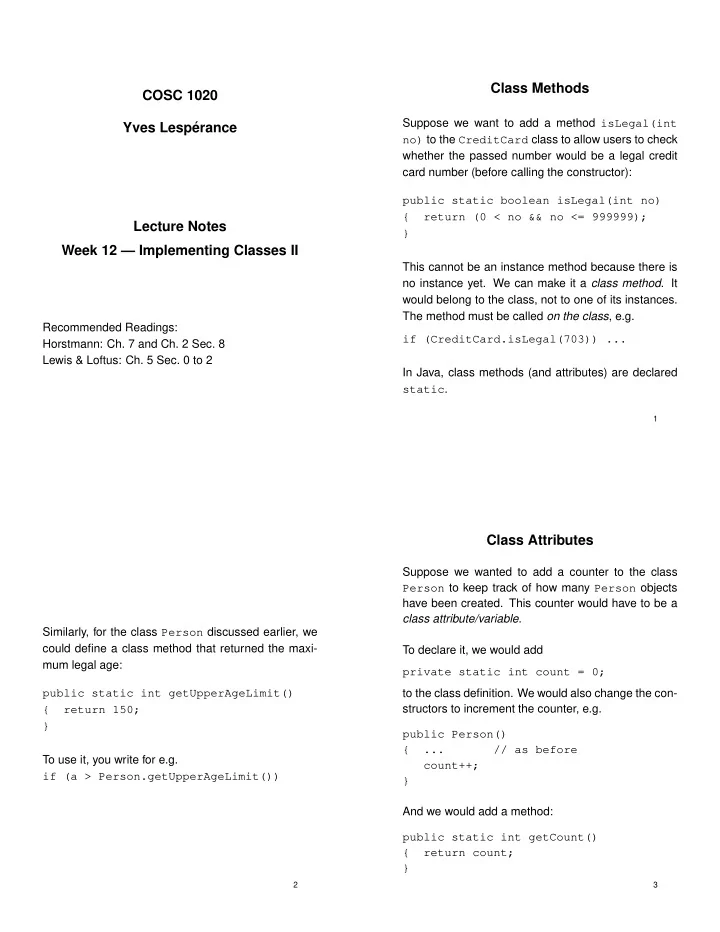
Then, we could use these as follows:
IO.println("Person count is " + Person.getCount()); Person p1 = new Person(); IO.println("Person count is " + Person.getCount()); Person p2 = new Person(); IO.println("Person count is " + Person.getCount());
4
Class Constants
A class may also define some constants for its users. For e.g., the class Stock defines the constant TSE URL, to store the URL used by the refresh method to estab- lish a connection with the TSE. To declare TSE URL for e.g., we would write public static final String TSE_URL = "http://tse.com"; to the Stock class definition. These are constant attributes of the class, not of its in-
- stances. You must refer to them using the class name,
e.g. IO.println(Stock.TSE URL);
5
Why Define a Class?
There are two cases where defining a class is useful.
- 1. Your program needs to work with some kind of data,
e.g. Persons. You want to group together the data and the operations that manipulate it. You also want to hide the details of how the data is represented and how the operations are implemented from users of the class. The class will make some op- erations public, i.e. available to the users, and provide information on how to use them. This is the class’s
- interface. The rest of the class’s definition is private
and hidden from users. When such a class allows many different possible im- plementations, one says that the class defines an ab- stract data type; e.g. stack, list, binary tree, etc.
6
- 2. You want to group together a set of related opera-