CSC 4181 Compiler Construction Overview of Compilers Part 1 - - PDF document

csc 4181 compiler construction overview of compilers part
SMART_READER_LITE
LIVE PREVIEW

CSC 4181 Compiler Construction Overview of Compilers Part 1 - - PDF document

CSC 4181 Compiler Construction Overview of Compilers Part 1 Introduction 1 1 What is a Compiler? A compiler is a computer program that translates a program in a source language into an equivalent program in a target language .


slide-1
SLIDE 1
  • CSC 4181

Compiler Construction Overview of Compilers Part 1

Introduction 1 Introduction 2

What is a Compiler?

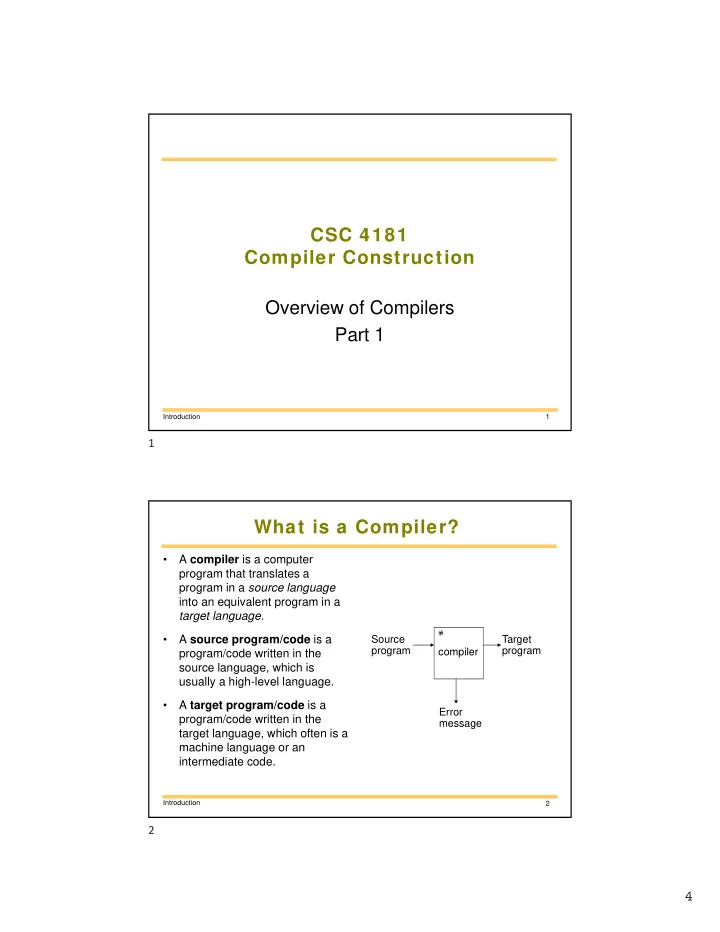
  • A compiler is a computer

program that translates a program in a source language into an equivalent program in a target language.

  • A source program/code is a

program/code written in the source language, which is usually a high-level language.

  • A target program/code is a

program/code written in the target language, which often is a machine language or an intermediate code.

  • compiler

Source program Target program Error message

1 2

slide-2
SLIDE 2
  • Introduction

3

Process of Compiling

scanner parser Semantic analyzer Intermediate code generator Code optimization Code generator Code optimization

  • Introduction

4

Scanning

  • A scanner reads a stream of characters and

puts them together into some meaningful (with respect to the source language) units called tokens.

  • It produces a stream of tokens for the next

phase of compiler.

3 4

slide-3
SLIDE 3
  • Introduction

5

Parsing

  • A parser gets a stream of tokens from the

scanner, and determines if the syntax (structure) of the program is correct according to the (context-free) grammar of the source language.

  • Then, it produces a data structure, called a

parse tree or an abstract syntax tree, which describes the syntactic structure of the program.

Introduction 6

Semantic analysis

  • It gets the parse tree from the parser together with

information about some syntactic elements

  • It determines if the semantics or meaning of the

program is correct.

  • This part deals with static semantic.

– semantic of programs that can be checked by reading

  • ff from the program only.

– syntax of the language which cannot be described in context-free grammar.

  • Mostly, a semantic analyzer does type checking.
  • It modifies the parse tree in order to get that

(static) semantically correct code.

5 6

slide-4
SLIDE 4
  • Introduction

7

Intermediate code generation

  • An intermediate code generator

– takes a parse tree from the semantic analyzer – generates a program in the intermediate language.

  • In some compilers, a source program is

translated into an intermediate code first and then the intermediate code is translated into the target language.

  • In other compilers, a source program is

translated directly into the target language.

Introduction 8

Intermediate code generation (cont’d)

  • Using intermediate code is beneficial when

compilers which translates a single source language to many target languages are required.

– The front-end of a compiler – scanner to intermediate code generator – can be used for every compilers. – Different back-ends – code optimizer and code generator– is required for each target language.

  • One of the popular intermediate code is

three-address code. A three-address code

instruction is in the form of x = y op z.

7 8

slide-5
SLIDE 5
  • Introduction

9

Code optimization

  • Replacing an inefficient sequence of

instructions with a better sequence of instructions.

  • Sometimes called code improvement.
  • Code optimization can be done:

– after semantic analyzing

  • performed on a parse tree

– after intermediate code generation

  • performed on a intermediate code

– after code generation

  • performed on a target code

Introduction 10

Code generation

  • A code generator

– takes either an intermediate code or a parse tree – produces a target program.

9 10