CSC 143 Recursion A recursive definition is one which is defined in - - PDF document

csc 143 recursion
SMART_READER_LITE
LIVE PREVIEW

CSC 143 Recursion A recursive definition is one which is defined in - - PDF document

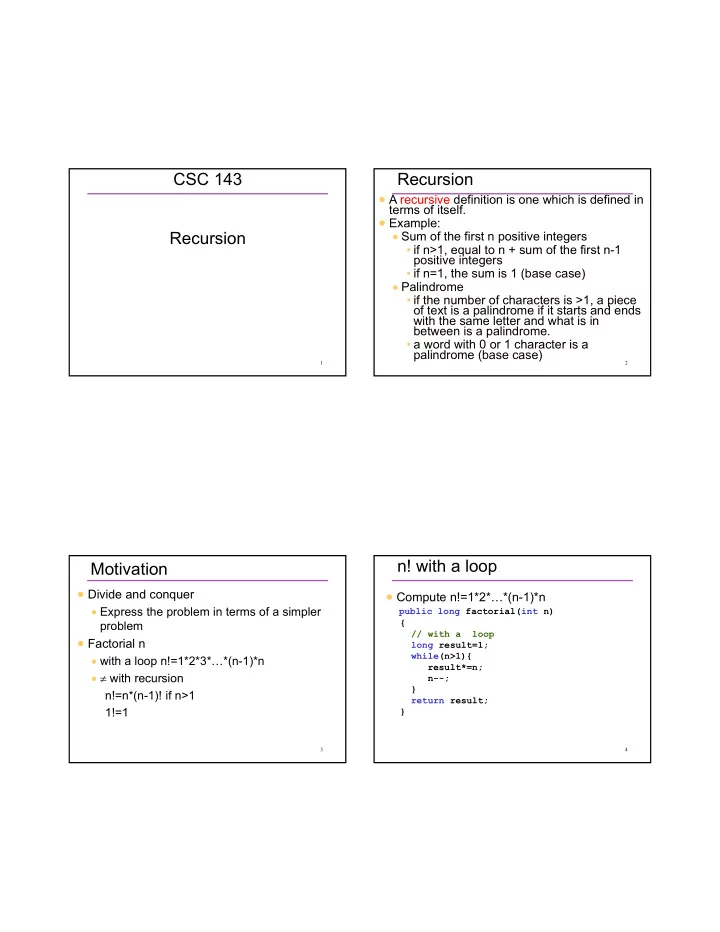
CSC 143 Recursion A recursive definition is one which is defined in terms of itself. Example: Sum of the first n positive integers Recursion if n>1, equal to n + sum of the first n-1 positive integers if n=1, the sum is


slide-1
SLIDE 1

1

CSC 143 Recursion

2

Recursion

 A recursive definition is one which is defined in

terms of itself.

 Example:

 Sum of the first n positive integers

  • if n>1, equal to n + sum of the first n-1

positive integers

  • if n=1, the sum is 1 (base case)

 Palindrome

  • if the number of characters is >1, a piece
  • f text is a palindrome if it starts and ends

with the same letter and what is in between is a palindrome.

  • a word with 0 or 1 character is a

palindrome (base case)

3

Motivation

 Divide and conquer

 Express the problem in terms of a simpler problem

 Factorial n

 with a loop n!=1*2*3*…*(n-1)*n   with recursion n!=n*(n-1)! if n>1 1!=1

4

n! with a loop

 Compute n!=1*2*…*(n-1)*n

public long factorial(int n) { // with a loop long result=1; while(n>1){ result*=n; n--; } return result; }

slide-2
SLIDE 2

5

n! with recursion

 Write n!=n*(n-1)!

public long factorial(int n) { // with recursion long result; if (n>1) result=n*factorial(n-1); else result=1; // base case return result; }

 How does it work? Recall that a method

call is done by value in java.

6

4 4 * factorial(3) 3 3 * factorial(2) 2 2 * factorial(1) 1 1 1 2 6 n result n result n result factorial(4) n result 24 (=4!)

different memory locations

7

Activation Records

 Recall that local variables and parameters are

allocated when a method is entered, deleted when the method exits (automatic storage).

 Whenever a method is called, a new

activation record is pushed on the call stack, containing:  a separate copy of all local variables  control flow info (e.g. return address)

 Activation record is popped at end of method  A recursive method call is handled the same

way  Each recursive call has its own copy of locals

8

Infinite Recursion

 Make sure that recursion will eventually end

with one of the base cases.

public long factorial(int n) { long result = factorial(n-1); //oups! if ( n==1) // the control flow never gets // to this line result=1; else result *=n; return result; }

 What happens? Whatever the value of n,

factorial(n-1) is called. It ends with a stack

  • verflow error.

 Make sure that you test for the base case

before calling the method again.

slide-3
SLIDE 3

9

Recursion versus loops

 Any recursive algorithm can be rewritten as

an iterative algorithm

 What is best?

 Some problems are more elegantly solved with recursion. Others with iterations.  Recursion is slightly more expensive. An activation record is pushed on and later popped from the stack for each recursive call

10

The towers of Hanoi (1)

 Move the tower of disks from the left to the

right peg.

 A larger disk can't be placed on top of a

smaller disk. Solution?

 Beautifully solved with recursion. More difficult

with a loop.

11

The towers of Hanoi (2)

 Recursive algorithm: move n disks in terms of

moving n-1 disks  Base case: 1 disk  To move n disks from the left to the right peg,

  • move the n-1 top disks from the left to the

middle peg

  • move the one remaining disk on the left

peg to the right peg

  • move the n-1 disks on the middle peg to

the right peg.

12

The towers of Hanoi (3)

public void move (int n,int peginit,int pegfinal, int pegtemp) { // move n disks from peginit to pegfinal, using // pegtemp as a temporary holding area if (n ==1) {System.out.println("move top disk from "+ peginit+" to " + pegfinal);} else { //move n -1 disks to pegtemp move(n-1,peginit,pegtemp,pegfinal); //move the remaining disk to pegfinal move(1,peginit,pegfinal,pegtemp); //move n -1 disks to pegfinal move(n-1,pegtemp,pegfinal,peginit); } }