
!!"!#"$%& !&
Kathleen Fisher!
cs242! Reading: “Beautiful Concurrency”, ! “The Transactional Memory / Garbage Collection Analogy”! Thanks to Simon Peyton Jones for these slides. !
! Multi-cores are coming!!
- For 50 years, hardware designers delivered 40-50%
increases per year in sequential program speed.!
- Around 2004, this pattern failed because power and
cooling issues made it impossible to increase clock frequencies.!
- Now hardware designers are using the extra
transistors that Moore’ s law is still delivering to put more processors on a single chip. !
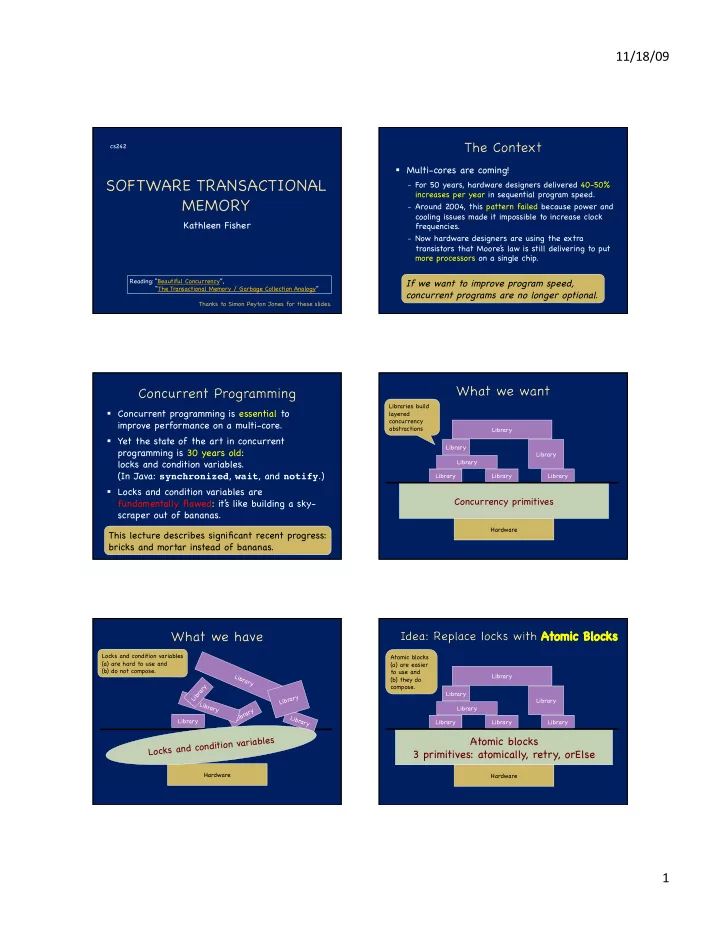
If we want to improve program speed, concurrent programs are no longer optional.! ! Concurrent programming is essential to improve performance on a multi-core.! ! Yet the state of the art in concurrent programming is 30 years old: locks and condition variables. " " (In Java: synchronized, wait, and notify.)! ! Locks and condition variables are fundamentally flawed: it’ s like building a sky- scraper out of bananas.! This lecture describes significant recent progress: bricks and mortar instead of bananas.!
Hardware!
Concurrency primitives!
Library! Library! Library! Library! Library! Library! Library! Libraries build layered concurrency abstractions ! Hardware! Library! Library! Library! L i b r a r y ! L i b r a r y ! Library! Library!
L
- c
k s a n d c
- n
d i t i
- n
v a r i a b l e s !
Locks and condition variables ! (a) are hard to use and ! (b) do not compose.!
At Atomic Blocks!
Atomic blocks! 3 primitives: atomically, retry, orElse!
Library! Library! Library! Library! Library! Library! Library! Hardware! Atomic blocks! (a) are easier to use and ! (b) they do compose.!