CS 251 Fall 2019 CS 251 Fall 2019 How are names resolved? - - PowerPoint PPT Presentation

cs 251 fall 2019 cs 251 fall 2019 how are names resolved
SMART_READER_LITE
LIVE PREVIEW

CS 251 Fall 2019 CS 251 Fall 2019 How are names resolved? - - PowerPoint PPT Presentation

CS 251 Fall 2019 CS 251 Fall 2019 How are names resolved? Principles of Programming Languages Principles of Programming Languages Ben Wood Ben Wood Key piece of semantics in any language. ML, Racket: Dynamic Dispatch Just one


slide-1
SLIDE 1

CS 251 Fall 2019 Principles of Programming Languages

Ben Wood

λ

CS 251 Fall 2019

Principles of Programming Languages

Ben Wood

λ

https://cs.wellesley.edu/~cs251/f19/

Dynamic Dispatch

semantic essence

  • f "object-oriented" programming languages

(OOP)

1 Dynamic Dispatch

How are names resolved?

Key piece of semantics in any language.

  • ML, Racket:

– Just one kind of variables. – Lexical scope – unambiguous binding – Record field names are not variables: no "lookup"

  • Java, …:

– Local variables: lexical scope (more limited) – Instance variables, methods

  • Look up in terms of special self / this "variable"
  • it's more complicated…

Dynamic Dispatch 2

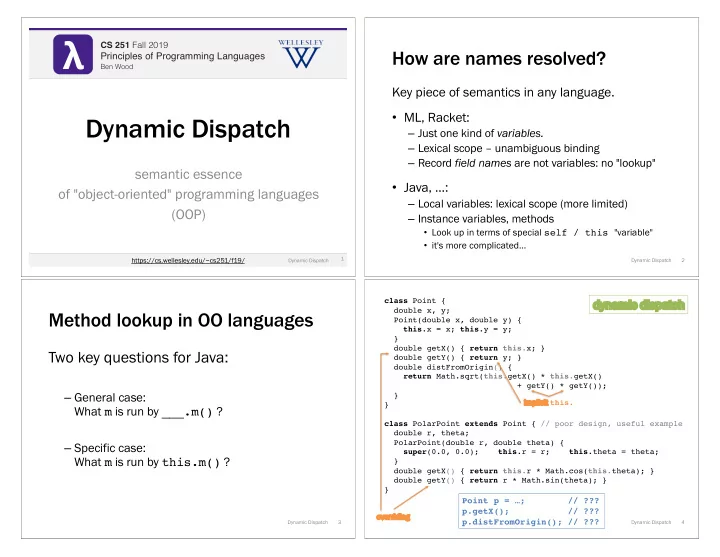
Method lookup in OO languages

Two key questions for Java:

– General case: What m is run by ___.m() ? – Specific case: What m is run by this.m() ?

3 Dynamic Dispatch Dynamic Dispatch 4

class Point { double x, y; Point(double x, double y) { this.x = x; this.y = y; } double getX() { return this.x; } double getY() { return y; } double distFromOrigin() { return Math.sqrt(this.getX() * this.getX() + getY() * getY()); } } class PolarPoint extends Point { // poor design, useful example double r, theta; PolarPoint(double r, double theta) { super(0.0, 0.0); this.r = r; this.theta = theta; } double getX() { return this.r * Math.cos(this.theta); } double getY() { return r * Math.sin(theta); } }

Point p = …; // ??? p.getX(); // ??? p.distFromOrigin(); // ???

  • v
  • verriding

im implicit icit this.

dy dynamic di disp spatch

slide-2
SLIDE 2

Method lookup: example

Ke Key qu questions:

– Which distToOrigin is called? – Which getX, getY methods does it call?

Dynamic Dispatch 5

Point p = …; // ??? p.getX(); // ??? p.distFromOrigin(); // ???

Dynamic dispatch

(a.k.a. late binding, virtual methods)

Th The unique OO semantics feature. Me Method call: e.m() Ev Evaluation rule: 1. Under the current environment, evaluate e to value v. 2. Let C refer to the class of the receiver object v. 3. Until class C contains a method definition m() { body } let C refer to the superclass of the current C and repeat step 3. 4. Under the environment of class C, extended with the binding this ↦ v, evaluate the body found in step 3. No Note: this refers to cu curren ent re receiver r obj

  • bject, not containing class.

– this.m() uses dy dynamic di dispatch just like other calls. – NO NOT lexical scope, not dynamic scope

Dynamic Dispatch 6

Dynamic Dispatch is not ...

  • bj0.m(obj1,...,objn)

≠ m(obj0,obj1,...,objn) Is this just an implicit parameter that captures a first argument written in a different spot? NO NO! "What m means" is determined by run-time class of obj0! Must inspect obj0 before starting to execute m. this is different than any other parameters.

7 Dynamic Dispatch

Key artifacts of dynamic dispatch

  • Why ov
  • verriding works...

distFromOrigin in PolarPointA

  • Subclass's definition of m "shadows" superclass's

definition of m when dispatching on object of subclass (or descendant) in all contexts, ev even if dispatching from method in superclass.

  • More complicated than the rules for closures

– Must treat this specially – May seem simpler only if you learned it first – Complicated != inferior or superior

8 Dynamic Dispatch

slide-3
SLIDE 3

Closed vs. open

ML: closures are, well, closed. May shadow even, but calls to odd are unaffected.

Dynamic Dispatch 9

fun even x = if x=0 then true else odd (x-1) and odd x = if x=0 then false else even (x-1) (* does not change odd: too bad, would help *) fun even x = (x mod 2) = 0 (* does not change odd: good, would break *) fun even x = false

Closed vs. open

Most OOP languages: subclasses can change the behavior of superclass methods they do not override.

Dynamic Dispatch 10

class A { boolean even(int x) { if (x == 0) return true; else return odd(x-1); } boolean odd(int x) { if (x == 0) return false; else return even(x-1); } } class B extends A { // improves odd in B objects boolean even(int x) { return x % 2 == 0; } } class C extends A { // breaks odd in C objects boolean even(int x) { return false; } }

OOP trade-off: im implic licit it ex exte tensibility

Any method that calls overridable methods may have its behavior changed by a subclass ev even if it is not overridden.

– On purpose, by mistake? – Behavior depends on calls to overridable methods

  • Ha

Harder to reason about “the code you're looking at.”

– Sources of unknown behavior are pervasive: all overridable methods transitively called by this method. – Avoid by disallowing overriding: “private” or “final”

  • Ea

Easier for subclasses to extend existing behavior without copying code.

– Assuming superclass method is not modified later

Dynamic Dispatch 11

FP trade-off: ex explicit ex exte tensibility

A function that calls other functions may have its behavior affected on

  • nly wh

where it it calls lls functio ions pa passe ssed as s arguments.

  • Ea

Easier to reason about “the code you're looking at.”

– Sources of unknown behavior are explicit: calls to argument functions.

  • Ha

Harder for other code to extend existing behavior without copying code.

– Only by functions as arguments.

Dynamic Dispatch 12

slide-4
SLIDE 4

Aside: overloading is static.

  • v
  • verloading:

> 1 methods in class have same name

  • v
  • verriding:

if and only if same number/types of arguments Pick the "best" overloaded method using the st static types of the arguments

– Complicated rules for “best” – Some confusion when expecting wrong over-thing

13 Dynamic Dispatch

static dispatch

(a.k.a early binding, non-virtual methods)

  • Lookup method based on static type of receiver.
  • Calls to e.m2() where e has declared class C

– (the lexically enclosing class is this's "declared class")

– alw always res resolve to "closest" method m2 defined in C or C's ancestor classes – completely ignores run-time class of object result of e

  • ... similar to lexical scope for method lookup with inheritance.
  • Same method call always resolves to same method definition.
  • Determined statically by type system before running program.
  • us

used for su super er in Java, non-virtual methods in C++

14

Requires static types...

Dynamic Dispatch Dynamic Dispatch 15

class Point { double x, y; Point(double x, double y) { this.x = x; this.y = y; } double getX() { return this.x; } double getY() { return y; } double distFromOrigin() { return Math.sqrt(this.getX() * this.getX() + getY() * getY()); } } class PolarPoint extends Point { // poor design, useful example double r, theta; PolarPoint(double r, double theta) { super(0.0, 0.0); this.r = r; this.theta = theta; } double getX() { return this.r * Math.cos(this.theta); } double getY() { return r * Math.sin(theta); } }

Point p = …; // ??? p.getX(); // ??? p.distFromOrigin(); // ???

  • v
  • verriding

im implicit icit this.

st static di disp spatch