CRUSTACEANS Crustaceans are primarily aquatic. This subphylum - - PowerPoint PPT Presentation

crustaceans
SMART_READER_LITE
LIVE PREVIEW

CRUSTACEANS Crustaceans are primarily aquatic. This subphylum - - PowerPoint PPT Presentation

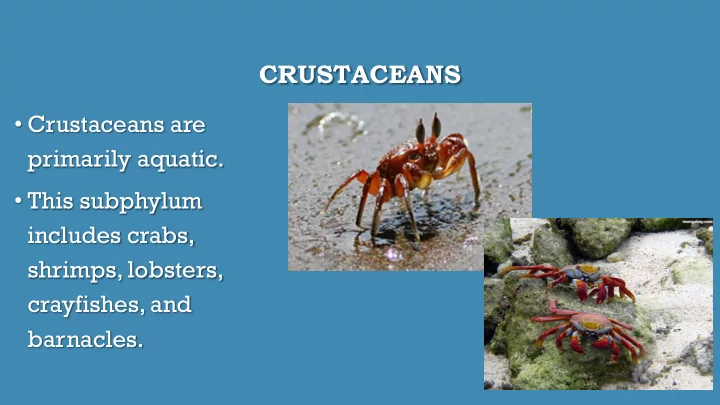
CRUSTACEANS Crustaceans are primarily aquatic. This subphylum includes crabs, shrimps, lobsters, crayfishes, and barnacles. Crustaceans typically have two pairs of antennae two or three body sections Chewing mouthparts


slide-1
SLIDE 1

CRUSTACEANS

  • Crustaceans are

primarily aquatic.

  • This subphylum

includes crabs, shrimps, lobsters, crayfishes, and barnacles.

slide-2
SLIDE 2
  • Crustaceans typically have
  • two pairs of antennae
  • two or three body sections
  • Chewing mouthparts called

mandibles.

slide-3
SLIDE 3

TYPICAL CRUSTACEAN

  • Body is divided into a

cephalothorax

  • Fusion of head and thorax
  • Thorax is behind the head

and houses the internal

  • rgans
  • Abdomen
  • Posterior part of body
slide-4
SLIDE 4
  • In a crustacean, the first two pairs of appendages are

antennae.

slide-5
SLIDE 5
  • The third pair of appendages are the mandibles.
  • A mandible is a mouthpart adapted for biting and grinding food.
slide-6
SLIDE 6
  • Decapods have five

pairs of legs.

  • In crayfishes, the

first pair of legs, called chelipeds, have large claws that catch, pick up, crush, and cut food.

slide-7
SLIDE 7
  • Along the

abdomen are several pairs of swimmerets, which are flipperlike appendages used for swimming.

slide-8
SLIDE 8
  • The final

abdominal segment is fused with a pair of paddlelike appendages to form a large, flat tail.

slide-9
SLIDE 9

BARNACLES

  • Sessile
  • Lost abdominal segments
  • Do not use mandibles
  • Use appendages to

capture and draw food particles into their mouth