Crops and Climate Len Coop, OSU Integrated Plant Protection Center - - PowerPoint PPT Presentation

crops and climate
SMART_READER_LITE
LIVE PREVIEW

Crops and Climate Len Coop, OSU Integrated Plant Protection Center - - PowerPoint PPT Presentation

Crops and Climate Len Coop, OSU Integrated Plant Protection Center & Botany Plant Pathology Feb 28, 2015 Small Farms Conference, Corvallis, OR (minor updates Mar 2, 2015) Has it been getting warmer in the Pacific NW & how will that

slide-1
SLIDE 1

Crops and Climate

Len Coop, OSU

Integrated Plant Protection Center & Botany Plant Pathology

Feb 28, 2015 Small Farms Conference, Corvallis, OR (minor updates Mar 2, 2015)

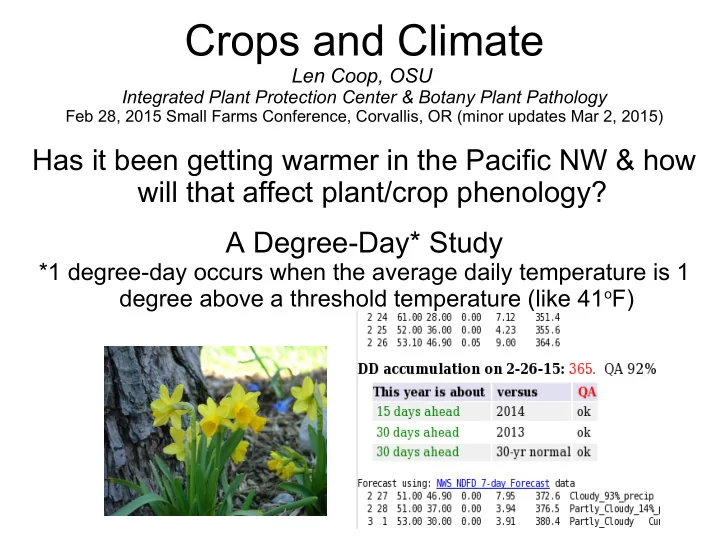
Has it been getting warmer in the Pacific NW & how will that affect plant/crop phenology? A Degree-Day* Study

*1 degree-day occurs when the average daily temperature is 1 degree above a threshold temperature (like 41oF)

slide-2
SLIDE 2

The daffodils were blooming as early as Valentine's Day (Feb 14th) this year!

Daffodils, That come before the swallow dares, and take The winds of March with beauty. –William Shakespeare, The Winter's Tale

We will look at heat units through today (Feb 28th as a reference)

slide-3
SLIDE 3

Have these past 2 months been the warmest ever? Is it part of a winter warming trend in the PNW? Is global warming caused by humans releasing all this CO2 into the atmosphere? (97% of Scientists think so...) Can we forecast these anomalies to help growers adapt to these trends?

slide-4
SLIDE 4

2015 is pretty much the warmest year since 1916!

Feb 28, 1992 (closest year in 100 years [372 DD] – followed eruption of Mt. Pinatuba) Feb 28, 2015 at 385 DD!

slide-5
SLIDE 5

2015 is pretty much the warmest year since 1916!

April 27, 1955 (8 wks later than this year) Feb 27, 2015

slide-6
SLIDE 6

The most favored explanation for now, though, seems to be the extremely warm waters across the Pacific

  • cean...which

can give rise to high pressure systems and hold them in place -

  • D. Swain,

Stanford Univ.

Warm Winter in the West

OSU PRISM Group Climate Data (Feb through the 23rd) Jan. temp. anomaly Feb. temp. anomaly

slide-7
SLIDE 7

Many (many) studies linking Sea Surface Temperatures to future climate = one form of “teleconnection” or statistical correlation of climate anomalies at large distances

slide-8
SLIDE 8

NOAA forecast on

  • Nov. 21, 2014

Blended from:

  • Sea Surface Indices &

Models

  • Numerical

Models

  • Statistical

Models

58% chance

  • f above normal

temperatures for Jan and Feb 2015 Feb 2015 forecast Jan 2015 forecast

Was Our Warmer-Than Normal Trend Forecasted well in Advance?

We are saying that these forecasts are “increasingly skillful”

slide-9
SLIDE 9

If we think of these as “climate forecasts” rather than “weather forecasts” they can be very useful, not only to plan for effects (such as early bloom or early pest attacks and so

  • n), but to gauge the short term effects of climate change.

Precip Temps March 2015 April 2015 May 2015

slide-10
SLIDE 10

Feb 2015 forecast Feb 2015 forecast

New USDA NIFA ARDP grant project to “harvest” these forecasts for use in crop and pest decision support (OSU IPPC, WSU, Fox Weather LLC)

Feb PRISM Normals

+

Localized forecast For pest & crop models at uspest.org

slide-11
SLIDE 11

Take-home Messages

  • The recent warm temperatures are part of a

general warming trend

  • Crops have been blooming earlier over time

(about 1 week per 4 decades on average)

  • We can now begin to forecast short term trends

(perhaps out 60-90 days)

  • Growers can adapt and

better prepared