Crop for Bioenergy & Biofuels Dr. Carl Kukkonen, CEO VIASPACE - - PowerPoint PPT Presentation

crop for bioenergy amp biofuels
SMART_READER_LITE
LIVE PREVIEW

Crop for Bioenergy & Biofuels Dr. Carl Kukkonen, CEO VIASPACE - - PowerPoint PPT Presentation

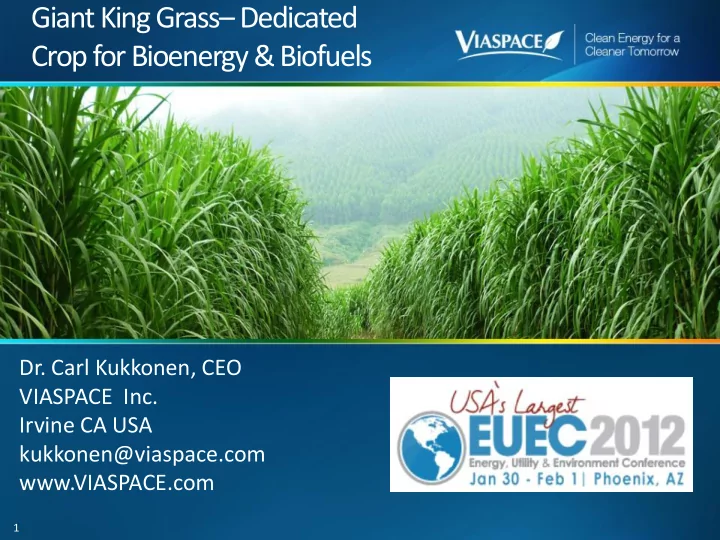
Giant King Grass Dedicated Crop for Bioenergy & Biofuels Dr. Carl Kukkonen, CEO VIASPACE Inc. Irvine CA USA kukkonen@viaspace.com www.VIASPACE.com 1 VIASPACE is a publicly traded company on the US OTC Bulletin Board VIASPACE

slide-1
SLIDE 1

Giant King Grass– Dedicated Crop for Bioenergy & Biofuels

  • Dr. Carl Kukkonen, CEO

VIASPACE Inc. Irvine CA USA kukkonen@viaspace.com www.VIASPACE.com

1

slide-2
SLIDE 2
  • VIASPACE is a publicly traded company
  • n the US OTC Bulletin Board

–VIASPACE stock symbol VSPC.OB

Safe Harbor Statement: Information in this presentation includes forward-looking statements which relate to future events or performance, and involve known and unknown risks, uncertainties and other factors that may cause our actual results, levels of activity, performance or achievements to be materially different from those expressed or implied by these forward-looking statements. Such factors include, without limitation, risks outlined in our periodic filings with the U.S. Securities and Exchange Commission, including Annual Report on Form 10-K for the year ended December 31, 2010, as well as general economic and business conditions; and other factors over which VIASPACE has little or no control.

2

slide-3
SLIDE 3
  • Dr. Carl Kukkonen

CEO Biography

1998-PRESENT VIASPACE Inc. CEO 1984-1998 NASA/Caltech Jet Propulsion Laboratory (JPL) Director Center for Space Microelectronics Technology & Manager of Supercomputing

– Led staff of 250 with $70 million annual budget – On review boards of 14 leading universities – NASA Exceptional Achievement Award 1992 – Space Technology Hall of Fame 2001

1977-1984 Ford Motor Company

– Developed direct injection diesel engine – Ford’s expert on hydrogen as automotive fuel – Research in Physics Department

1975-1977 Purdue University postdoctoral fellow 1968-1975 Cornell University MS & PhD in theoretical physics 1966-1968 University of California Davis BS physics

3

slide-4
SLIDE 4

Biomass is Low Carbon Fuel

  • Biomass energy is

solar energy & CO2 captured in plants by photosynthesis

  • Burning biomass or

biofuels simply recycles the CO2 stored in the plant

  • Biomass is carbon

neutral except

– Fertilizer, harvesting, & delivery contribute some carbon dioxide

4

slide-5
SLIDE 5

Advantages of Biomass

  • Renewable energy source that can be locally grown

and provide jobs & energy security – Less expensive than imported oil or gas

  • Can generate electricity 24 hours per day

– Solar and wind are transient not base power – Less expensive than solar and wind

  • Burning & regrowth is carbon neutral
  • In the future, biomass can produce liquid biofuels,

biochemicals and biomaterials

  • Little market for biomass (except corn) now in US
  • Focus on developing world

5

slide-6
SLIDE 6

6

Compare Biomass Costs to Fossil Fuel

  • Coal is cheapest fuel

– Most electricity is from coal – But most carbon dioxide and

  • ther pollutants
  • Biomass is next cheapest

– With near zero net carbon dioxide emissions – Generate electricity and produce cellulosic biofuels

  • Natural gas is next

– Cleanest fossil fuel

  • Oil is most expensive

Gigajoule=278 kilowatt-hr

mt=metric ton=tonne=2204 lb Biomass is dry mt and HHV

Coal US price 27GJ /mt $60 /mt $2.22 /GJ Coal Europe 27GJ /mt $100 /mt $3.70 /GJ Oil 6.1GJ /barrel $90 /barrel $14.45 /GJ Nat. Gas $5.00 /Mbtu $5.27 /GJ Bio- mass 18.4 GJ/mt $42 /mt $2.28 /GJ

China

slide-7
SLIDE 7

100% Biomass Power Plants Hundreds in Use Today

  • All use agricultural or forestry waste as fuel

– Corn, wheat, rice straw, rice husk, bark, branches etc – Waste prices have risen dramatically – Agricultural waste has not been available with long term contracts—spot market only – Banks will not finance projects without long term fuel supply contract

  • Dedicated energy crops can be grown as fuel

– Perennial grasses, fast growing trees – Reliable, low cost, financeable fuel – However no power plants operating in the world

7

slide-8
SLIDE 8

Biomass Energy Issues

  • Food versus fuel

– Most countries have restricted or prohibited the use of food for fuel

  • Corn & palm oil are examples

– Displacing food land will be restricted

  • Is the enough land for biomass?

– FAO (UN) reports that that “250-800 M ha of additional agricultural land could be brought into production without encroaching upon areas of high ecological or social value” – 80M ha of Giant King Grass with its high yield could replace all coal in the world—9% size of US

8

slide-9
SLIDE 9

Biomass Power Plant

  • Size

– Coal/natural gas/nuclear~1000MW – Large 100% biomass ~30MW – Need 33 biomass power plants to replace 1000MW – Biomass power plants—distributed generation

  • Environmental

– Biomass has much lower CO2 emissions and lower NOX, SO2, HCL, Hg and As emissions than coal – Sustainable growth will be required

  • Do not cut down the rainforest

9

Note: Most general observations apply to all perennial grasses such as switchgrass, Miscanthus and elephant grass. High yield and resulting low cost of Giant King Grass allows bioenergy projects with good financial returns.

slide-10
SLIDE 10

VIASPACE Giant King Grass

10

slide-11
SLIDE 11

Giant King Grass

  • Very high yield

– 100 dry MT/ha/year (44 US t/acre)

  • Sustainably grown, not a food

crop, grows on marginal land

  • Perennial grass, harvest 2-3

times per year

  • Not genetically modified
  • Not an invasive species
  • Needs sunshine, warm weather

& rain or irrigation-no freezing

  • Fertilizer use is modest
  • No pesticide

11

slide-12
SLIDE 12

Yield Comparison

  • f Perennial Grasses

12

slide-13
SLIDE 13

Applications of Giant King Grass

  • Direct combustion in electric power/

heat/steam plant

  • Pellets for co-firing with coal
  • Briquettes for boilers
  • Biogas /anerobic digestion
  • Cellulosic liquid biofuels--

ethanol/butanol

  • Pyrolysis to bio oil
  • Catalytic coversion to bio diesel
  • Biochemicals and bio plastics
  • High-temperature gasification
  • Torrefaction to bio coal
  • Pulp for paper and textiles

Applications that are commercial today with other feedstock Low cost of Giant King Grass will allow commercial applications in future

13

slide-14
SLIDE 14

Giant King Grass to Produce Clean Electricity

  • Direct combustion--Burn Giant King Grass in a

boiler to produce high pressure steam which turns a generator to make electricity

– 100% biomass--sizes from 10 – 35 MW – Co-fire pellets with coal in existing power plant

  • Anaerobic Bio digestion of Giant King Grass to

produce biogas which is burned in an engine which turns a generator

– Sizes from 0.5 – 3.0 MW – Thousands of bio digesters in Europe

  • High-temp gasification & engine/generator

14

slide-15
SLIDE 15

Closed Loop Biomass Power Plant

  • Power plant integrated with Giant King Grass

plantation

  • Water and sunshine in–clean, low carbon

electricity out

VIASPACE Power Plant Partner Customer

15

slide-16
SLIDE 16

Direct Combustion Biomass Power Plant

Biomass fuel handling Special boiler burns biomass to create steam High pressure steam turbine turns generator to make electricity

16

slide-17
SLIDE 17

Giant King Grass & Biomass Power / Steam Plant

  • Giant King Grass has excellent

energy content of 18.4 MJ (megajoule) per dry kilogram HHV equivalent to 4400 kcal/kg, 7900 btu/lb

  • Burn in a power plant instead
  • f coal or oil
  • Giant King Grass properties

similar to corn & wheat straw

  • 30 MW power plant requires

1600 ha of Giant King Grass

30 MW Power Plant Uses Corn Straw Today

  • Suitable for Giant King Grass

17

slide-18
SLIDE 18

Giant King Grass Energy Analysis

Proximate Analysis Unit Sun Dried As Received Giant King Grass Bone Dry Total Moisture % 14 Volatile Matter % 65.68 76.37 Ash % 3.59 4.17 Fixed Carbon % 16.74 19.46 Total Sulfur % 0.11 0.13 HHV MJ/Kg 15.85 18.43 LHV MJ/Kg 14.52

  • 18
slide-19
SLIDE 19

Biomass Power Plant Uses Agricultural Waste Today

19

slide-20
SLIDE 20

Biomass Power Plant

20

slide-21
SLIDE 21

Giant King Grass Pellets as Coal Replacement

  • Giant King Grass pellets can

replace up to 20% of coal in an existing coal-fired power plant

– Burning coal and biomass together is called cofiring – Requires small modification

  • Preserves large capital

investment in existing power plant with 30 year additional life

  • Meets carbon reduction

targets

  • 16M tons of pellets used

globally today

– 46M tons by 2020

  • Grass is grown, dried and

pressed into pellets and shipped in bulk like shipping grain

  • Large global demand

– Particularly in Europe – Korea, China, Japan emerging Him him him him him

21

slide-22
SLIDE 22

Giant King Grass Pellets-- Tested by Many Independent Laboratories

22

Biomass Energy Lab, a JV of Timber Products Inspection & Control Union is only US lab accredited for European biomass fuel quality testing

slide-23
SLIDE 23

Test Data on Giant King Grass

23

slide-24
SLIDE 24

Giant King Grass and Factory

Note CEO standing at lower right . Giant King Grass is 4 m tall 110 ha ( 270 acre) test site provides

  • seedlings for large energy projects
  • demonstration of production
  • sample quantities for customers

24

slide-25
SLIDE 25

Giant King Grass After Harvest

Field dried grass and regrowth 10 days after harvest

  • 25
slide-26
SLIDE 26

Field Dried Grass & Regrowth

26

slide-27
SLIDE 27

Field Dried Grass Transported to Nearby Factory

Co-location of plantation and factory means grass does not need to be baled

27

slide-28
SLIDE 28

Chipper, Rotary Dryer and Hammer Mill

28

slide-29
SLIDE 29

Biogas Electricity

  • Biogas (methane and carbon dioxide) is

produced through anaerobic digestion (bio digestion) of Giant King Grass

– with organic fertilizer as valuable byproduct

  • The biogas is burned in an engine generator

set to generate clean electricity

– With heat as valuable byproduct

  • Biogas electricity is widely used in Europe

– 4000 biogas power plants in Germany alone

29

slide-30
SLIDE 30
  • Biogas is produced when Giant

King Grass decomposes without

  • xygen (anaerobic digestion)
  • Biogas is composed of methane

(55%) and carbon dioxide and used to generate electricity and heat

– Organic fertilizer is the byproduct – Can be put back on grass fields – Biogas is the greenest option

  • Bio-methane is the "green" energy

equivalent of methane, the principal component of natural gas

  • Biogas can also be upgraded to

pure methane and inserted into the existing natural gas pipelines

  • Giant King Grass has been

independently tested for biogas yield and the results are excellent

Biogas plant generating 1 MW of electricity and 1 MW of heat plus organic fertilizer

Biogas from Giant King Grass

Giant King Grass is cut every 30-45 days at 3-5 feet tall for biogas

30

slide-31
SLIDE 31
  • Sizes of Biogas power

plants are 0.5 to 3 MW

  • 70 hectare Giant King

Grass per 1 MW power

  • Provides 24/7 electricity

for remote area, factory

  • r to the grid
  • Biogas power plant and

plantation should be co- located to minimize fuel transportation costs

  • Waste heat and organic

fertilizer have value

Giant King Grass has both higher biogas yield per kilogram and higher kilogram yield per hectare than competing biomass

– Lower cost feedstock and electricity & higher profit

.

Biogas to Electricity

1.5 MW biogas engine generator set

31

slide-32
SLIDE 32

Bio-Methane Yield/ Hectare of Land

  • Biogas production uses fresh Giant King Grass

with yield of 375 mt/ha

  • Measured biogas yields are 160-190 cubic

meters of biogas/tonne of fresh grass

– Methane content is 57% of biogas

  • Bio-methane yield is 94 -111 m3/ha/day
  • Giant King Grass bio-methane yield is 3.4 - 4.0

million BTU per hectare per day

  • 1 MW of electricity requires 70 ha

32

slide-33
SLIDE 33

Cellulosic Biofuels, Biochemicals and Bioplastics Applications

  • f Giant King Grass

33

slide-34
SLIDE 34

Cellulosic Biofuels, Biochemicals & Bio Plastics

  • 1st generation bio ethanol is made from sugar

cane, corn or recently cassava

– Making fuel from food is being restricted or prohibited

  • 2nd generation is cellulosic ethanol made from

– corn straw– not the corn grain – Sugar cane bagasse—after the sugar is removed – Dedicated energy crops such as Giant King Grass

  • 2nd generation processes utilize the polymeric

sugars trapped in the stalks and leaves

– Requires pretreatment and enzymatic hydrolysis – Currently more expensive and not yet commercial

34

slide-35
SLIDE 35

Giant King Grass for Fermentation-Based Biorefinery

Giant King Grass tests by 3 independent companies. Giant King Grass has essentially the same composition as corn Stover and miscanthus per dry ton

35

slide-36
SLIDE 36

Compare Giant King Grass Yield to Corn & Miscanthus

36

slide-37
SLIDE 37

Land-Use Efficiency Ethanol per Acre

37

slide-38
SLIDE 38

Feedstock is the Largest Cost

  • f Cellulosic Ethanol

Giant King Grass and co-location can reduce feedstock cost by 40-50% making cellulosic ethanol profitable

38

slide-39
SLIDE 39

Giant King Grass & Biorefinery

  • Potential products from cellulose

– Ethanol, butanol – Lactic acid > polylactic acid > bioplastics – Pulp> Paper, viscose textile fibers

  • Potential products from hemicellulose

– Ethanol, butanol – chemicals such as furfural and acetic acid

  • Lignin for combustion, fiber strengthener for

structural plastics, adhesives and epoxy resins

  • Wastewater for biogas and organic fertilizer

39

slide-40
SLIDE 40

Giant King Grass--Scalable & Sustainable Development

  • Giant King Grass plantation co-located with a

power plant, pellet mill, bio-methane facility

  • r biorefinery

– Scalable, integrated, clean energy module that can be replicated throughout the world

  • Provides local employment for farmers and

power or processing plant operators

  • Provides clean electricity
  • Provides energy security & independence
  • Money stays in country rather than sent
  • verseas to purchase fuel

40

slide-41
SLIDE 41

Advantages of Giant King Grass

  • “Platform” energy crop for many bioenergy applications

– Electricity generation. biofuels, biochemicals & bio plastics

  • Low cost--Can meet cost targets for energy & biofuels

applications because of high yield

– Less expensive than agricultural waste – Can be used in combination w/ agricultural waste

  • Perennial crop

– Do not have to plant every year, just harvest – Short rotation—first harvested in 6.5 months

  • Provides reliable, well documented, consistent quality

fuel or feedstock with predictable, affordable price

– Fuel supply reliability required for project financing

41

slide-42
SLIDE 42

VIASPACE Business

  • VIASPACE works on integrated plantation and

bioenergy or biorefinery projects

– 90 MW biomass power plant in Thailand – Plantation & pellet mill in Dominican Republic

  • VIASPACE is seeking quality project opportunities
  • VIASPACE will work with project developer or act

as project developer

  • Potential R&D collaborations
  • Giant King Grass samples available

42

slide-43
SLIDE 43

Thank You

43