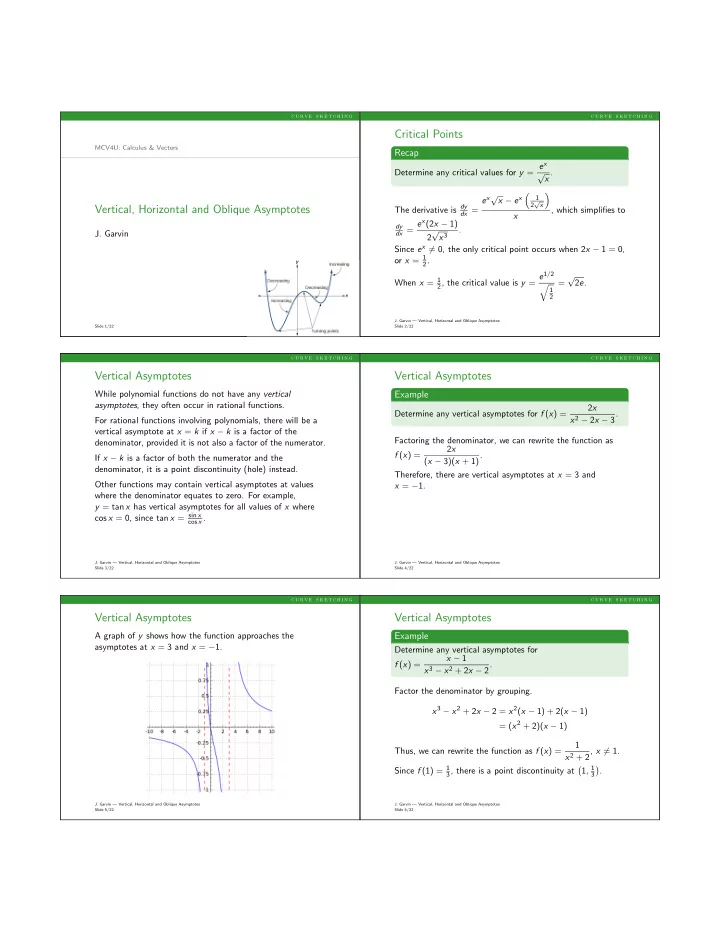
Critical Points MCV4U: Calculus & Vectors Recap Determine any - - PDF document

critical points
SMART_READER_LITE
LIVE PREVIEW

Critical Points MCV4U: Calculus & Vectors Recap Determine any - - PDF document

c u r v e s k e t c h i n g c u r v e s k e t c h i n g Critical Points MCV4U: Calculus & Vectors Recap Determine any critical values for y = e x x . e x x e x 1 2 x Vertical, Horizontal and Oblique Asymptotes The


slide-1
SLIDE 1

c u r v e s k e t c h i n g

MCV4U: Calculus & Vectors

Vertical, Horizontal and Oblique Asymptotes

  • J. Garvin

Slide 1/22

c u r v e s k e t c h i n g

Critical Points

Recap

Determine any critical values for y = ex √x . The derivative is dy

dx =

ex√x − ex

1 2√x

  • x

, which simplifies to

dy dx = ex(2x − 1)

2 √ x3 . Since ex = 0, the only critical point occurs when 2x − 1 = 0,

  • r x = 1

2.

When x = 1

2, the critical value is y = e1/2

  • 1

2

= √ 2e.

  • J. Garvin — Vertical, Horizontal and Oblique Asymptotes

Slide 2/22

c u r v e s k e t c h i n g

Vertical Asymptotes

While polynomial functions do not have any vertical asymptotes, they often occur in rational functions. For rational functions involving polynomials, there will be a vertical asymptote at x = k if x − k is a factor of the denominator, provided it is not also a factor of the numerator. If x − k is a factor of both the numerator and the denominator, it is a point discontinuity (hole) instead. Other functions may contain vertical asymptotes at values where the denominator equates to zero. For example, y = tan x has vertical asymptotes for all values of x where cos x = 0, since tan x = sin x

cos x .

  • J. Garvin — Vertical, Horizontal and Oblique Asymptotes

Slide 3/22

c u r v e s k e t c h i n g

Vertical Asymptotes

Example

Determine any vertical asymptotes for f (x) = 2x x2 − 2x − 3. Factoring the denominator, we can rewrite the function as f (x) = 2x (x − 3)(x + 1). Therefore, there are vertical asymptotes at x = 3 and x = −1.

  • J. Garvin — Vertical, Horizontal and Oblique Asymptotes

Slide 4/22

c u r v e s k e t c h i n g

Vertical Asymptotes

A graph of y shows how the function approaches the asymptotes at x = 3 and x = −1.

  • J. Garvin — Vertical, Horizontal and Oblique Asymptotes

Slide 5/22

c u r v e s k e t c h i n g

Vertical Asymptotes

Example

Determine any vertical asymptotes for f (x) = x − 1 x3 − x2 + 2x − 2. Factor the denominator by grouping. x3 − x2 + 2x − 2 = x2(x − 1) + 2(x − 1) = (x2 + 2)(x − 1) Thus, we can rewrite the function as f (x) = 1 x2 + 2, x = 1. Since f (1) = 1

3, there is a point discontinuity at

  • 1, 1

3

  • .
  • J. Garvin — Vertical, Horizontal and Oblique Asymptotes

Slide 6/22

slide-2
SLIDE 2

c u r v e s k e t c h i n g

Vertical Asymptotes

Since x2 + 2 ≥ 2, the denominator is never equal to zero. Thus, there are no vertical asymptotes.

  • J. Garvin — Vertical, Horizontal and Oblique Asymptotes

Slide 7/22

c u r v e s k e t c h i n g

Horizontal Asymptotes

A horizontal asymptote is a value that a function approaches as x → ∞ or x → −∞. Formally, if lim

x→±∞ f (x) = L, then y = L is a horizontal

asymptote for f (x). In previous courses, you have probably determined the equations of horizontal asymptotes by dividing polynomial terms by the highest power, then observing what happens as either x → ∞ or x → −∞. This is the same technique used here, but formalized using limit notation.

  • J. Garvin — Vertical, Horizontal and Oblique Asymptotes

Slide 8/22

c u r v e s k e t c h i n g

Horizontal Asymptotes

Example

Determine any horizontal asymptotes for y = 4x2 − 3x 2x2 + 5 . Factor the highest power, x2, from each term. 4x2 − 3x 2x2 + 5 = x2 4 − 3

x

  • x2

2 + 5

x2

  • = 4 − 3

x

2 + 5

x2

  • J. Garvin — Vertical, Horizontal and Oblique Asymptotes

Slide 9/22

c u r v e s k e t c h i n g

Horizontal Asymptotes

Evaluate the limits as x → ∞ and x → −∞. lim

x→∞

  • 4 − 3

x

2 + 5

x2

  • = 4 − 0

2 + 0 lim

x→−∞

  • 4 − 3

x

2 + 5

x2

  • = 4 − 0

2 + 0 = 2 = 2 In this case, the line y = 2 is a horizontal asymptote as x → ∞ and as x → −∞. This is not always the case. Some functions may have different asymptotes as x gets very large, or very small.

  • J. Garvin — Vertical, Horizontal and Oblique Asymptotes

Slide 10/22

c u r v e s k e t c h i n g

Horizontal Asymptotes

A graph of y shows the function approaching y = 2 as x → ∞ and as x → −∞.

  • J. Garvin — Vertical, Horizontal and Oblique Asymptotes

Slide 11/22

c u r v e s k e t c h i n g

Horizontal Asymptotes

Example

Determine any horizontal asymptotes for y = x + 2 √ 9x2 + 1 . The square root complicates matters here, so we need to approach it with an analytical perspective. As x → ∞, 9x2 will have a much greater effect than the +1 in the denominator. When x is sufficiently large, the 1 will be almost insignificant. Therefore, the denominator may be approximated by √ 9x2,

  • r 3x, so we can use x as the highest power.

This gives us y = x

  • 1 + 2

x

  • x

9x2+1 x

, or y = 1 + 2

x √ 9x2+1 x

.

  • J. Garvin — Vertical, Horizontal and Oblique Asymptotes

Slide 12/22

slide-3
SLIDE 3

c u r v e s k e t c h i n g

Horizontal Asymptotes

The square root continues to be an issue in the denominator, so we need to simplify further. Since x is positive when x → ∞, we can use the fact that x = √

  • x2. Similarly, x is negative when x → −∞, so

x = − √ x2. 1 + 2

x √ 9x2+1 √ x2

= 1 + 2

x

  • 9x2+1

x2

1 + 2

x √ 9x2+1 − √ x2

= 1 + 2

x

  • 9x2+1

x2

= 1 + 2

x

  • 9 + 1

x2

= 1 + 2

x

  • 9 + 1

x2

  • J. Garvin — Vertical, Horizontal and Oblique Asymptotes

Slide 13/22

c u r v e s k e t c h i n g

Horizontal Asymptotes

Finally, we can evaluate the limits as x → ∞ and x → −∞. lim

x→∞

1 + 2

x

  • 9 + 1

x2

= 1 + 0 √9 + 0 lim

x→−∞

1 + 2

x

  • 9 + 1

x2

= 1 + 0 −√9 + 0 = 1

3

= − 1

3

Therefore, there are two horizontal asymptotes for the

  • function. As x → ∞, there is a horizontal asymptote at

y = 1

3, and as x → −∞, there is one at y = − 1 3.

  • J. Garvin — Vertical, Horizontal and Oblique Asymptotes

Slide 14/22

c u r v e s k e t c h i n g

Horizontal Asymptotes

A graph of y shows both horizontal asymptotes.

  • J. Garvin — Vertical, Horizontal and Oblique Asymptotes

Slide 15/22

c u r v e s k e t c h i n g

Oblique Asymptotes

An oblique asymptote, or slant asymptote, is a linear asymptote that is neither vertical nor horizontal. For rational functions involving polynomials, oblique asymptotes occur when the numerator has a degree one greater than the denominator. For example, the rational function y = x2 + 3x x − 2 has an

  • blique asymptote with equation y = x + 5, whereas the

rational function y = x x2 − 4 does not have an oblique asymptote. Rational functions involving polynomials may contain a horizontal asymptote or an oblique asymptote, but not both. The equation of an oblique asymptote may be found using long or synthetic division.

  • J. Garvin — Vertical, Horizontal and Oblique Asymptotes

Slide 16/22

c u r v e s k e t c h i n g

Oblique Asymptotes

Example

Determine the equation of any oblique asymptotes for f (x) = x2 + 5x − 4 x + 3 . Use x = −3 and synthetic division to find the quotient, which is the equation of the asymptote. 1 5 − 4 − 3 − 3 − 6 1 2 − 10 Therefore, f (x) has an oblique asymptote with equation y = x + 2.

  • J. Garvin — Vertical, Horizontal and Oblique Asymptotes

Slide 17/22

c u r v e s k e t c h i n g

Oblique Asymptotes

A graph of f (x) is below.

  • J. Garvin — Vertical, Horizontal and Oblique Asymptotes

Slide 18/22

slide-4
SLIDE 4

c u r v e s k e t c h i n g

Other Asymptotes

While the asymptotes covered in this course are limited to vertical, horizontal and oblique, an asymptote may assume the shape of any function. For example, a rational function with a numerator of order 3 and a denominator of order 1 will have a parabolic asymptote, while a quintic numerator and a quadratic denominator will result in a cubic asymptote. In general, a rational function with a polynomial or order n and a denominator of order m, with n > m, will have a polynomial asymptote with order n − m.

  • J. Garvin — Vertical, Horizontal and Oblique Asymptotes

Slide 19/22

c u r v e s k e t c h i n g

Other Asymptotes

Example

Determine the equation of the parabolic asymptote to y = x3 + 4x2 − 2x + 1 x − 2 . Use synthetic division to determine the equation. 1 4 − 2 1 2 2 12 20 1 6 10 21 The equation of the parabolic asymptote is y = x2 + 6x + 10, or y = (x + 3)2 + 1.

  • J. Garvin — Vertical, Horizontal and Oblique Asymptotes

Slide 20/22

c u r v e s k e t c h i n g

Other Asymptotes

A graph of y shows how the function approaches the asymptote.

  • J. Garvin — Vertical, Horizontal and Oblique Asymptotes

Slide 21/22

c u r v e s k e t c h i n g

Questions?

  • J. Garvin — Vertical, Horizontal and Oblique Asymptotes

Slide 22/22