CREATIVITY Identifying creativity in music You cannot teach - - PowerPoint PPT Presentation

creativity
SMART_READER_LITE
LIVE PREVIEW

CREATIVITY Identifying creativity in music You cannot teach - - PowerPoint PPT Presentation

Workshop case study 1: Discussing creativity in music CREATIVITY Identifying creativity in music You cannot teach creativity, but you can kill it and education Rating creativity in music (Evans, F. T, in Tornkvist, 1998, p. 5)


slide-1
SLIDE 1

CREATIVITY and education

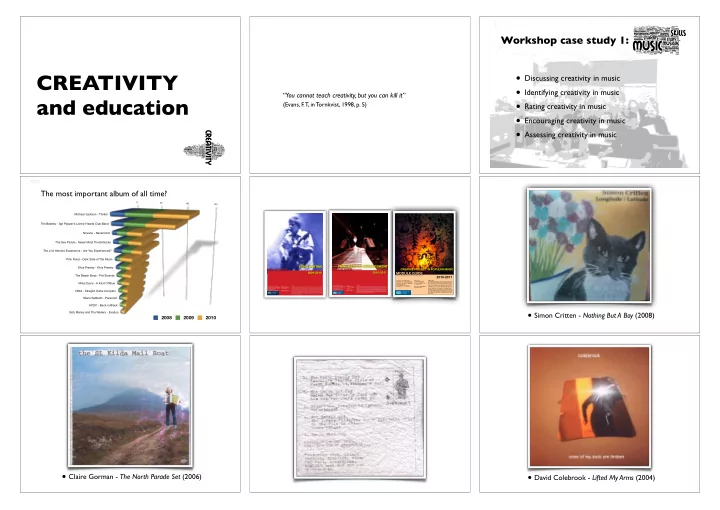
“You cannot teach creativity, but you can kill it”

(Evans, F. T, in Tornkvist, 1998, p. 5)

Workshop case study 1:

  • Discussing creativity in music
  • Identifying creativity in music
  • Rating creativity in music
  • Encouraging creativity in music
  • Assessing creativity in music

50 100 150

Michael Jackson - Thriller The Beatles - Sgt Pepper’s Lonely Hearts Club Band Nirvana - Nevermind The Sex Pistols - Never Mind The Bollocks The Jimi Hendrix Experience - Are You Experienced? Pink Floyd - Dark Side of The Moon Elvis Presley - Elvis Presley The Beach Boys - Pet Sounds Miles Davis - A Kind Of Blue NWA - Straight Outta Compton Black Sabbath - Paranoid ACDC - Back in Black Bob Marley and The Wailers - Exodus

2008 2009 2010

The most important album of all time?

CREATIVE PROJECT IN POPULAR MUSIC

MODULE GUIDE 2010-2011

SCHOOL OF TECHNOLOGY FACULTY OF ARTS, DESIGN & TECHNOLOGY UNIVERSITY OF DERBY CHRIS WILSON E: C.J.WILSON@DERBY.AC.UK T: 01332593161 MODULE CODE: 6MS021. THROUGH-YEAR Electronics & Sound Subject Group Module Leader Introduction The module takes the form of a structured, student man- aged commercially orientated project enabling develop- ment of personal creative interests and abilities, and pro- vides students with the opportunity to develop relevant artistically and commercially orientated work. Based on consolidation of the variety of techniques developed in the pre-requisite music composition, arrangement and production modules, the musical and technical objectives
  • f the project are negotiated as appropriate with the tutor
and need to be of relevance to the experience and exper- tise of the student as a distinct component of their final year studies.

SONG WRITING

MODULE GUIDE 2009-2010

SCHOOL OF TECHNOLOGY FACULTY OF ARTS, DESIGN & TECHNOLOGY UNIVERSITY OF DERBY CHRIS WILSON E: C.J.WILSON@DERBY.AC.UK T: 01332593161 MODULE CODE: 4MS017 THROUGH-YEAR Electronics & Sound Subject Group Module Leader Introduction As the most significant musical form in contemporary popular music, this mod- ule aims to enable the student to develop their song writing technique through the basic application of lyric writing and musical arrangement in compositional
  • practice. Incorporating an exploration of song writing as both creative and re-
creative activity, study will also focus on the language and form of a number of significant song writing styles and genres. The student is encouraged to draw
  • n their own experiences of music performing and listening in the development
  • f song writing techniques.

PRINCIPLES OF ARRANGEMENT

MODULE GUIDE 2010-2011

SCHOOL OF TECHNOLOGY FACULTY OF ARTS, DESIGN & TECHNOLOGY UNIVERSITY OF DERBY CHRIS WILSON E: C.J.WILSON@DERBY.AC.UK T: 01332593161 MODULE CODE: 4MS016 THROUGH-YEAR Electronics & Sound Subject Group Module Leader Introduction This module aims to enable the students to develop their compositional technique through the basic application of arrangement in compositional practice. Incorporating an exploration of musical composition as both creative and re-creative activity, study will also focus on the theory and practice relating to instrumentation, language, form and arrangement techniques involved in a number of significant music styles and gen-
  • res. Focusing on performance-based and production-based music, the student is en-
couraged to draw on their own experiences of music performing and listening in the development of musical arrangement techniques.
  • Simon Critten - Nothing But A Boy (2008)
  • Claire Gorman - The North Parade Set (2006)
Creative Project in Popular Music 2004
  • David Colebrook - Lifted My Arms (2004)
slide-2
SLIDE 2
  • Technical competency and dexterity
  • Adherence to prevailing conventions
  • Imagination and communication
  • Story telling
  • Expression

Communication, media, film and cultural studies:

Workshop case study 2:

  • Sustainability
  • Imagination
  • Functionality
  • Economy

Architecture:

Workshop case study 3:

How to teach and assess creativity

Vertical thinking Lateral thinking

parallel or analogous concepts Expertise and conventional thinking vision/divergence convention/convergence

PROBLEM

SOLUTION Provocation

Lateral thinking

Disconnection

.

Disconnection

.

Realm of engagement Isolation Disconnection

. .

Turn forward/disconnection point

.

Applying lateral thinking

Generating ideas for a research project

Student comment: “I just can’t see how I can type 10,000 words...” Provocation: Where do you want to be at the end of your research project? Provocation: Don’t type any words... Student comment: “Use dictation software!” Student comment: “Anywhere, as long as I don’t have to move back home” Provocation: What would you need to avoid having to move home? Group answers: “Win the lottery”

Value of music; commerciality and ideology; taste and preference..

“Marry Royalty”

Fame and celebrity culture; credibility and authenticity; genre, style and historicity...

“Send an avatar”

The Gorrilaz; artifice and authenticity; performance aesthetics and “liveness”...

“Get hover boots”

Drugs and popular culture; staging and performance effects; musical talent...

Skills Challenges F L O W

Imitation M a n i p u l a t i

  • n

P r e c i s i

  • n

A r t i c u l a t i

  • n

N a t u r a l i s a t i

  • n

Adapted from Byrne, MacDonald & Carlton, 2003 (Challenge + Skills), and post Bloom psycho-motor domain work by Dave (1975)

Skills Challenges

Control Flow Arousal R e l a x a t i

  • n

Boredom A p a t h y Worry A n x i e t y

Adapted from Czikszentmihali, 1996.

Control Flow A r

  • u

s a l Relaxation Boredom Apathy Worry Anxiety

Deep personal insight Synergies with wider studies Resonance of circumstances Opportunity Interest Motivation A s s e s s m e n t C l a s h w i t h w i d e r s t u d i e s C h a l l e n g i n g c i r c u m s t a n c e s E n f

  • r

c e d d i s c

  • n

n e c t i

  • n

Lack of insight Disconnection Lack of opportunity Disinterest Lack of motivation Defence mechanism Overt absorption elsewhere lack of understanding Incomplete knowledge Incomplete data Awareness of time constraints Lack of skill or knowledge base Detailed knowledge Controlled data Capacity Developed skill Defence mechanism Overt absorption elsewhere lack of understanding C a p a c i t y R e s

  • u

r c e s U n d e r s t a n d i n g M

  • t

i v a t i

  • n
slide-3
SLIDE 3

Influences on creativity in education

G u i d a n c e M o t i v a t i o n O p p o r t u n i t y S u p p o r t C u l t u r e E n v i r o n m e n t P r o c e s s e s

+

  • Embrace risk and failure
  • Encourage divergent

thinking, play and playfulness

  • Facilitate personalisation
  • f learning and

expression of learning

  • utcomes
  • Structure learning away

from imitation or repetition

  • Basadur Simplex process

How to assess creativity

  • uniqueness
  • associations of ideas
  • risk-taking
  • potential
  • operability
  • well-craftedness
  • attractiveness.

Creative Feedback Package (CFP) PRODUCT:

“...a product or response is creative to the extent that appropriate observers independently agree it is creative”

Balchin, T. Assessing Students’ Creativity: Lessons From Research, Brunel University.

Levels of creativity*

  • 1. Primitive and intuitive expression
  • 2. Academic and technical level
  • 3. Inventive level
  • 4. Innovative level
  • 5. Genius level

* Taylor (1959) in Jackson, N (2005) Assessing students’ creativity: synthesis of higher education teacher views, Higher Education Academy.

Should HE be focused on development of levels 2 and 3? (Jackson, 2005)

  • Risk.
  • Diversity.
  • Environment.
  • Understanding (Assessment)
  • Personalisation.
  • Collaboration.
  • Innovation.

Culture and system

“To make a prairie it takes a clover and one bee, One clover, and a bee, And revery. The revery alone will do, if bees are few.” Dickinson, E

Chris Wilson

BMus(Hons), MPhil, PG Cert (HE), FHEA Senior Lecturer in Music Teaching Fellow, School of Technology University of Derby Director CeX-IMA MS206, Markeaton Street T: 01332593161 E: c.j.wilson@derby.ac.uk W: http://sparg.derby.ac.uk Li: http://uk.linkedin.com/in/chriswilson101 Tw: http://twitter.com/ChrisWilson101

Thank You - Q&A