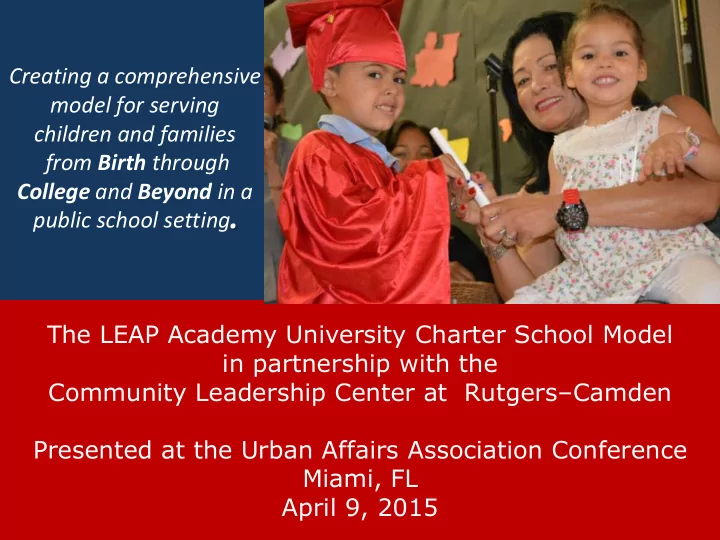
SLIDE 1 Creating a comprehensive model for serving children and families from Birth through College and Beyond in a public school setting The LEAP Academy University Charter School Model in partnership with the Community Leadership Center at Rutgers–Camden Presented at the Urban Affairs Association Conference Miami, FL April 9, 2015
SLIDE 2 Presenters
- Dr. Gloria Bonilla-Santiago
Board of Governors Distinguished Service Professor in Public Policy and Administration, Rutgers-Camden; Director of the Rutgers-Camden Community Leadership Center (CLC); Founder and Chair of LEAP Academy Charter School Wanda Garcia Associate Director of Rutgers-Camden Community Leadership Center (CLC) and PhD Student, Public Affairs and Community Development Matthew Closter PhD Student, Public Affairs and Community Development, and Graduate Assistant, Rutgers-Camden Community Leadership Center (CLC)
SLIDE 3 Case study of community transformation through a combination of elements:
- Quality Education
- Visionary Leadership
- Community Engagement
- University Partnership
SLIDE 4
VIDEO PRESENTATION
SLIDE 5 LEAP in Context
- Public charter schools drive neighborhood
revitalization, merging the urban education and community development fields
- Public charter schools foster stronger relationships
with communities by de-centralizing operations
SLIDE 6
- Schools have the ability to foster relationships
between various power structures of communities and elites, creating a path to economic security.
- Schools that partner with anchor institutions
have a major impact in neighborhood development efforts.
SLIDE 7
- Schools connect youth to adult conventional
norms and adapting them to mainstream societal and economic structures.
SLIDE 8 The Collective Mission Statement
The mission of the LEAP Academy is to enhance
- pportunities for the children and families of
Camden through the collaborative design, implementation, and integration of education, health and human services, professional development, and community development.
SLIDE 9
LEAP Historical Milestones
SLIDE 10 1997 - 1999: LEAP Academy
Elementary School. 2000 – 2003: LEAP graduates its first 8th grade class and begins a high school program. A Pre-School Program under the umbrella of the Rutgers Centers of Excellence is added to serve 90 children. 2004 – 2010 LEAP acquires a high school facility, and graduates its first 6 senior classes with 100% graduation and college placement. 60 ninth graders are recruited to participate in a STEM High School Program that will eventually serve 240 students. 2011-2015: LEAP acquires a STEM Facility and plans for new school facility in at the Wilson Building
SLIDE 11
Core Planning Areas
SLIDE 12
- understanding the needs of the community
- researching successful strategies and leveraging
expertise
- involving residents in all aspects of planning and
program design
Research and Program Design
- promoting a transformative vision to local
stakeholders and the the community
- leveraging community leadership and participation
through training and capacity building
- assembling competent and committed staff
team
Commitment Building
- collecting and analyzing baseline data about
the community
- engaging diverse stakeholders in planning
- develop a collective guiding product that
incorporates broad input and ownership
Strategic Planning
SLIDE 13
- secure funding for planning
- design multi-year resource development plan
- engage in partnerships that result in leveraged
resources
Resource Development
- design of innovative management and governance
structures
- design programs in direct response to community needs
- identify and cultivate opportunities for continued
community participation
Programming and Operations
- document the process through multiple and varied
archives
- develop formative and outcome based evaluation
mechanisms
Documentation and Evaluation
SLIDE 14 Stakeholder Analysis/Engagement
leaders
- Foudantions/Funders
- Business
- Community based and
service organizations
- Faculty and Staff
- University President
- Board of Governors
- Students
- Legislators (State and Local)
- Governor
- State and Local Officials
- Camden Board of Educuation
- Delaware River Port
Authority
SLIDE 15
- 1. Student Achievement – Comes
first
- 2. We do what ever It takes to get
the job Done.
- 3. We take the High Road
- 4. We are a Family
- 5. Positive and Caring Culture
- 6. We are all Accountable
- 7. Transparency with each other
- 8. Improvement is ongoing
- 9. Diversity is our Strength
10.We are one Team
LEAP Values
SLIDE 16
Five Core Elements of the LEAP Model
SLIDE 17
1.Accountability for People, Time, Money and Programs
SLIDE 18
- 2. Pipeline of College Access for all
students PreK- 16
SLIDE 22
SLIDE 23 A Focus on Pipeline Development The Rutgers/LEAP Pipeline to College
23
SLIDE 24
BIRTH – 16 EDUCATIONAL INVESTMENTS AND INNOVATIONS
SLIDE 25
- School based centers to channel university support for
the school. – Health and Human Services, offering primary health and social work services to families and children – Early Childhood Program offering pre-school services
SLIDE 26 – Health and Wellness Center, in partnership with the Graduate School of Nursing Rutgers-Camden – Parents Academy providing programs to strengthen the skills of families;
SLIDE 27 – Center for College Access working with students, teachers and families in ensuring college preparedness – Legal Enrichment Center offering free legal services and educational programming to families; applied research, academic training, and experiential learning for law school and LEAP students
SLIDE 28 Enrollment Profile of the Birth-12th Pipeline
- 1,700 students Birth through 12th
- LEAP Academy
– Lower Elementary Campus (K-3) – Upper Elementary (4-6) – Intermediate High School (7-9) – High School (10-12)
- Early Learning Research Academy
– Infants (6 months - 1 year) – Toddlers (age 1-3 ) – Preschoolers (ages 3-4)
SLIDE 29
Factors of LEAP Model
SLIDE 30
Family Engagement
SLIDE 31 Core Elements of LEAP’s Family Engagement Framework
SLIDE 32
LEAP Principles for Family Engagement
SLIDE 33
IMPACT
SLIDE 34
- 100% in 2005
- 100% in 2006
- 100% in 2007
- 100% in 2008
- 100% in 2009
- 100% in 2010
- 100% in 2011
- 100% in 2012
- 100% in 2013
- 100% in 2014
- 100% in 2015
SLIDE 35 Comparative High School Graduation Rates for LEAP and Surrounding High Schools (2012-2013)
100% 91.21 97% 98% 87% 94% 45% 55% 83%
0% 10% 20% 30% 40% 50% 60% 70% 80% 90% 100% High School Graduation Rates 2012-2013 LEAP Cherry Hill West Haddonfield Cherry Hill East Collingswood Voorhees Camden High Woodrow Wilson State Average
SLIDE 36
Transforming Cooper Street and the Educational Corridor
SLIDE 37 (PK-6): 639 Cooper Street
SLIDE 38 (7-12): 549 Cooper Street
SLIDE 39 528 Cooper Street
SLIDE 40 501 Cooper Street
SLIDE 41 130 North Broadway, Camden
SLIDE 42 SCHOOLS AS NEXUS FOR COMMUNITY DEVELOPMENT
SLIDE 43 Theory of Action
SLIDE 44 Strong Early Childhood Programs High Performing Schools Effective K-12 programs Higher high school graduation rates Successful transitions from high school to college/career Academic enrichment programs Social, recreation and character building for children and youth Quality health services Social service programs Adult learning opportunities and Job readiness training Neighborhood based employment opportunities Legal services Safe schools and neighborhoods Business development Crime prevention Local/community based leadership development Better housing options and support for residents Community Building and Ownership Interagency Collaboration
Better outcomes for children and youth
Children & Youth
Better outcomes for the community
Community
Better outcomes for families
Families
Logic Model of Outcomes
SLIDE 45 Challenges to University Engagement
- Change of Community Perception of
Unresponsiveness (Out of touch/Out of date) to one that is responsive and caring about Community
- Lack of alignment between disciplines and society’s
problems
SLIDE 46
- Institutional Disconnect with the present and future
- Going beyond Outreach and Service as means for
engagement
SLIDE 47 New Community Practices for University Engagement –Responsiveness and Respect –Transforming Climate and Culture of our Institutions –Academic Neutrality and Objectivity
SLIDE 48 –Institutional Integration and Incentives –Institutional Integration and Incentives –Resource /Multiple Partners –Multi-disciplinary Approaches
SLIDE 49 –Creating new knowledge from practice into academia –Sense of urgency for college readiness, equity and achievement
SLIDE 50
Lessons Learned from our Applied Work
SLIDE 51
comprehensive approach, with intentional alignment across institutions and contexts (e.g. family, school, the broader community), instead of piecemeal, uncoordinated efforts;
- Participation by diverse partners instead of
single-sector initiatives;
SLIDE 52
- A focus on geographically
defined areas instead of being too broad in scope;
- A governance structure that includes a lead
- rganization to drive the effort instead of a
leaderless coalition;
- Active engagement by residents instead of
purely top-down decisions;
SLIDE 53
- Cross fertilization between
students and faculty to engage in research, service learning and community development;
- An asset-based approach that builds on existing
resources and strengths rather than considering communities as deficits to be remediated; and
SLIDE 54
- Flexible, non-categorical funding from diverse
sources instead of restricted funds that constrain nimble actions