Created by: Denice Drenth, Danille Pijpker, Deniece Kouseband, Giel - - PowerPoint PPT Presentation

created by
SMART_READER_LITE
LIVE PREVIEW

Created by: Denice Drenth, Danille Pijpker, Deniece Kouseband, Giel - - PowerPoint PPT Presentation

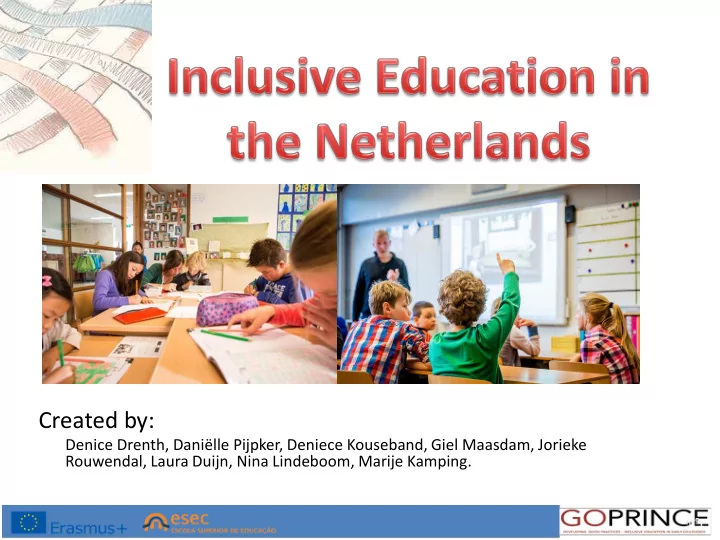
Created by: Denice Drenth, Danille Pijpker, Deniece Kouseband, Giel Maasdam, Jorieke Rouwendal, Laura Duijn, Nina Lindeboom, Marije Kamping. 1 Inclusive Education Education system Preschool Primary school group 1&2 (age

slide-1
SLIDE 1

Created by:

Denice Drenth, Daniëlle Pijpker, Deniece Kouseband, Giel Maasdam, Jorieke Rouwendal, Laura Duijn, Nina Lindeboom, Marije Kamping.

1

slide-2
SLIDE 2

Inclusive Education  Education system Preschool Primary school group 1&2 (age 4-6) Primary school group 3/4/5 (age 6-9) Primary school group 6/7/8 (age 10-12) Cluster schools Our education system Movie

2

slide-3
SLIDE 3

Website of the Dutch government: the premise of Inclusive Education: ‘All pupils should get a place at a school that suits their qualities and possibilities’ Main goal: ‘to challenge each child to get the best

  • ut of themselves’
slide-4
SLIDE 4

Five goals that the Government wants to achieve:

  • 1. All pupils -> appropriate place in education.
  • 2. Regular school or school for special education.
  • 3. Schools -> more opportunities for customizes

support.

  • 4. Possibilities and educational needs of child

decisive.

  • 5. Children -> not stuck at home long-term.
slide-5
SLIDE 5

Duty of care: three possibilities:

  • 1. Offer on private school.
  • 2. Offer on another regular school.
  • 3. Offer at school for special education.

Next sheets: apply Inclusive Education in primary schools.

5

slide-6
SLIDE 6

6

slide-7
SLIDE 7

Childcare

 Children aged 0 – 4 years  Groups of 16 children  Working parents

Playgroup

 Children aged 2 – 4 years  1 to 4 day parts a week  Goal is to let children play not raise

7

slide-8
SLIDE 8

Preschool education

Pre school education for children with a lower level or a language delay Children 2 – 6 years Special methods: Piramide, Kaleidescoop

8

slide-9
SLIDE 9

9

For children age 0 to 7 years  Developmental problems A team of different experts examines and treats the child Different help for each child

slide-10
SLIDE 10

Kindergarten

May go to school at the age of 4 Must go to school at the age of 5 Grade 1/2 – groep 1/2 Playful learning

slide-11
SLIDE 11

Circle

Singing Dailey programme Reading Theme learning

  • Math
  • Vocabulary
slide-12
SLIDE 12

Corners

Housing corner Building corner Painting corner Computer corner Theme corner

slide-13
SLIDE 13

Learning the Alphabet

At least 20 letters Recognizing and using verbal

slide-14
SLIDE 14

Inclusive education kindergarten

Parents can choose which school they prefer.

  • Regular education
  • Special education

The school needs to make a schedule for the individual student.

slide-15
SLIDE 15

Method: Piramide

Extra exercises and a individual workbook. From the arrear child to the gifted ones.

slide-16
SLIDE 16

A regular school day in the Netherlands;

school starts at 8:30 AM and ends at 15:15 AM. At Wednesday and Friday school ends at 12:15 AM. At 10:00 AM children have a short “fruit” break and play outside for a while. 12:00 – 13:00 AM children go home to eat bread.

16

slide-17
SLIDE 17

Learning the basic skills:

Read Write Spell Count

slide-18
SLIDE 18

All pupils work towards the same core objectives, some will need extra help. For example this children need extra help: Childeren with an extreme lower

  • r higher intelligence level

Children with autism Children with ADHD Children with down syndrome

18

slide-19
SLIDE 19

What help can be provided for example Help with reading or counting Help with speaking; speech therapist

19

slide-20
SLIDE 20

Subjects Math 123 Reading Dutch language ABC The man |is |going |to | the supermarket.

20

slide-21
SLIDE 21

Subjects:

Geography History Nature English language  Religion  Traffic  First aid

21

slide-22
SLIDE 22

The teacher makes together whit the extra help and his/her class possible for disabled children to study like normal children

22

slide-23
SLIDE 23

And get the extra help they need

23

slide-24
SLIDE 24

For children with disabilities, chronic illness or disorder. More attention and support.  Because: the school has smaller groups and more experts.

Regular eduction Special eduction

slide-25
SLIDE 25

Cluster 1: blind, visually impaired children. Cluster 2: deaf, hearing-impaired children.

  • communication problems
  • Autism

Cluster 3: disabled and chronically ill children.

  • long-term sick
  • Epilepsy

Cluster 4: children with behavioral disorders and problems.

slide-26
SLIDE 26

26

slide-27
SLIDE 27
  • Motor or fysical

disabilities

  • Sensory

disability

  • Chronic disease
  • ADHD
  • Dyslexia
  • Autism

27

  • Students dean
  • Adapted study

program

  • Extra examtime
  • Financial

measures

  • Wheelchair

facilities

slide-28
SLIDE 28

28