
SLIDE 1
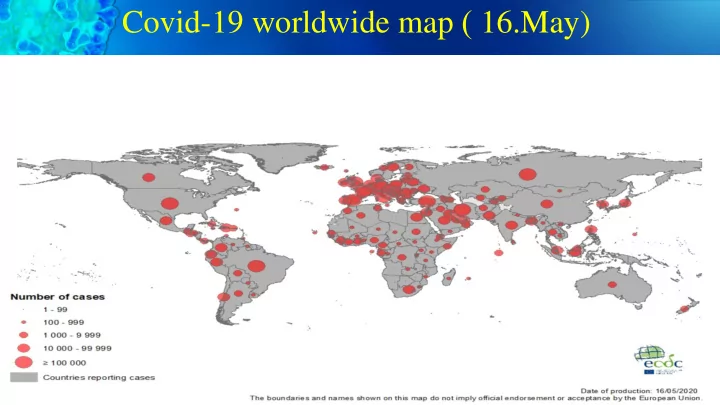
Covid-19 worldwide map ) 16.May) What is Convalescent Blood Products - - PowerPoint PPT Presentation
Covid-19 worldwide map ) 16.May) What is Convalescent Blood Products therapy Convalescent blood products (CBP) ,obtained by collecting whole blood or plasma from a patient who has survived a previous infection and developed humoral immunity
plasma from a patient who has survived a previous infection and developed humoral immunity against the pathogen responsible for the disease.
leads to its eradication from the blood circulation through administering pathogen-specific antibodies.
immunity :
Convalescent whole blood (CWB Convalescent plasma (CP) Convalescent serum (CS) Pooled human immunoglobulin(Ig) High-titer human Ig Polyclonal or monoclonal antibodies
Passive immunization is the only short term strategy to confer immediate immunity to susceptible individuals
Spanish Flu A (H1N1) Avian influenz (H5N1) Pandemiic influenza A 2009 (H1N1 pdm09) SARS Coronavirus (SARS-Cov-1), MERSCoronavirus
respiratory syndrome coronavirus-2 (SARS-CoV-2).
RESULTS: The mean (±SD) age of the patients was 64±18 years, 63% were men, Symptoms began 7±4 days before admission. The most common symptoms were cough and shortness of breath; 50% of patients had fever on admission, 58% had diabetes mellitus. All the patients were admitted for hypoxemic respiratory failure; 75% needed mechanical ventilation. Most of the patients (17) also had hypotension and needed vasopressors.
New England Journal , March 2020
50 % Mortality
from March -April ,2020.
parameters. Result:
discharged.
Conclusion:
The data indicate that administration of convalescent plasma is a safe treatment option for those with severe COVID-19
Analyzed key safety metrics after transfusion of ABO-compatible human COVID-19 convalescent plasma in 5,000 hospitalized adults with severe or life-threatening COVID-19, with 66% in the intensive care unit, as part of the US FDA Expanded Access Program for COVID-19 convalescent plasma. Results: The incidence of all serious adverse events (SAEs) in the first four hours after transfusion was <1%, including mortality rate (0.3%). Of the 36 reported SAEs, there were 25 reported incidences of related SAEs, including mortality (n=4), transfusion- associated circulatory overload (TACO; n=7), transfusion-related acute lung injury (TRALI; n=11), and severe allergic transfusion reactions (n=3). However, only 2 (of 36) SAEs were judged as definitely related to the convalescent plasma transfusion by the treating
Conclusion: Given the deadly nature of COVID-19 and the large population of critically- ill patients included in these analyses, the mortality rate does not appear excessive.
These early indicators suggest that transfusion of convalescent plasma is safe in hospitalized patients with COVID-19.
March 24, 2020, FDA approve convalescent plasma in exposed individuals not yet infected, in those with mild to moderate disease, and in those severely ill as IND. April 3rd ,2020 the FDA Approved use of CP in very sick patients and patients at high risk of becoming very sick .
The document outlines three pathways for access to convalescent plasma: 1: is under an emergency use investigation new drug (IND) application. This allows a provider to apply for compassionate use in an individual patient with severe or immediately life-threatening COVID-19. 2: The second is a traditional pathway to apply for an IND to support research ,clinical trials. 3: Government could provide expanded access of convalescent plasma to participating institutions under a master treatment protocol.
Evidence of COVID-19 documented by a laboratory test (nasopharyngeal swab, positive serological test for SARS-CoV-2 antibodies after recovery) Complete resolution of symptoms at least 14 days prior to donation, Or Complete resolution of symptoms at least 28 days prior to donation To prevent transfusion-related acute lung injury (TRALI) female donors with a history of pregnancy were
Donor eligibility requirements for the collection of plasma by plasmapheresis based on IBTO and FDO guidelines Negative test results for relevant transfusion-transmitted infections (HIV, HBV, HCV, RPR) Recommended but not required: Defined SARS-CoV-2 neutralizing antibody titers (IgM, IgG neutralizing antibody) (Greater than 1:80) If neutralizing antibody titers cannot be obtained in advance, consider storing a retention sample from the convalescent plasma donation for determining antibody titers at a later date)
While there are few studies to guide the use of CP for SARS-CoV-2 infection , recent studies have shown that Neutralizing Ab in the CP result in disappearing viremia and improve in oxygen saturating . There are 4 general class of potential recipients: 1- Those with critical disease , 5% of infected symptomatic individuals, who have multiorgan failure and COVID-related ARDS 2- Those with severe disease, 14% pf infected symptomatic individuals who have dyspnea , hypoxia or >50%,lung involvement on imaging 3-Those who have tested positive, 81 % of infected symptomatic patients but have mild to moderate symptoms 4- Those who are high-risk for infection post-exposure and having serious illness (such as being older or immunocompromised) as prophylactic measure.
Patient selection based on inclusion criteria by Physician Filling out of Consent Form for receive Convalescent Plasma by Patients or Family Plasma Request Form to Blood Bank of Hospital by Physician Deliver of released Convalescent Plasma and Matched blood Group to Physician Transfusion of 1 unit (500 CC) plasma within 4 hrs. And start data collection (lab data, Imaging study,,,,,,) in two groups (Cases & Controls) by physician In case of unsatisfactory response based on physician decision second unit will be transfused to patient And follow up till discharge
All recorded data transferred to Researchers After hospital discharge on weekly basis patients will follow up for 1 month
Eligible Donors calls for plasma donation: COVID-19 treated patients that their disease was confirmed by the qRT- PCR Two weeks after discharge from hospitalization and both the clinical sign and laboratory tests were improved completely. Qualified Nurse interview with the donor and she/he complete the forms (disease hix,….) Qualified Physician examine the donors After Physician confirmation specific blood/samples for HIV,HBV,HCV, RPR, Blood Group taken from donors Donors donate plasma #500 CC Plasma Units transferred to -30 °C cooling chambers Samples transferred to Virology Lab
After Lab confirmation regarding Negative results the plasma released Released Plasma stored at Hospital Blood Bank
we request from external lab to do that (Specification shown in next slide)
COVID-19 IgM, COVID-19 IgG, HBs Ag, HIV Ab, HCV Ab, RPR, SGOT and Total Protein. The qRT-PCR was performed on the collected CP to make sure that the samples are free from COVID-19 virus. The all of plasmas negative COVID-19 and No viremia in plasmas Blood group : (A) 34.6%,( B) 25%, (O)34.7% and (AB) 5.7% Specific antibodies against COVID-19 were evaluated by the semi-quantitative ELISA and Rapid Strip Test IgG 98% Pos, IgM 75% Pos
Dr Abolghasemi Dr cheraghali Dr eshghi Dr imani fooladi
and requiring mechanical ventilation or other forms of supported oxygenation
Age (Yrs.) 51 ± 13.4 (range 25-85) Sex (No.; %) M (36; 72%); F (14; 28%) Blood Group (type; %) O (36%); B (32%); A (12%); AB (8%)
Clinical parameter Mean ± SD; (Range) BPs BPd 126 ± 19.2 (90-196) 75 ±10.7 (50-99) SpO2 80.6 ± 9.7 (53-92) Respiratory rate 23 ± 5.7 (16-40) No.(%) of patients with Comorbidity Yes: 32 (64%) No: 18 (36%) No.(%) of patients with Tachypnea Yes: 37 (74%) No: 13 (26%) Mechanical Ventilation (on day of plasma transfusion) Yes: 21 (42%) No: 29 (58%)
Average baseline clinical parameters of patients on their admission to the hospital and following infusion of convalescent plasma Clinical parameter On admission (Mean ± SD) (range) Post plasma (Mean ± SD) (range) Body temperature 36.9 ± 0.6 (35.7- 39.5) 37.0 ± 0.5 (36.0- 38.8) @ 12 hrs. 36.9 ± 0.6 (35.6- 38.2) @ 84 hrs. CT Scan abnormality score 19 ± 4 (8-25) 13 ± 6 (2-25) SOFA score 3 ± 4 (0-9) 5 ± 3 (0-11) @ 1 day
Average baseline para clinical parameters of patients on their admission to the hospital and following infusion of convalescent plasma
Clinical lab parameter On admission Mean (SD)/Median (IQR) Post plasma Mean (SD)/Median (IQR) Lymphocytes 900.4 ± 683.6 1009 ± 683.6 CRP 21.1 (13.8-31.9) 11.6 (8.6-29.4) Cr. 1 (0.8-1.2) 0.9 (0.7-1.2) LDH 820 (105-652) 1028 (801- 2092)
Final outcome of patients received convalescent plasma who received plasma < 7 days post admission (Total Number of patients: 34) Event @ 14 days post plasma
@ 30 days post plasma
Alive 28 (82%) 25 (74%) Death 6 (18%) 9 (26%)
Final outcome of patients received convalescent plasma who received plasma > 7 days post admission (Total Number of patients: 16) Event @ 14 days post plasma
@ 30 days post plasma
Alive 8 (50%) 7 (44%) Death 8 (50%) 9 (56%)
before 7 days of patients admission
will reduce its efficacy
Collaboration with Local Test KIT producer company and they finally provide an Iranian Test Kit for rapid diagnose of Covid-19 infected patents Collaboration with local pharmaceutical company to provide specific Covid-19 IgG
Case 1: two axial lung CT scan without contrast in a 39 year old male before plasma therapy shows diffuse ground glass and consolidative opacities in both lungs field compatible with sever covid-19 pneumonia(A) and 18 day later dramatic response to treatment and complete resolution of opacities after treatment (B)
Case 2: two axial lung CT scan without contrast in a 63 year old female before plasma therapy shows diffuse ground glass and consolidative opacities and bilateral pleural effusion compatible with sever covid-19 pneumonia(A) and 7 day later dramatic response to treatment with very faint residual ground opacities on after treatment (B)
Case 3: two axial lung CT scan without contrast in a 25 year old male before plasma therapy shows patchy ground glass opacities (GGO) in left lung and diffuse consolidative opacities in right lung field compatible with sever covid-19 pneumonia(A) and 15 day later dramatic response to treatment and complete resolution of
Case 4: two axial lung CT scan without contrast in a 26 year old female before plasma therapy shows diffuse ground glass and consolidative opacities in both lungs field compatible with sever covid-19 pneumonia(A) and 12 day later dramatic response to treatment and nearly complete resolution of opacities after treatment with very faint residual GGO (B)
Case 5: two axial lung CT scan without contrast in a 44 year old male before plasma therapy shows large area
significant response to treatment with small residual consolidative and linear opacities after treatment (B)
Serious ADR occurred
Reach to the point where plasma supply become more than demand, because the demand would be uncertain Perform Ab test for all donors to ensure that all have high titer of neutralizing Ab Optimizing final product (what Ab, IgG ,neutralizing or what protein, what level
surplus plasma. Need more clinical data