Coverage Expansions and the Remaining Uninsured: A Look at California - - PDF document

coverage expansions and the remaining uninsured
SMART_READER_LITE
LIVE PREVIEW

Coverage Expansions and the Remaining Uninsured: A Look at California - - PDF document

5/28/2015 Coverage Expansions and the Remaining Uninsured: A Look at California During Year One of ACA Implementation Rachel Garfield Kaiser Family Foundation May 28, 2015 Figure 1 Project Overview: Kaiser Survey of Low Income Americans and the


slide-1
SLIDE 1

5/28/2015 1

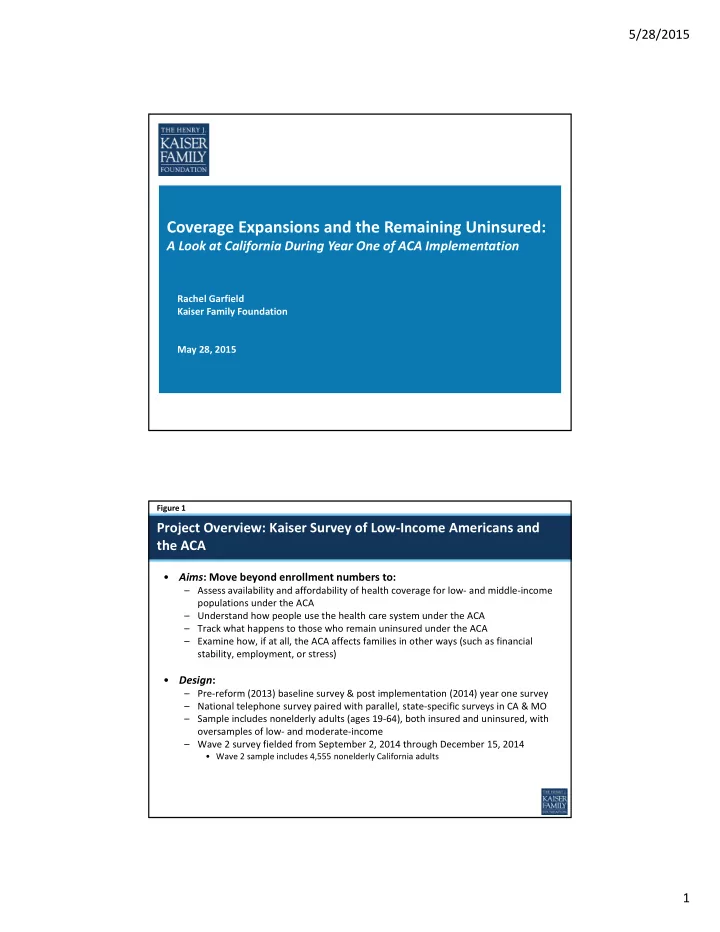
Coverage Expansions and the Remaining Uninsured:

A Look at California During Year One of ACA Implementation

Rachel Garfield Kaiser Family Foundation May 28, 2015

Figure 1

  • Aims: Move beyond enrollment numbers to:

– Assess availability and affordability of health coverage for low‐ and middle‐income populations under the ACA – Understand how people use the health care system under the ACA – Track what happens to those who remain uninsured under the ACA – Examine how, if at all, the ACA affects families in other ways (such as financial stability, employment, or stress)

  • Design:

– Pre‐reform (2013) baseline survey & post implementation (2014) year one survey – National telephone survey paired with parallel, state‐specific surveys in CA & MO – Sample includes nonelderly adults (ages 19‐64), both insured and uninsured, with

  • versamples of low‐ and moderate‐income

– Wave 2 survey fielded from September 2, 2014 through December 15, 2014

  • Wave 2 sample includes 4,555 nonelderly California adults

Project Overview: Kaiser Survey of Low‐Income Americans and the ACA

slide-2
SLIDE 2

5/28/2015 2

Figure 2

  • Early start on coverage expansions through Bridge

to Reform Medicaid waiver (2010‐2015)

  • Full expansion of Medi‐Cal and coverage through

Covered California as of January 2014

  • Single, on‐line portal for both Medi‐Cal and

Covered California enrollment

  • Heavy investment in outreach and enrollment
  • Year 1 website and enrollment “glitches”
  • Unexpected large enrollment numbers
  • 1.7M determined eligible for Covered California plan
  • Medi‐Cal enrollment grew by 2.8M

Overview of ACA Implementation in California

Figure 3 Uninsured Newly Insured

NOTES: Includes adults ages 19‐64. “Newly Insured” include people who were insured as of interview date and gained coverage since January

  • 2014. “Uninsured” includes people who lacked coverage as of the interview date. Those who refused or did not know answers to work status

questions not shown. * Significantly different from Uninsured at the p<0.05 level. SOURCE: 2014 Kaiser Survey of Low‐Income Americans and the ACA.

Characteristics of Nonelderly Adults in California, by Insurance Coverage in Fall 2014

No worker 26% No worker 33% Part‐ time worker 22% Part‐ time worker 24% Full‐ time worker 52% Full‐ time worker 43%*

Family Work Status

Uninsured Newly Insured

Race/Ethnicity

Hispanic 54% Hispanic 41%* White 19% White 33%* Other 27% Other 26%

Uninsured Newly Insured

Gender

Female 41% Female 56%* Male 59% Male 44%*

slide-3
SLIDE 3

5/28/2015 3

Figure 4 37% 17% 21% 15% 30% 23% 33%* 30%* 20%* 11%* 36%* 44%* Fair to Poor Overall Health Fair to Poor Mental Health Has Ongoing Condition Taking a Prescription^

Uninsured Newly Insured Previously Insured

NOTE: Includes adults ages 19‐64. “Previously Insured” includes people who were insured as of interview date and have been insured since before January 2014. “Newly Insured” include people who were insured as of interview date and gained coverage since January 2014. “Uninsured” includes people who lacked coverage as of the interview date. ^Does not include birth control. * Significantly different from Uninsured at the p<0.05 level. SOURCE: 2014 Kaiser Survey of Low‐Income Americans and the ACA.

Health Status Among Nonelderly Adults in California, by Insurance Coverage in Fall 2014

Figure 5 14% 19% 8% Uninsured Newly Insured Previously Insured

NOTES: Includes adults ages 19‐64. “Previously Insured” includes people who were insured as of interview date and have been insured since before January 2014. “Newly Insured” include people who were insured as of interview date and gained coverage since January 2014. “Uninsured” includes people who lacked coverage as of the interview date. *Significantly different from Uninsured at the p<0.05 level. SOURCE: 2014 Kaiser Survey of Low‐Income Americans and the ACA.

Change in and Site of Usual Source of Care Among Nonelderly Adults in California, by Insurance Coverage in Fall 2014

Among those with a usual source of care, share who changed where go for regular care:

60% 47%* 22%* 26% 35% 64%* 15% 18% 14%

Uninsured Newly Insured Previously Insured Clinic or Health Center Doctor's Office or HMO Other Among those with a usual source of care, share who go to:

slide-4
SLIDE 4

5/28/2015 4

Figure 6 35% 24% 8% 12% 35% 20% 11% 18% 29%* 12%* 7% 15% Postponed or went without care Never got needed care Provider would not accept you as a new patient Had to wait longer than reasonable for an appointment Uninsured Newly insured Previously Insured

NOTES: Includes adults ages 19‐64. “Previously Insured” includes people who were insured as of interview date and have been insured since before January 2014. “Newly Insured” include people who were insured as of interview date and gained coverage since January 2014. “Uninsured” includes people who lacked coverage as of the interview date. *Significantly different from Uninsured at the p<0.05 level. SOURCE: 2014 Kaiser Survey of Low‐Income Americans and the ACA.

Problems Getting Care Among Nonelderly Adults in California, by Insurance Coverage in Fall 2014

Share reporting:

Figure 7 64% 75% 26% 40%* 65%* 17%* 47% 20%* 36%* 12%* 27%* Not Confident Can Afford Usual Medical Costs Not Confident Can Afford Major Medical Costs Any problem paying medical bills Difficult to Afford Monthly Premium Uninsured Newly Insured Previously Insured

NOTE: Includes adults ages 19‐64. “Previously Insured” includes people who were insured as of interview date and have been insured since before January 2014. “Newly Insured” include people who were insured as of interview date and gained coverage since January 2014. “Uninsured” includes people who lacked coverage as of the interview date. * Significantly different Uninsured at the p<0.05 level. SOURCE: 2014 Kaiser Survey of Low‐Income Americans and the ACA.

Financial Problems due to Medical Costs Among Nonelderly Adults in California, by Insurance Coverage in Fall 2014

N/A

slide-5
SLIDE 5

5/28/2015 5

Figure 8 Don't need it, 10% Immigration Status, 10% Opposed to the ACA/Prefer to pay penalty, 3% Don't know how to get it, 5% Told they were ineligible, 8% Unemployed/Work doesn't offer/Not eligible at work, 5% Don't know/ refused , 5% Other reason, 11% Too expensive, 44%

Reasons for Being Uninsured Among Uninsured Nonelderly Adults in California, Fall 2014

NOTE: Includes uninsured adults ages 19‐64. SOURCE: 2014 Kaiser Survey of Low‐Income Americans and the ACA.

When asked in their own words, the remaining uninsured said that the main reason they were without insurance was… Figure 9

Conclusions and Policy Implications

  • 1. Coverage expansions reached many who have historically been left out of the public and

private insurance systems.

  • Ongoing community outreach, particularly to the Hispanic population, may further

extend coverage gains.

  • 2. Uninsured adults in the state continue to face barriers to needed care.
  • Clinics and health centers serve a vital role in meeting the needs of this population

and will require ongoing support to continue to do so.

  • 3. Cost continues to prevent many uninsured adults from seeking or gaining coverage.
  • While coverage provides financial protection once insured, many newly insured

adults are still in precarious financial positions and face affordability challenges.

  • 4. Newly insured adults report improved access to care, but continued attention is needed

to ensure those who have coverage are able to access care.