Cost and Coverage Implications of the ACA Medicaid Expansion: - - PDF document

cost and coverage implications of the aca medicaid
SMART_READER_LITE
LIVE PREVIEW

Cost and Coverage Implications of the ACA Medicaid Expansion: - - PDF document

Cost and Coverage Implications of the ACA Medicaid Expansion: National and State by State Analysis Report Authors: John Holahan, Matthew Buettgens, Caitlin Carroll, and Stan Dorn Urban Institute November 26, 2012 FIGURE 1 Objectives of the


slide-1
SLIDE 1

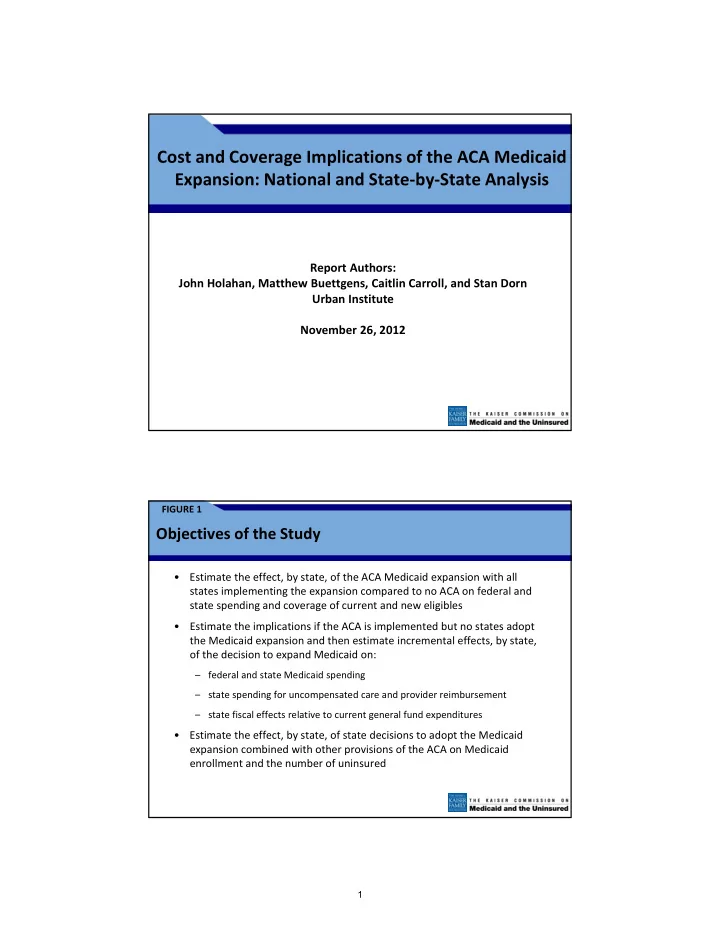
Cost and Coverage Implications of the ACA Medicaid Expansion: National and State‐by‐State Analysis

Report Authors: John Holahan, Matthew Buettgens, Caitlin Carroll, and Stan Dorn Urban Institute November 26, 2012

FIGURE 1

Objectives of the Study

  • Estimate the effect, by state, of the ACA Medicaid expansion with all

states implementing the expansion compared to no ACA on federal and state spending and coverage of current and new eligibles

  • Estimate the implications if the ACA is implemented but no states adopt

the Medicaid expansion and then estimate incremental effects, by state,

  • f the decision to expand Medicaid on:

– federal and state Medicaid spending – state spending for uncompensated care and provider reimbursement – state fiscal effects relative to current general fund expenditures

  • Estimate the effect, by state, of state decisions to adopt the Medicaid

expansion combined with other provisions of the ACA on Medicaid enrollment and the number of uninsured

1

slide-2
SLIDE 2

FIGURE 2

Methods

  • Develop a pre‐ACA baseline for each state, based on CBO projections and state

expenditure data

  • Estimate the ACA’s state‐by‐state impact with no state expanding Medicaid and with all

states expanding Medicaid, using the Urban Institute Health Insurance Policy Simulation Model (HIPSM) ; the model incorporates pre‐ACA eligibility rules for each state – Participation rates result from model estimates of individual behavior and are consistent with published research – Cost of coverage depends on individual characteristics such as health status, previous characteristics and state; overall estimates of federal expenditures are close to CBO’s

  • Federal matching rates depend on ACA provisions: standard FMAP for new enrollment

among current eligibles, higher ACA rates for new eligibles and higher match rate for CHIP eligibles

  • We estimate savings to states with limited benefit programs whose recipients become

new eligibles and states with prior expansion programs that receive enhanced matching rates FIGURE 3

State Estimates will Vary Due to Limitations in this Study

  • While HIPSM uses two years of Current Population Survey data,

sample sizes can be somewhat small in some states

  • Several sources of savings to states cannot be estimated with 50‐state

data:

– Savings from no longer covering certain adults with incomes above 138% of the federal poverty line (FPL), who could be moved from Medicaid into exchange – Savings on certain adults with incomes at or below 138% of the FPL, such as the medically needy, who could now be covered as new eligibles, with higher federal matching payments – Savings on non‐Medicaid health care (e.g., state mental health) for the uninsured who newly qualify for Medicaid – Additional state revenue that results from, e.g., the effect of new federal expenditures on the state economy

2

slide-3
SLIDE 3

FIGURE 4

Total State and Federal Medicaid Spending Under ACA with All States Expanding Medicaid, 2013‐2022

Note: Individual components may not sum to totals due to rounding. Source: Urban Institute estimates prepared for the Kaiser Commission on Medicaid and the Uninsured, October 2012.

Total Medicaid Spending Over the Decade: $7,368 Billion

Total New Medicaid Spending under ACA: $1,029 Billion New State Spending under ACA $76 New Federal Spending under ACA $952 Baseline Federal Spending, No ACA $3,659 Baseline State Spending, No ACA $2,680

$ in billions: FIGURE 5

New State and Federal Medicaid Expenditures under ACA, with All States and No States Expanding Medicaid, 2013‐2022

Source: Urban Institute estimates prepared for the Kaiser Commission on Medicaid and the Uninsured, October 2012.

$ in billions:

$76 $68 $8 $952 $152 $800 ACA with All States Expanding Medicaid ACA with No States Expanding Medicaid Incremental Impact of Medicaid Expansion

State Federal

3

slide-4
SLIDE 4

FIGURE 6

$26.5 $221.5 $50.0 $730.9 $76.5 $952.5

New Federal and State Spending on Current and New Eligibles Under the ACA with All States Expanding Medicaid, 2013‐2022

Source: Urban Institute estimates prepared for the Kaiser Commission on Medicaid and the Uninsured, October 2012.

Current New Total Total = $248.0 billion Total = $780.9 billion Total = $1,028.9 billion State Federal FIGURE 7

Impact of the Incremental Adoption of the Medicaid Expansion on Federal and State Expenditures, 2013‐ 2022

21.0% 11.1% 14.6% 34.5% 26.2% 26.2%

0.3% ‐4.6% ‐4.2% 4.5% 4.6% 3.5%

12.3% 3.8% 5.7% 23.3% 19.8% 17.5%

Federal State Total U.S.

New England Middle Atlantic South Atlantic East South Central West South Central

SOURCE: Urban Institute estimates prepared for the Kaiser Commission on Medicaid and the Uninsured, October 2012. NOTE: Selected Regions Displayed: The New England region includes CT, ME, MA, NH, RI, and

  • VT. The Middle Atlantic region includes DE, DC, MD, NJ, NY, and PA. The South Atlantic region includes FL, GA,

NC, SC, VA, and WV. The East South Central region includes AL, KY, MS, and TN. The West South Central region includes AR, LA, OK and TX.

4

slide-5
SLIDE 5

FIGURE 8

Change in State Medicaid Expenditures Under the ACA With All States Expanding Compared to No States Expanding Medicaid, 2013‐2022

Source: Urban Institute estimates prepared for the Kaiser Commission on Medicaid and the Uninsured, October 2012. >2% to 4% (17 states) >0% to 2% (12 states, including DC) >4% to 7% (12 states) ‐11% to 0% (10 states) WY WI WV WA VA VT UT TX TN SD SC RI PA OR OK OH ND NC NY NM NJ NH NV NE MT MO MS MN MI MA MD ME LA KY KS IA IN IL ID HI GA FL DC DE CT CO CA AR AZ AK AL

US Total: 0.3% FIGURE 9

Net State Fiscal Impact of Medicaid Expansion, Including State Savings in Uncompensated Care Costs, 2013‐2022

Source: Urban Institute estimates prepared for the Kaiser Commission on Medicaid and the Uninsured, October 2012.

$8,238 ‐$18,310 ‐$10,072 Incremental Change in Medicaid Spending Due to Expansion Change in State Spending on Uncompensated Care Due to Expansion Net Change in State Spending Due to Expansion

$ in millions:

5

slide-6
SLIDE 6

FIGURE 10

0.3% ‐4.6% ‐4.2% 4.5% 4.6% 3.5% ‐0.4% ‐4.8% ‐4.4% 3.1% 2.9% 2.5%

Change in State Medicaid Expenditures Change in State Expenditures on Medicaid and Uncompensated Care Combined

Impact of the Incremental Adoption of the Medicaid Expansion on State Expenditures, 2013‐ 2022

U.S.

New England Middle Atlantic South Atlantic East South Central West South Central

SOURCE: Urban Institute estimates prepared for the Kaiser Commission on Medicaid and the Uninsured, October 2012. NOTE: Selected Regions Displayed: The New England region includes CT, ME, MA, NH, RI, and

  • VT. The Middle Atlantic region includes DE, DC, MD, NJ, NY, and PA. The South Atlantic region includes FL, GA,

NC, SC, VA, and WV. The East South Central region includes AL, KY, MS, and TN. The West South Central region includes AR, LA, OK and TX.

FIGURE 11

0.1% ‐1.1% ‐1.8% 1.2% 1.2% 1.1% ‐0.1% ‐1.2% ‐1.9% 0.8% 0.8% 0.8%

State Medicaid Expenditure Net State Expenditure

Incremental Impact of the Medicaid Expansion on State Medicaid Expenditures Relative to General Fund Expenditures, 2013 ‐2022

U.S.

New England Middle Atlantic South Atlantic East South Central West South Central

SOURCE: Urban Institute estimates prepared for the Kaiser Commission on Medicaid and the Uninsured, October 2012. NOTE: Selected Regions Displayed: The New England region includes CT, ME, MA, NH, RI, and

  • VT. The Middle Atlantic region includes DE, DC, MD, NJ, NY, and PA. The South Atlantic region includes FL, GA,

NC, SC, VA, and WV. The East South Central region includes AL, KY, MS, and TN. The West South Central region includes AR, LA, OK and TX.

6

slide-7
SLIDE 7

FIGURE 12

Medicaid Enrollment Under ACA With and Without Medicaid Expansion, 2022

Source: Urban Institute estimates prepared for the Kaiser Commission on Medicaid and the Uninsured, October 2012.

52.4 52.4 52.4 5.7 21.3 No ACA Baseline ACA with No States Expanding Medicaid ACA with All States Expanding Medicaid

No ACA Baseline Medicaid Enrollment New Medicaid Enrollment

FIGURE 13

Number of Uninsured With and Without ACA and Medicaid Expansion, 2022

53.3 38.2 28.0 15.1 25.3 No ACA Baseline ACA with No States Expanding Medicaid ACA with All States Expanding Medicaid Number of Uninsured Reduction in Uninsured

Source: Urban Institute estimates prepared for the Kaiser Commission on Medicaid and the Uninsured, October 2012.

28% reduction in # uninsured 48% reduction in # uninsured 7

slide-8
SLIDE 8

FIGURE 14

Percentage Reduction in Uninsured Under the ACA With All States Expanding and No States Expanding Medicaid, 2022

U.S.

New England Middle Atlantic South Atlantic East South Central West South Central

28.3% 23.7% 28.4% 29.1% 30.9% 34.0% 47.6% 39.5% 41.5% 51.4% 58.3% 52.9%

No States Expand Medicaid All States Expand Medicaid

SOURCE: Urban Institute estimates prepared for the Kaiser Commission on Medicaid and the Uninsured, October 2012. NOTE: Selected Regions Displayed: The New England region includes CT, ME, MA, NH, RI, and

  • VT. The Middle Atlantic region includes DE, DC, MD, NJ, NY, and PA. The South Atlantic region includes FL, GA,

NC, SC, VA, and WV. The East South Central region includes AL, KY, MS, and TN. The West South Central region includes AR, LA, OK and TX.

FIGURE 15

Summary

  • If all states implement the ACA Medicaid expansion, the federal

government will fund the vast majority of the increased Medicaid costs.

  • If all states implement the expansion, gains in Medicaid coverage would

substantially reduce the number of uninsured

  • Due to other provisions in the ACA, states will face increased enrollment

and spending even if they do not implement the Medicaid expansion

  • The additional state cost of implementing the Medicaid expansion is small

relative to total state spending without the expansion and relative to large increases in federal funding

  • Accounting for reductions in spending on uncompensated care, states as a

whole are likely to see net savings from the Medicaid expansion

  • States may be able to achieve other savings that could not be accounted

for in this report using 50 state data

8