
SLIDE 1
1/14/2013 1
The Medicaid Expansion: State Options & Considerations
Presentation to
Montana Legislature January 14, 2013
2
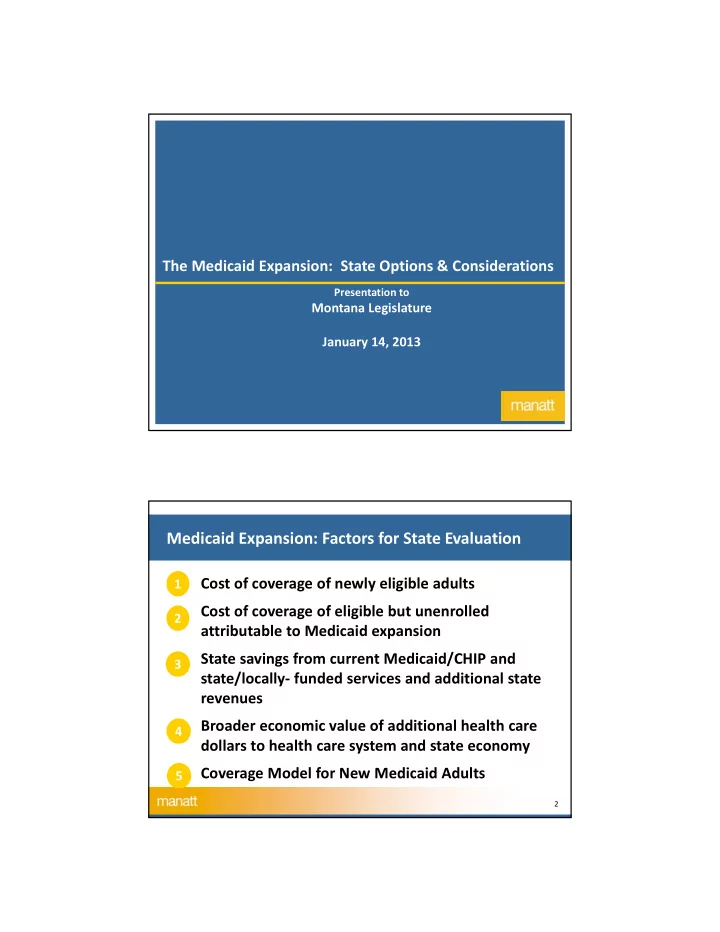
Medicaid Expansion: Factors for State Evaluation Cost of coverage of - - PDF document
1/14/2013 The Medicaid Expansion: State Options & Considerations Presentation to Montana Legislature January 14, 2013 Medicaid Expansion: Factors for State Evaluation Cost of coverage of newly eligible adults 1 Cost of coverage of eligible but
2
3
2014 2015 2016 2017 2018 2019 2020 2014‐2020 (cumulative) Total Number of Newly Eligible Number of Newly Eligible Who Take Up Cost Per Member Per Year Total Medicaid Costs of Newly Eligible State Share
0% 0% 0% 5% 6% 7% 10%
State Subtotal 4
2014 2015 2016 2017 2018 2019 2020
Cumulative
Number of currently eligible but unenrolled Number who take up PMPY Cost Total Cost Percentage attributable to Medicaid expansion FMAP (regular) Subtotal – State Costs
5
2014 2015 2016 2017 2018 2019 2020
Cumulative
PMPY administrative costs Subtotal ‐ State Cost
6
Source: Matthew Buettgens, Stan Dorn and Caitlin Carroll. "Consider Savings as Well as Costs," Robert Wood Johnson Foundation, July 2011.
7
New Adult Group: individuals with incomes below 133% FPL who are under age 65; not pregnant; not entitled to or enrolled in Medicare; and, not eligible under an existing mandatory category.
Newly Eligible Individuals: adults under age 65 with incomes below 138% of the FPL who were not covered under state’s Medicaid Plan or under a Waiver with comprehensive benefits as of December 1, 2009.
Enhanced FMAP: states will receive enhanced FMAP for adults within the new adult group who are “newly eligible” beginning January 1, 2014.
FMAP Proxy: HHS will establish a proxy methodology to adjust FMAP payment to states to take into account “newly eligible” individuals who would have been eligible under another category in 2009. Year Enhanced FMAP Newly Eligible Adults up to 138% FPL State Share Federal Share 2014 0% 100% 2015 0% 100% 2016 0% 100% 2017 5% 95% 2018 6% 94% 2019 7% 93% 2020+ 10% 90%
8
Potential Populations & Programs Estimated State Savings 2014 2015 2016 2017 2018 2019 2020 2014‐2020 (cumulative) Medicaid 1115 Waivers – Expansion Populations Breast and Cervical Cancer Treatment Program Family Planning Waiver/SPAs Enhanced CHIP FMAP in 2015 Pregnant Women Other Subtotal: Savings
9
Programs and Services for the Uninsured
Estimated State Savings 2014 2015 2016 2017 2018 2019 2020 2014‐2020 (cumulative) Coverage for specific diseases/conditions Funding for certain public health services State/local mental health spending State/local substance abuse spending State High Risk Pool Costs for inpatient care of prisoners State/local indigent care funding Other Subtotal: Savings
10
Estimated State Revenue 2014 2015 2016 2017 2018 2019 2020 2014‐2020 (cumulative) Provider Fees/Assessments Plan Fees/Assessment General Business Taxes Other Other Total: Revenue Note: State Revenues to be populated using Input/Output Model
11
State Savings & Revenue
2014 2015 2016 2017 2018 2019 2020 2014‐2020 (cumulative) Current Medicaid Populations and Programs Current State/Locally‐ Funded Programs for the Uninsured New State Revenue
TOTAL
12
State Costs 2014‐2020
Newly Eligible Adults Currently Eligible but Unenrolled Administration TOTAL X
State Savings & Revenue 2014‐2020 Current Medicaid/CHIP Populations and Programs Current State/Locally‐ Funded Programs for the Uninsured New State Revenue
TOTAL Y X – Y = Medicaid Expansion Related Costs 2014‐2020
13
Determine Alternative Benefit Plan (Benchmark benefits) Compare to Medicaid standard benefits Compare to benefits offered by qualified health plans in
Consider whether and how to apply cost‐sharing Generally limited, but new federal guidance expected
Evaluate purchasing models Fee‐for‐service Managed fee‐for‐service Medicaid managed care Qualified health plans 14 Reasons to expand; States cite: Health insurance will be available to more residents The economics Opportunity to reform Medicaid and drive system wide
Costs of not expanding Reasons not to expand; States cite: The economics Enhanced FMAP may not hold Medicaid is broken
15