
SLIDE 1
Cosmology with DLA absorption systems
- Paolo Molaro
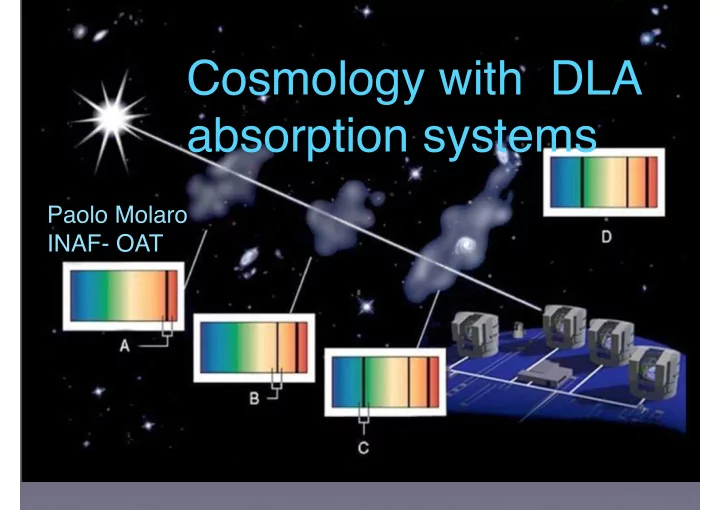
Cosmology with DLA absorption systems Paolo Molaro INAF- OAT - - PowerPoint PPT Presentation
Cosmology with DLA absorption systems Paolo Molaro INAF- OAT outline I II What are the DLAs? Primordial Deuterium The neutral gas content Molecules gas in DLAs: of the Universe H 2 , HD, CO Chemical abundances,
dust, chemical patterns.
I II
H2, HD, CO
6839 candidates
QSO J0903+2628 [C/H] = -3.43 [O/H] = -3.05 [Si/H] = -3.21
Galaxies
MDLA span from 106 to 1011 , with average 108 M⊙
LDLA span from the LLBG down for 8 mag
SFRDLA from 0.1 to 10 M⊙ yr-1 (possibly lower)
D isotope is blueshifted respect to HI by -83 km s-1
Adams (1976), first suggested primordial D could be measured in QSO absorption lines
Tytler et al (1996), Burles & Tytler (1998) Molaro et al (1999) ,Kirkman et al 2000
QSO 1937 1009 zabs=3.572
LLS: Log N(HI) =17.9
Songaila et al (1994), Carswell et al (1994), Rugers & Hogan (1996)
(in agreement with 7Li and 4He!)
105 D/H= 2.3 ± 0.6
Tytler et al (1996)
Riemer-Sorensen et al (2017)
105D/H= 2.62 ± 0.05
Burles &Tytler (1998) Q1009+2956 zabs =2.504 LogN(I)=17.4 105D/H = 4.0 ± 0.7 Zavarygin et al (2017)
S/N ~147 (from 60)
=>Ly 14 small contamination in the Ly-α
105D/H=3.16 ± 0.6
large error
the HI line
QSO 0347-3819 zabs=3.0 UVES, LogN(I)=6.3 ± 1.3 1020 D/H=2.24±0.67 10-5; D' Odorico et al 2001 QSO 2206-199 zabs=2.0, LogN(I)=20.5 D/H=1.65±0.25 10-5 Pettini & Bowen (2001)
Ly-8, Ly-10, Ly-12
O'Meara et al 2001 HS 0105+1619 zabs 2.53 Sub-DLA Log(HI)=19.4 [M/H]= -1.8
[Si/H]<-4.2
D/H=2.04±0.61 10-5 Fumagalli O'Meara Prochaska (2011)
LogN(HI)=17.95+/-0.05
2003 Kirkman et al 2004 Crighton et al PKS 1937-1009 Riemer Sorensen et al 2015 2006 O'Meara et al QSO J1558-0031 Cooke et al 2014 2008 Pettini et al Q0913+072 Cooke et al 2014 2011 Fumagalli et al 2012 Noterdaeme et al 2012 Pettini & Cooke J1419+0829 Cooke et al 2014
J1358+6522
Cooke et al (2014)
zabs = 3.067, LogN(HI)=20.5, [Fe/H] = -2.84
simple system: two components b=8-9 km/s
10-5 D/H=2.58±0.07
10 measurements before 2014
sub-sample of the best 5 systems (4 DLA +1 subDLA) with several resolved DI lines i.e. less contamination by Ly-α forest
no dispersion (the two not plotted have large errors) no dependence on HI no dependence on metallicity
5 DLA systems Cooke et al 2014 3 re-determination: Zavarygin et al (2017); Riemer-Sorensen et al (2015, 2017) 2 new determinations: Cooke et al 2016, Balashev et al 2017
~ 1% error!!!
All systems after 2014: 10 systems:
Riemer-Sorensen et al (2017)
no dust in the DLA (when measured)
small depletion is expected for [Fe/H]~ -2
Evidence of D depletion in dust from FUSE
Dvorkin et al (2016)
D/H in the context of cosmological structure formation 105Dp =2.58
D ~ not sensitive to expansion rate strong sensitivity to eta. BB only astronomical source (spallation minor) , stars destroy D
4He extragalactic HII regions (Peimpert et
al 2017)
7Li: Halo stars
D: DLAs
Li problem
Fields et al (2018)
S(E) factor D(p,g)3He
leading reactions:
Theoretical S(E) have uncertainties ~ 1% error.
D/H can shift by 4.5% (Marcucci et al 2016)
also at ~1%
( for Yp, CMBT=2.7258 K, Steigman 2006,)
The odd acoustic peaks in the power spectrum are enhanced over the even as we increase the baryon density.
100 Ωb,oh2 = 2.226 ± 0.023
100 Ωb,oh2 = 2.260 ± 0.018 ± 0.029 exp S(E)
perfect agreement!
Cooke et al (2016)
(with D/H=25.69 ±0.27: 100Ωb Ωb,oh2 ~ 2.245 ± 0.015 ± 0.029 (preliminary!)
no need for new physics beyond the SM. 100 Ωb,oh2 = 2.226 ± 0.023
100 Ωb,oh2 = 2.226 ± 0.023
Planck 100 Ωb,oh2 = 2.156 ± 0.017 ± 0.011 new S factor Cooke et al (2016)
theoretical S(E) (Marcucci et al 2016): lower Dp (~ 4.5%), lower eta, and lower Ω
with 105D/H=2.569 ±0.027 =>100 Ωb,oh2 = 2.140 ± 0.015 ± 0.011 (preliminary!)
7Li predicted by SBBN is OK, no
nuclear fix to the Li problem
Gustavino (2017)
6Li not produced in the
SBBN enhanced
In the Milky Way. Lyman and Werner bands (~ 1000 A ) first detected in a rocket experiment (Carruthers 1967), then Copernicus and FUSE.
Fuse FUV Lyman Band lines
f(H2) >10-2
photodissociated by hv> 14 ev,
Ground state is X. It has 30 vibrational levels, each with an infinite number of rotational states.
The next two singlet levels are B C, connected to ground X by allowed electric-dipole transitions (analogs of HI Ly-alpha). Lyman and Werner bands start at 1108 Å and 1040 Å, and are spread to the HI Lyman edge at 911.7 Å
from Field et al (1966)
Dissociation Excitation
Werner 12.3 eV , C
nuclear distance
Levshakov & Vershalovich 1985 on a spectrum of PKS 0528-250 by Morton et al 1980 taken
at the 3.9 Anglo-Australian Telescope
Confirmation: Foltz et al 1998, Srianand & Petijean 1998, Gee & Betchold 1999
PKS 0528-250
courtesy Regina Jorgenson
H2 lines fall within the Lyman forest
Bagdonaite (2013)
H2 is found preferentially in high metallicity systems less abundant in high redshift DLA
Balashev et al 2017
f(H2) correlates with dust depletion
H2 formation needs dust, and dust needs metals
Levshakov et al. 2001
Ledoux et al 2003
Noterdaeme et al (2015) study of the few log H(I) ~ 22
At Log H(I)~22 the incidence is higher but the molecular level (f(H2)~ 10-4 -10-2) remains
low. No evidence for dense molecular clouds
detection rate: 13 − 20%. Preselection: dusty systems
DLA,detection rate: 10 − 18% . Preselected
detection rate 1-5%. Unbiased, blind survey.
candidates from SDSS (z>2.3) spectra (logN(H2) > 19.5), 100 candidates found, 8 studied 8 systems ( 100% success)
Preselection of strong CI lines from SDSS (or 2175 A bump)
fraction 1-5% Jogerson et al (2013)
H2 in DLA: ~ 40
GRBs: 4 (Prochaska et al 2009, Kruhler et
al 2013, Friis et al 2015, D’Elia et al 2014)
peak at z~ 2.5 (related to dust)
like the Milky Way Texc decrease with N(H2)
Balashev et al 2017
➡ density: n(H) ~ 50-60 cm-3 ➡ sizes: ~ pc
logN(H)=21.82, logN(H2)=21.21,
Balashev et al 2017
strongly saturated lines, Cl to resolve the structure [Zn/H]=-1.5 Texc=123 ± 9 K n ~ 260-380 cm-3
36
λobs = λrest (1+zabs)(1+Ki Δµ/µ)
electron-vibro-rotational transitions have different dependence from the reduced H2 mass.
me= 0. 5 Mev ∝ the vacuum expectation value of the Higgs field => The weak scale (223 Me mp = 938 Mev = (862QCD + 74q +2QED) Mev ∝ ΛQCD => strong forces
µ = strong/weak
highly exaggerated
H2 : <Δµ/µ> = 3.4 ± 2.7 ppm
Q1232+082 Varshalovich et al 2001 J1439+1117 Srianand et al 2008 J2123-0500 Tumlison et al 2010 Q0812+32 Balashev et al 2010 Q1331+170 Balashev et al 2010 J1237+064 Noterdaeme et al 2010 J0000+0048 Noterdaeme et al 2017 J0843+0221 Balashev et al 2017
2008),
fractionation and charge exchange processes: D+ + H2 => HD + H+ (Litz 2015)
Q1232+082 zabs=2.3
CO second molecule more abundant in the universe. Elusive for more than a quarter of century Discovery: (Srianand et al 2008)
SDSS J1439+1117, DLA zabs=2.4
Srianand et al 2008, Noterdaeme et al 2010, 2011,2017
non detection in the system with the highest H2
but [Zn/H] =-1.5 (Balashev et al 2017)
CO and H2
XCO conversion factor: CO-H2 is not known
provides a good measure of the TCMB energy between J and (J-1): EJ = 5.54 J K
J1439+1117, zabs=2.418
Milky-Way
Srianand et al 2008
Excitation of atomic or molecular lines with transition energies ~ K TCMB ( z ) can be excited by TCMB
Tr = 2.725(1 + z)
Srianand et al 2008 on CO
Songaila et al (1994) at z=1.776 measured < 8.2 K.
The population of fine-structure levels of the ground state of C I* or C II* depends mainly on (Bachall Wolfe 1968):
CN Molecules:
CN, used in the Galaxy (Meyer &Jura 1985, Ritchey et al 2010. However, CN not yet detected in external galaxies
Molecules Composed of Atoms Probably Present in Interstellar Space, in Publications of the Dominion Astrophysical Observatory (Victoria, BC), vol. 7, 1941, pp. 251–272.
H2 provides simultaneous determination of local density, kinetic temperature and UV radiation, thus allowing to estimate the level of collisional excitation of CI* and CII*
TCMB = 10 ± 4 K
TCMB(z) = 9 K
Q 0347-381 zabs=3.0
TCMB=12.1(+1.7,-3.2) K TCMB(z) = 10.5 K
Cui et al (2005)
Molaro et al 2002 QSO 1331+170 zabs=1.77 TCMB= 7.2 ± 0.8 K T(z) = 7.566 K
Srianand et al 2008, Noterdaeme et al 2010,2011
AX(0-0)-AX(4-0) band
CO levels depend "uniquely" from CMB photons
Noterdaeme et al 2011 Constraint to non adiabatic expansion (.e. decaying DE)
Sobolev et al 2015 relative populations of CO levels function of: TCMB,TKin ,n, f(H2)
precision of a fraction of degree difficult to obtain at high z collisions with H2, H
for Tkin=100 K
Noterdaeme et al 2017
9.9 - 0.3 K=> 9.6 K
nh =50 cm-3 Tkin=50
correction using the Sobolev 2015 formula
Muller et al 2013
PKS 1830-211 z~0.89, ATCA obs
The most precise measure ever
TCMB = 5 ± 0.1 K
Hurier et al 2014
t-SZ from Planck
also Saro et al 2014 using the South Pole Telescope
~ 1% DT/T
Sunyaev-Zeldovich (S-Z) effect: change in the spectral energy of the CMB towards clusters owing to inverse Compton scattering of the CMB photons by hot intra cluster gas. Useful for z<0.6 (Fabbri et al 1978, Luzzi et al 2009)
Decaying Dark Energy
Ma 2008; Jetzer et al 2011,2012
DLA useful for:
✦ precise chemistry of 90% (up to z~ 5) of the universe ✦ universal chemical evolution ✦ smoking gun of the first stars ✦ nucleosynthesis of elements: nitrogen, carbon ✦ measure Dp and the baryonic component at few % level ✦ probe the variability of alpha and me/mp ✦ measure TCMB(z)