Absorption Electromagnetic waves and interactions; spectroscopy - - PDF document

absorption
SMART_READER_LITE
LIVE PREVIEW

Absorption Electromagnetic waves and interactions; spectroscopy - - PDF document

4/11/2016 Content PCSI TUDOMNYEGYETEM LTALNOS ORVOSTUDOMNYI KAR Light; www.aok.pte.hu Absorption Electromagnetic waves and interactions; spectroscopy Definition of absorption; Absorption measurements; (Mikls Nyitrai; 2 nd of


slide-1
SLIDE 1

4/11/2016 1

PÉCSI TUDOMÁNYEGYETEM ÁLTALÁNOS ORVOSTUDOMÁNYI KAR www.aok.pte.hu

Absorption spectroscopy

(Miklós Nyitrai; 2nd of March 2016)

www.aok.pte.hu

Content

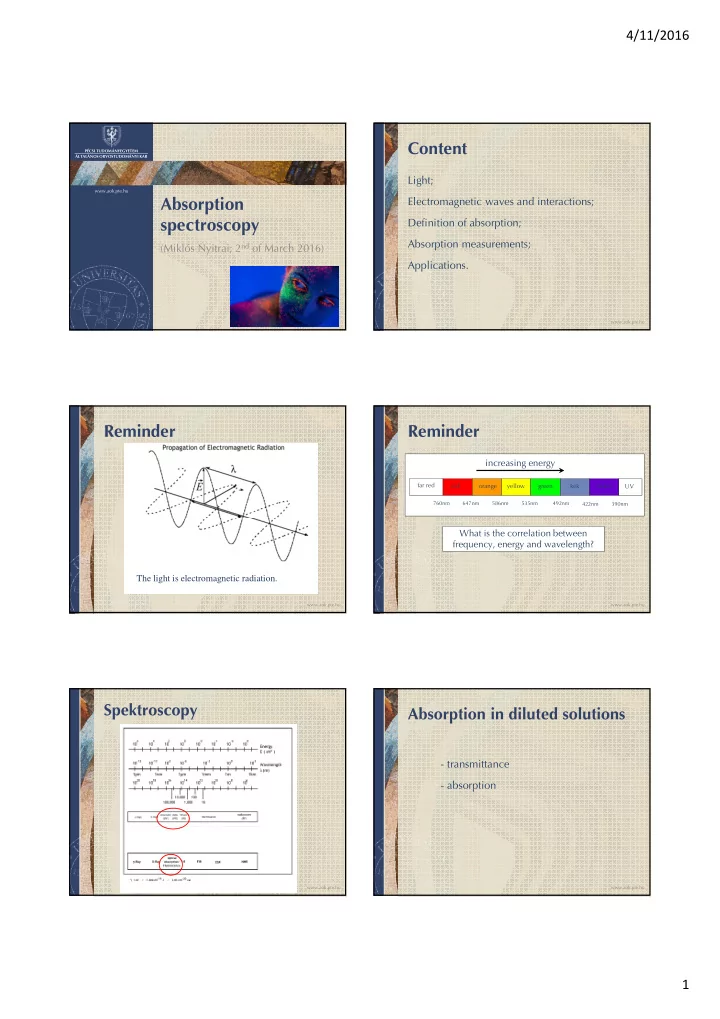
Light; Electromagnetic waves and interactions; Definition of absorption; Absorption measurements; Applications.

www.aok.pte.hu

Reminder

The light is electromagnetic radiation.

www.aok.pte.hu

Reminder

red

  • range

yellow green kék violet far red UV

390nm 422nm 492nm 535nm 586nm 647nm 760nm

increasing energy What is the correlation between frequency, energy and wavelength?

www.aok.pte.hu

Spektroscopy

www.aok.pte.hu

Absorption in diluted solutions

  • transmittance
  • absorption
slide-2
SLIDE 2

4/11/2016 2

www.aok.pte.hu

Transmittance

substance light source detector T = I / I0 Usually given in %

I0 I

www.aok.pte.hu

Absorption

  • r

light absoprtion

www.aok.pte.hu

Absorption

Sample

light intensity distance

I0 I

Exponential function!!!

I = I0 exp (-kx)

  • r

I = I0 e-kx

www.aok.pte.hu

N = N0 exp (-λt)

  • r

N = N0 e-λt

Similar to the radioactive decay low!

www.aok.pte.hu

sample

intensity ln(distance)

I0 I

Exponential too!

A different presentation

www.aok.pte.hu

The Born-Oppenheimer approximation; Nuclear vs. Electron motions.

What are the bases?

slide-3
SLIDE 3

4/11/2016 3

www.aok.pte.hu

Example: water molecule

http://www1.lsbu.ac.uk/water/vibrat.html

www.aok.pte.hu

Esum = Eelect + Evibr + Erot The changes can be then written as: ∆Esum = ∆Eelect + ∆Evibr + ∆Erot

The splitting of the energy levels

www.aok.pte.hu

Energy scheme: band spectra

www.aok.pte.hu

The magnitude of the energy types: ∆Eelect ~ 1,000 * ∆Evibr ~ 1,000,000 * ∆Erot

The energy scale

www.aok.pte.hu

Spin multiplicity within the molecules

The number of possible quantum states (n) of a system based on the spin quantum number S: M = 2S+ S+1 Szingulett → S=0; M = 1 Triplett → S=1; M = 3

singlet ground state excited singlet state excited triplet state

www.aok.pte.hu

Interpretation of absorption

S0 S1 Ground state S0 – S1 Excited ed state Vibrational relaxation (10-12s) excitation (10-15s) hν T1 T1 → S0 (10-3 – 10-1s ) vibrational levels

1 2 3 4 5

S1 → T1: intersystem crossing (10-10 – 10-8 s)

slide-4
SLIDE 4

4/11/2016 4

www.aok.pte.hu

Aim:

  • easy understanding
  • measurable
  • additive

Note: transmittance (T = I / I0) is not additive. A solution of 50% transmittance is mixed with a solution of 60% transmittance (keeping the concentrations) will never give a solution of 110% transmittance.

The definition of absorption

www.aok.pte.hu

sample

intensity distance

I0 I I = I0 10-ε(λ) c x

Define parameters! Why ε(λ) and not only ε ?

Distance dependence

www.aok.pte.hu

λ (nm) absorption

ε depends on λ!

Why ε(λ) and not only ε?

www.aok.pte.hu

substance

OD = A = - log (I / I0) = ε (λ) c x

I0 I

„optical density”

I = I0 10-ε(λ) c x

The definition of absoprtion

www.aok.pte.hu

photometry = absorption spectroscopy

Absorption measurements

www.aok.pte.hu

light source sample detector monochromator

How to measure absorption?

A scheme of a photometer.

slide-5
SLIDE 5

4/11/2016 5

www.aok.pte.hu

Spektrophotometer

Main componen ents: 1. Ligh ght source ce

  • UV lamp (~180-350nm): Deuterium lamp
  • Visible source (~350-800nm): Wolfram

2. Monochromat ator: to select wavelength. 3. Sample holder er: e.g. a cuvette 4. photodet etekt ektor: PMT, diode… 5. Other componen ents: lenses, filters, slits.

www.aok.pte.hu

How does the prism work?

www.aok.pte.hu

How does the prism work?

www.aok.pte.hu

The wavelength dependence of the refraction index

λ n λ

www.aok.pte.hu

red purple yellow White light Monochromatic light

The wavelength dependence of the refraction index

www.aok.pte.hu

Why we use reference?

Photometers

slide-6
SLIDE 6

4/11/2016 6

www.aok.pte.hu

The absorption of proteins

www.aok.pte.hu

The absorption of proteins

www.aok.pte.hu

The absorption of proteins

www.aok.pte.hu

Measured absorption: A Extinkciós coefficient: ε Usual units for ε: M-1cm-1, or (mg/ml)-1cm-1 If A = 0.55 and ε = 1.1 (mg/ml)-1cm-1 c = (A/ ε) in mg/ml; c = 0.5 mg/ml

Applications: protein concentration

www.aok.pte.hu

λ (nm) absorption fluorescent probe protein

What is the advantage of additivity? (example)

www.aok.pte.hu

5 10 15 20 0.0 0.2 0.4 0.6 0.8 1.0 S [mDia3-FH2] (µM)

Application: gel electrophoresis

slide-7
SLIDE 7

4/11/2016 7

www.aok.pte.hu

  • interpretation of absorption;
  • definition of absorption;
  • absorption measurements;
  • applications.

Summary

www.aok.pte.hu

Thank you!