Correlation MDM4U: Mathematics of Data Management Sometimes we are - - PDF document

correlation
SMART_READER_LITE
LIVE PREVIEW

Correlation MDM4U: Mathematics of Data Management Sometimes we are - - PDF document

s t a t i s t i c s o f t w o v a r i a b l e s s t a t i s t i c s o f t w o v a r i a b l e s Correlation MDM4U: Mathematics of Data Management Sometimes we are interested in how changes in one variable relates to those of another.


slide-1
SLIDE 1

s t a t i s t i c s o f t w o v a r i a b l e s

MDM4U: Mathematics of Data Management

How Are Data Related?

Scatter Plots and Linear Correlation

  • J. Garvin

Slide 1/19

s t a t i s t i c s o f t w o v a r i a b l e s

Correlation

Sometimes we are interested in how changes in one variable relates to those of another. Correlation is a numerical value that represents the degree to which two variables are related. Correlation can also be viewed as a measure of how much

  • ne variable depends on another.

In this unit, we will talk about different types of correlations.

  • J. Garvin — How Are Data Related?

Slide 2/19

s t a t i s t i c s o f t w o v a r i a b l e s

Scatter Plots

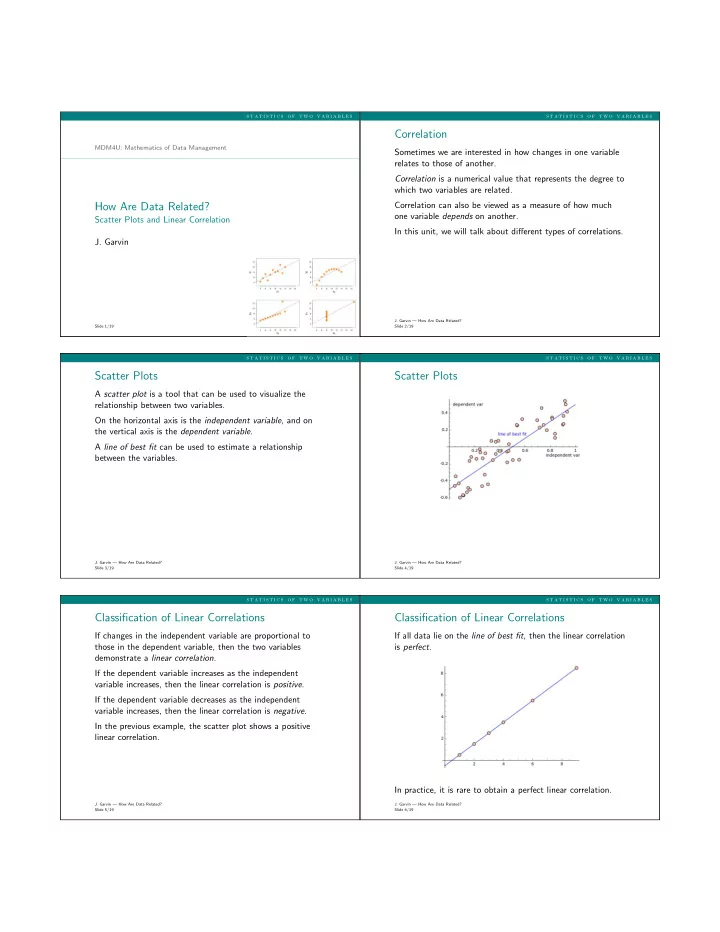
A scatter plot is a tool that can be used to visualize the relationship between two variables. On the horizontal axis is the independent variable, and on the vertical axis is the dependent variable. A line of best fit can be used to estimate a relationship between the variables.

  • J. Garvin — How Are Data Related?

Slide 3/19

s t a t i s t i c s o f t w o v a r i a b l e s

Scatter Plots

  • J. Garvin — How Are Data Related?

Slide 4/19

s t a t i s t i c s o f t w o v a r i a b l e s

Classification of Linear Correlations

If changes in the independent variable are proportional to those in the dependent variable, then the two variables demonstrate a linear correlation. If the dependent variable increases as the independent variable increases, then the linear correlation is positive. If the dependent variable decreases as the independent variable increases, then the linear correlation is negative. In the previous example, the scatter plot shows a positive linear correlation.

  • J. Garvin — How Are Data Related?

Slide 5/19

s t a t i s t i c s o f t w o v a r i a b l e s

Classification of Linear Correlations

If all data lie on the line of best fit, then the linear correlation is perfect. In practice, it is rare to obtain a perfect linear correlation.

  • J. Garvin — How Are Data Related?

Slide 6/19

slide-2
SLIDE 2

s t a t i s t i c s o f t w o v a r i a b l e s

Classification of Linear Correlations

If most data are close to the line of best fit, we classify the linear correlation as strong. If most data are widely dispersed, the linear correlation is weak. Linear correlations that are neither that close, nor that dispersed, are moderate.

  • J. Garvin — How Are Data Related?

Slide 7/19

s t a t i s t i c s o f t w o v a r i a b l e s

Classification of Linear Correlations

Example

Classify the correlation in the following scatter plot. The scatter plot shows a moderate negative linear correlation.

  • J. Garvin — How Are Data Related?

Slide 8/19

s t a t i s t i c s o f t w o v a r i a b l e s

Classification of Linear Correlations

Example

Classify the correlation in the following scatter plot. The scatter plot shows a strong positive linear correlation.

  • J. Garvin — How Are Data Related?

Slide 9/19

s t a t i s t i c s o f t w o v a r i a b l e s

Correlation Coefficient

The strength of a linear correlation can also be assigned a numerical value, known as the correlation coefficient.

Pearson’s Coefficient of Correlation

The correlation coefficient of a linear relationship is given by r = n xy − ( x)( y)

  • [n x2 − ( x)2] [n y2 − ( y)2]

, where each of the n data has a coordinate (x, y). Despite its appearance, this is relatively straightforward to calculate using a table. We need the sums of each of the following: the x values, the y values, the products of each x-y pair, the x2 values, and the y2 values.

  • J. Garvin — How Are Data Related?

Slide 10/19

s t a t i s t i c s o f t w o v a r i a b l e s

Correlation Coefficient

Example

Given the following data relating an object’s length (cm) to its mass (kg), calculate the correlation coefficient and classify the correlation. Illustrate the data using a scatter plot. Length 15 22 19 18 15 45 27 18 18 51 Mass 2.8 3.5 3.4 2.8 3.0 6.1 4.2 3.2 2.9 7.0

  • J. Garvin — How Are Data Related?

Slide 11/19

s t a t i s t i c s o f t w o v a r i a b l e s

Correlation Coefficient

x y xy x2 y2 15 2.8 42.0 225 7.84 22 3.5 77.0 484 12.25 19 3.4 64.6 361 11.56 18 2.8 50.4 324 7.84 15 3.0 45.0 225 9.00 45 6.1 274.5 2025 37.21 27 4.2 113.4 729 17.64 18 3.2 57.6 324 10.24 18 2.9 52.5 324 8.41 51 7.0 357.0 2601 49.00 248 38.9 1133.7 7622 170.99

  • J. Garvin — How Are Data Related?

Slide 12/19

slide-3
SLIDE 3

s t a t i s t i c s o f t w o v a r i a b l e s

Correlation Coefficient

r = n xy − ( x)( y)

  • [n x2 − ( x)2] [n y2 − ( y)2]

= 10 · 1133.7 − 248 · 38.9

  • (10 · 7622 − 2482)(10 · 170.99 − 38.92)

≈ 0.9932 Thus, the data demonstrate a strong, positive linear correlation.

  • J. Garvin — How Are Data Related?

Slide 13/19

s t a t i s t i c s o f t w o v a r i a b l e s

Correlation Coefficient

The correlation coefficient, while useful, is just a number and may or may not be relevant to the data at hand. It is important to graph the data before any conclusions can be made about the significance of the correlation coefficient.

  • J. Garvin — How Are Data Related?

Slide 14/19

s t a t i s t i c s o f t w o v a r i a b l e s

Correlation Coefficient

Example

Which graph has the greatest correlation coefficient? All have a correlation coefficient of approximately 0.816, even though all of the relationships are not linearly related.

  • J. Garvin — How Are Data Related?

Slide 15/19

s t a t i s t i c s o f t w o v a r i a b l e s

Correlation and Causation

While the previous example illustrated a fairly common cause-and-effect relationship – that an increase in length results in an increase in mass – a high correlation coefficient does not necessarily imply causation. Consider the following scatter plot comparing monthly ice cream sales and deaths due to drowning.

  • J. Garvin — How Are Data Related?

Slide 16/19

s t a t i s t i c s o f t w o v a r i a b l e s

Correlation and Causation

  • J. Garvin — How Are Data Related?

Slide 17/19

s t a t i s t i c s o f t w o v a r i a b l e s

Correlation and Causation

The data are relatively close to the line of best fit, and the correlation coefficient is 0.859, suggesting a strong, positive correlation between ice cream sales and deaths due to drowning. It does not make sense, however, to conclude that an increase in ice cream sales causes an increase in the number of deaths. Instead, the strong correlation is probably due to another factor – in this case, the time of year. We will discuss external sources of bias in more detail later.

  • J. Garvin — How Are Data Related?

Slide 18/19

slide-4
SLIDE 4

s t a t i s t i c s o f t w o v a r i a b l e s

Questions?

  • J. Garvin — How Are Data Related?

Slide 19/19