Corporate Presentation October 2019 Disclaimer IMPORTANT: YOU - - PowerPoint PPT Presentation

corporate presentation
SMART_READER_LITE
LIVE PREVIEW

Corporate Presentation October 2019 Disclaimer IMPORTANT: YOU - - PowerPoint PPT Presentation

CSE: MMEN | OTC: MMNFF Corporate Presentation October 2019 Disclaimer IMPORTANT: YOU MUST READ THE FOLLOWING BEFORE CONTINUING The information contained in this presentation has been prepared by MedMen Enterprises Inc. (MedMen or the


slide-1
SLIDE 1

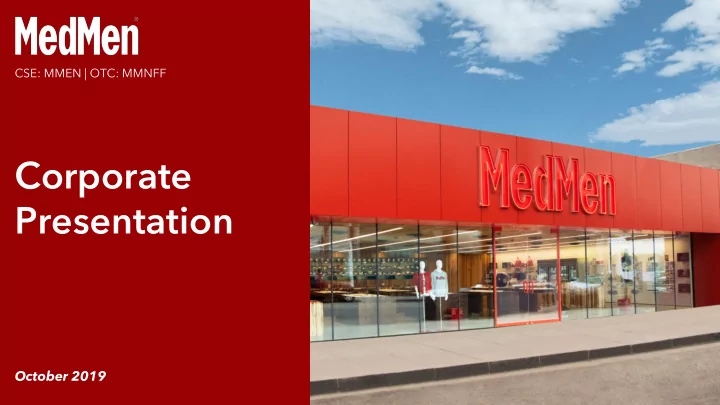
Corporate Presentation

October 2019

CSE: MMEN | OTC: MMNFF
slide-2
SLIDE 2 IMPORTANT: YOU MUST READ THE FOLLOWING BEFORE CONTINUING The information contained in this presentation has been prepared by MedMen Enterprises Inc. (“MedMen” or “the Company”) and contains information pertaining to the business, operations, assets and prospects of the Company. The information contained in this presentation (a) is provided as at the date hereof and is subject to change without notice, (b) does not purport to contain all the information that may be necessary or desirable to fully and accurately evaluate an investment in the Company, and (c) is not to be considered as a recommendation by the Company that any person make an investment in MedMen. Other than as may be required by applicable laws, the Company is under no obligation to update any information included in this presentation. An investment in the securities of the Company is speculative and involves a number of risks. Other than as may be authorized by the Company upon request, this presentation may not be reproduced, in whole or in part, in any form or forwarded or further distributed to any other person. Any forwarding, distribution or reproduction of this presentation in whole or in part is
  • unauthorized. The Company takes no responsibility for, and provides no assurance as to the reliability of, any information that others may give readers of this presentation.
FORWARD-LOOKING INFORMATION AND RISK ACKNOWLEDGEMENTS This document contains “forward-looking statements” and “forward-looking information” within the meaning of applicable securities laws (collectively, “forward-looking information”) with respect to the Company, including, but not limited to: information concerning the completion and timing of the completion of contemplated acquisitions, expectations regarding whether the contemplated acquisitions will be consummated, including whether conditions to the consummation of the proposed acquisitions will be satisfied and whether the proposed acquisitions will be completed on the current terms, the timing for completing the proposed acquisitions, expectations for the effects of the proposed acquisitions, including the potential number and location of factories and stores or licenses therefor to be acquired and markets to be entered into by the Company as a result of completing such proposed acquisitions, expectations regarding the markets to be entered into by the Company as a result of completing such proposed acquisitions, the ability of the Company to successfully achieve its business objectives as a result of completing the contemplated acquisitions, targeted performance metrics set forth on the “Target Store Economics” slide and the revenue targets set forth on the “Investor Highlights” slide, estimates of future cultivation, manufacturing and extraction capacity, estimates of future revenue (and the method by which such future revenue is generated), store related forecasts, including as to number of planned stores to be opened in the future, information as to the development and distribution of the Company’s brands and products, information as to the development and implementation of the Company’s customer rewards program, and any other statement that may predict, forecast, indicate or imply future plans, intentions, levels of activity, results, financial position, operational or financial performance or achievements. Such forward- looking information involves known and unknown risks, uncertainties and other factors which may cause the actual plans, intentions, activities, results, financial position, performance or achievements of the Company to be materially different from any future plans, intentions, activities, results, financial position, performance or achievements expressed or implied by such forward-looking information. Often, but not always, forward-looking information can be identified by the use of words such as “plans”, “expects”, “is expected”, “budget”, “scheduled”, “estimates”, “forecasts”, “intends”, “anticipates”, will”, “projects”, or “believes” or variations (including negative variations) of such words and phrases, or statements that certain actions, events, results or conditions “may”, “could”, “would”, “might” or “will” be taken, occur or be achieved. Except for statements of historical fact, information contained herein constitutes forward-looking information. Forward-looking information is not a guarantee of future performance and is based upon a number of estimates and assumptions of management at the date the statements are made including among other things assumptions about: the contemplated acquisitions being completed on the current terms and current contemplated timeline; development costs remaining consistent with budgets; favorable equity and debt capital markets; the ability to raise sufficient capital to advance the business of the Company; favorable operating conditions; political and regulatory stability; obtaining and maintaining all required licenses and permits; receipt of governmental approvals and permits; sustained labor stability; stability in financial and capital goods markets; favourable production levels and costs from the Company’s operations; the pricing of various cannabis products; the level of demand for cannabis products; and the availability of third party service providers and other inputs for the Company’s operations. While the Company considers these assumptions to be reasonable, the assumptions are inherently subject to significant business, social, economic, political, regulatory, competitive and other risks and uncertainties, contingencies and other factors that could cause actual performance, achievements, actions, events, results or conditions to be materially different from those projected in the forward-looking
  • information. Many assumptions are based on factors and events that are not within the control of the Company and there is no assurance they will prove to be correct.
Furthermore, such forward-looking information involves known and unknown risks, uncertainties and other factors which may cause the actual plans, intentions, activities, results, financial position, performance or achievements of the Company to be materially different from any future plans, intentions, activities, results, financial position, performance or achievements expressed or implied by such forward-looking information. Such factors include, among others: the ability to consummate the proposed acquisitions; the ability to obtain requisite regulatory approvals and third party consents and the satisfaction of other conditions to the consummation of the proposed acquisitions on the proposed terms and schedule; the potential impact of the announcement or consummation of the proposed acquisitions on relationships, including with regulatory bodies, employees, suppliers, customers and competitors; the diversion of management time on the proposed acquisitions; risks relating to cannabis being illegal under US federal law and risks of federal enforcement actions related to cannabis; negative changes in the political environment or in the regulation of cannabis and the Company’s business; risks relating to lack of banking providers and characterization of the Company’s revenue as proceeds of crime as a result of anti-money laundering laws and regulation; the costs of compliance with and the risk of liability being imposed under the laws the Company operates under including environmental regulations; negative shifts in public opinion and perception of the cannabis industry and cannabis consumption; risks that service providers may suspend or withdraw services; the limited operating history of the Company; reliance on the expertise and judgement of senior management of the Company; increasing competition in the industry; risks related to financing activities, including leverage; risks related to the management of growth; increased costs related to the Company becoming a publicly traded company; risks inherent in an agricultural business; adverse agricultural conditions impacting cannabis yields; risks relating to rising energy costs; risks of product liability and other safety related liability as a result of usage of the Company's cannabis products; negative future research regarding safety and efficacy of cannabis and cannabis derived products; risk of shortages of or price increases in key inputs, suppliers and skilled labor; a lack of reliable data on the medical and adult-use cannabis industry; loss of intellectual property rights or protections; cybersecurity risks; constraints on marketing products; fraudulent activity by employees, contractors and consultants; tax and insurance related risks; risk of litigation; conflicts of interest; compliance with extensive government regulation; changes in general economic, business and political conditions, including changes in the financial markets; as well as those risk factors discussed in the Company’s Listing Statement filed on SEDAR at www.sedar.com on May 29, 2018 and discussed in the Company’s other public filings available on SEDAR. Although the Company has attempted to identify important factors that could cause actual results to differ materially, there may be other factors that cause results not to be as anticipated, estimated or intended. There can be no assurance that such forward-looking information will prove to be accurate as actual results and future events could differ materially from those anticipated in such information. Accordingly, readers should not place undue reliance on forward-looking information. Forward-looking information is provided and made as of the date of this presentation and MedMen does not undertake any obligation to revise or update any forward-looking information other than as required by applicable law.

Disclaimer

2
slide-3
SLIDE 3 NON-IFRS FINANCIAL AND PERFORMANCE MEASURES In addition to providing financial measurements based on IFRS, the Company provides additional financial metrics that are not prepared in accordance with IFRS. Management uses non-IFRS financial measures, in addition to IFRS financial measures, to understand and compare operating results across accounting periods, for financial and operational decision-making, for planning and forecasting purposes and to evaluate the Company’s financial performance. These non-IFRS financial measures are EBITDA, Adjusted EBITDA, Adjusted Net Loss, Working Capital, Four Wall Retail Gross Margin, Four Wall Retail Gross Margin Rate, Four Wall Retail EBITDA Margin, Four Wall Retail EBITDA Margin Rate, and Annualized Per Square Foot Revenue. Management believes that these non-IFRS financial measures reflect the Company’s ongoing business in a manner that allows for meaningful comparisons and analysis of trends in the business, as they facilitate comparing financial results across accounting periods and to those of peer
  • companies. Management also believes that these non-IFRS financial measures enable investors to evaluate the Company’s operating results and future prospects in the same manner as management. These non-IFRS financial measures may also exclude expenses and gains that may be
unusual in nature, infrequent or not reflective of the Company’s ongoing operating results. As there are no standardized methods of calculating these non-IFRS measures, the Company’s methods may differ from those used by others, and accordingly, the use of these measures may not be directly comparable to similarly titled measures used by others. Accordingly, these non- IFRS measures are intended to provide additional information and should not be considered in isolation or as a substitute for measures of performance prepared in accordance with IFRS. EBITDA, ADJUSTED EBITDA, ADJUSTED NET LOSS, WORKING CAPITAL, FOUR WALL RETAIL GROSS MARGIN, FOUR WALL RETAIL EBITDA MARGIN, AND ANNUALIZED PER SQUARE FOOT REVENUE EBITDA, Adjusted EBITDA, Adjusted Net Loss, Working Capital, Four Wall Retail Gross Margin, Four Wall Retail Gross Margin Rate, Four Wall Retail EBITDA Margin, Four Wall Retail EBITDA Margin Rate, and Annualized Per Square Foot Revenue are financial measures that are not defined under IFRS. We use these non-IFRS financial measures, and believe they enhance an investor’s understanding of our financial and operating performance from period to period. EBITDA, Adjusted EBITDA, Adjusted net Loss and Working Capital exclude certain material non-cash items and certain other adjustments we believe are not reflective of our ongoing operations and our performance. Four Wall Retail Gross Margin is calculated as retail sales less the related cost of goods sold, while the Four Wall Retail Gross Margin Rate is the related gross margin divided by retail
  • sales. Four Wall Retail EBITDA” Margin is the Four Wall Retail Gross Margin less direct store operating expenses, including Rent, Payroll, Security, Insurance, Office Supplies, Payment Processing Fees, while the Four Wall Retail EBITDA Margin Rate is the related EBITDA margin divided by
retail sales. Annualized Per Square Foot Revenue is the net revenue divided by the total retail square feet. In particular, we have and continue to make significant acquisitions and investments in cannabis properties and management resources to better position our organization to achieve
  • ur strategic growth objectives which have resulted in outflows of economic resources. Accordingly, we use these metrics to measure our core financial and operating performance for business planning purposes. In addition, we believe investors use both IFRS and non-IFRS measures to
assess management’s past and future decisions associated with our priorities and our allocation of capital, as well as to analyze how our business operates in, or responds to, swings in economic cycles or to other events that impact the cannabis industry. However, these measures do not have any standardized meaning prescribed by IFRS and may not be comparable to similar measures presented by other companies in our industry. These financial measures are not intended to represent and should not be considered as alternatives to net income, operating income or any other performance measures derived in accordance with IFRS as measures of operating performance or operating cash flows or as measures of liquidity. These Non-IFRS measures have important limitations as analytical tools and should not be considered in isolation or as a substitute for any standardized measure under IFRS. For example, certain of these non-IFRS financial measures:
  • exclude certain tax payments that may reduce cash available to us;
  • do not reflect any cash capital expenditure requirements for the assets being depreciated and amortized that may have to be replaced in the future;
  • do not reflect changes in, or cash requirements for, our working capital needs; and
  • do not reflect the interest expense, or the cash requirements necessary to service interest or principal payments on our debt.
Other companies in our industry may calculate these measures differently than we do, limiting their usefulness as comparative measures.

Disclaimer

MARKET DATA AND INDUSTRY FORECASTS Market data and industry forecasts used in this presentation were obtained from government or other industry publications, various publicly available sources or based on estimates derived from such publications and reports and management's knowledge of, and experience in, the markets in which the Company operates. Government and industry publications and reports generally indicate that they have obtained their information from sources believed to be reliable, but do not guarantee the accuracy and completeness of their information. Actual
  • utcomes may vary materially from those forecast in such reports or publications, and the prospect for material variation can be expected to increase as the length of the forecast period increases. Although the Company believes that these sources are generally reliable, the
accuracy and completeness of such information is not guaranteed and have not been independently verified by the Company and as such the Company does not make any representation as to the accuracy of such information. Further, market and industry data is subject to variations and cannot be verified due to limits on the availability and reliability of data inputs, the voluntary nature of the data gathering process and other limitations and uncertainties inherent in any statistical survey. See also “ Forward-Looking Information and Risk Acknowledgments". CURRENCY All references to $ or “dollar” in this presentation are references to USD, unless otherwise indicated. CANNABIS-RELATED ACTIVITIES ARE ILLEGAL UNDER U.S. FEDERAL LAWS The U.S. Federal Controlled Substances Act classifies “marihuana” as a Schedule I drug. Accordingly, cannabis-related activities, including without limitation, the cultivation, manufacture, importation, possession, use or distribution of cannabis and cannabis products are illegal under U.S. federal law. Strict compliance with state and local laws with respect to cannabis will neither absolve the Company of liability under U.S. federal law, nor will it provide a defense to any federal prosecution which may be brought against the Company with respect to adult- use or recreational cannabis. Any such proceedings brought against the Company may adversely affect the Company’s operations and financial performance. 3
slide-4
SLIDE 4

Mission

To provide an unparalleled experience that invites the world to discover cannabis and all its benefits.

Vision

We believe that a world where cannabis is legal and regulated is safer, healthier and happier.

4
slide-5
SLIDE 5

MedMen is the most recognizable cannabis retailer in the U.S.

Track Record of Execution Footprint Overview 1

70

retail store licenses 1

32

  • perating

Stores 1

9

states

2M +

recreational transactions since 1/1/18

$42M

Q4 2019 revenue 2

$168M

run-rate revenue 3

$7,000+

California Sales / SF 4

15%

sequential revenue growth 2

6X

  • utperforms

average California dispensary 4

6%

California market share 5

MedMen Snapshot

Notes: Financial metrics based on most recent fiscal quarter ending 6/29/19 (1) Company is licensed for 70 retail stores, including pending acquisitions in California and Michigan. Operating stores include locations to be acquired through pending acquisitions (2) Actual Figures for Fiscal Q4 2019 ending 6/29/19 (3) Pro forma for unaudited revenue from retail stores to be acquired through pending acquisitions (4) MedMen figure based on system-wide fiscal Q4 2019 average sales for stores in California (5) Based on implied market share from California Department of Tax and Fee Administration and actual system-wide in California revenue for fiscal Q4 2019 (Source: http://www.cdtfa.ca.gov/news/19-19.htm) 5
slide-6
SLIDE 6

Company Highlights

Focused on Branded Retail

Building a national retailer for the modern cannabis consumer

Established Playbook for Growth

Compelling roadmap to deliver profitable and long-term growth

Meaningful Share in Core Markets

Leading footprint in California, the prize of the cannabis industry

Accelerating Revenue Profile

Strong financial trajectory supported by prudent capital allocation

Targeting $1 Billion in Revenue Through Existing Footprint

6
slide-7
SLIDE 7

Increasing Market Share in Core States

Licensed for:

States

12

Factories

~50% U.S. Population Addressable

MedMen is focused on deepening presence in core markets

17 4 35 3

# of Retail Licenses

70

Retail Stores

9

States 3 1 21 1 7 Note: Includes pending but not yet completed acquisitions in California and Michigan. There are 32 stores currently operational. 1) Company is currently waiting on Massachusetts state licensing on two potential locations which have received local approval. 4
slide-8
SLIDE 8

MedMen Strategy

Build MedMen Brand Through Flagship Retail Stores

▪ Capitalize on first mover advantages by opening stores in top markets ▪ Build brand awareness and customer acquisition through marketing

Expand Retail Footprint and Create Omnichannel Experience

▪ Continue to deepen market share in core consumer markets across the U.S. ▪ Leverage data and insights to launch delivery, loyalty and targeted CPG brands

Drive Profitability Through Investments in Supply Chain

▪ Scale manufacturing to increase share of higher-margin private label brands ▪ Leverage national scale to maximize operating leverage and control supply chain Objective

1

Los Angeles Las Vegas NYC Miami Retail Stores Loyalty Delivery In-store Pickup

Objective

2

Objective

3

8
slide-9
SLIDE 9 Beverly Hills West Palm Beach Downtown L.A. Las Vegas (Paradise) New York (Fifth Avenue) LAX Airport Venice Beach (Abbot Kinney)

MedMen’s retail portfolio includes the most iconic cannabis retail stores in the U.S.

Building MedMen Brand Through Flagship Retail

9
slide-10
SLIDE 10

The Evolution of the Cannabis Industry

Metric Cannabis Natural Foods Alcohol Industry Leaders by Revenue Retailers Retailers Brands Three-Tier Distribution System No No Yes CPG Fragmentation High High Low Retail Fragmentation Low Low High e-Commerce Penetration % 1 TBD 3% 4% Private Label Threat High High Low

MedMen believes the cannabis industry will resemble the market dynamics in natural foods with retailers controlling the supply chain and holding the leverage

10 Note: Metric evaluations based on internal assessment (1) Alcohol online penetration based on estimate from Winsight Grocery Business. Natural foods penetration based on estimate for all grocery from Bain & Company.
slide-11
SLIDE 11

Focused on Branded Retail

11
slide-12
SLIDE 12

“I was wrong in a couple ways on Kraft Heinz. I think we talked around election time about the packaged goods brands losing some ground against the retailers” “We made a mistake in terms of trying to push hard against certain of the retailers and finding

  • ut that we weren’t as strong as we thought we were.”

“House brands, private label, is getting stronger…and it’s going to keep getting bigger… try to think of the billion dollar brands that have been created in food and they’re private label”

Warren Buffet discussing power dynamics between CPG companies and retailers:

February 2019 CNBC Interview on Kraft Heinz

12
slide-13
SLIDE 13

The Value of Cannabis Retail

Cannabis Regulations Favor Retailers 1 Retail Experience and Consumer Touchpoint 2 Retailers Control the Supply Chain 3 Real-Time Data and Insights 4

13
slide-14
SLIDE 14 Real Estate Strategy Zoning Restrictions

Limited Licensing

(1) Represents population for Los Angeles County (2) Annual tourist figure based on estimate from Los Angeles Times (January 2018)

Regulations in core markets provide significant first mover advantages for cannabis retailers

Regulated oligopolies with limited retail licenses in target markets Strict zoning restrictions for cannabis retailers limits viable storefront locations First-mover advantage to secure limited prime real estate As regulations ease, MedMen will have head start to build consumer loyalty

Los Angeles Case Study

Population: 10 Million 1 Annual Tourists: 40 Million 2

Sensitive Uses: 700 feet 4

from other dispensaries, schools, parks, libraries

Retail Licenses: 187 3 Example: MedMen Beverly Hills Zoning Restrictions Real Estate Strategy Transactions since 1/1/18: 2 million

Layers of Defensibility

(3) Los Angeles Office of Finance as of May 2019 (Source: https://finance.lacity.org/legal-cannabis-retailers) (4) City of Los Angeles Department of Cannabis Regulation 14

Cannabis Regulations Favor Retailers

1

slide-15
SLIDE 15

Loyalty to Trusted Retailers

Across all consumer verticals, consumer loyalty to trusted national retailers with local product selection has put pressure on national CPG brands

Cannabis retailers are unrestricted in their ability to control the supply chain and relationship with the customer

Margin Protection

As wholesale prices decline, retailers have ability to exert pressure

  • n supplier pricing while holding retail pricing steady

Growing Share of Private Label

Consumer indifference towards product brands has led to the significant growth of private label brands

No Loyalty to Product Brands

Millions of consumers shopping cannabis for the first time have limited affinity to specific products and rely on retail staff for purchases

15

Retailers Control the Supply Chain

2

slide-16
SLIDE 16

Open Layout Inviting Space Visual Collateral

1,000+

SKUs across California

175

Vendors

3,000

Target Square Footage

Technology-Enabled

iPads, mobile check-out

15+

Product Categories

MedMen serves as the trusted gateway to millions of first-time cannabis consumers

1

Store Cleanliness

Satisfaction with Store Experience 2:

2

Staff Friendliness

3

Store Environment

Customer Conversion Rate 1:

73% 23%

Average Retailer (1) MedMen data based on November and December across all retail stores. Data for average retailer: http://www.comqi.com/sales_conversion_rates_more_for_physical_stores/ (2) Based on MedMen Exit Survey from 11/22/18 to 12/31/18 (n=635) 16

Retail Experience and Consumer Touchpoint

3

slide-17
SLIDE 17

2 million

Transactions Since 1/1/18 Retail Merchandising Real Estate Strategy Targeted Advertising

Product Development

Loyalty Program

Customer Demographics

Abbot Kinney Store Customer Origin:

CA - 65% NY - 5% FL - 4% TX - 3%

60%+

Returning Customers Identifying Leading Brands

Real-Time Data and Insights

4

Source: MedMen internal data as of May 28, 2019 17
slide-18
SLIDE 18

Meaningful Share in Core Markets

18
slide-19
SLIDE 19 Recreational & Medical Use Legalized Medical / CBD Use Legalized

$80 Billion U.S. Market 1

$10 Billion Canadian Market 2 The U.S. is the Largest Cannabis Market in the World

Note: Regulatory map based on National Conference of State Legislatures (1) Cowen Group estimate for 2030 (January 2019) (2) Eight Capital estimate for 2024 (May 2018) 19
slide-20
SLIDE 20

86% of Potential U.S. Cannabis Market is Unpenetrated

Source: Market size based on Brewers Association (beer), Park Street (wine and spirits), Ackrell Capital (coffee), Cowen Group (cannabis). Penetration rates based on Nielsen Panel Data (beer), Park Street (wine and spirits), Ackrell Capital (coffee) and Cowen Group (cannabis). Penetration defined as percentage of adults consuming respective product in the past year

Beer

$100B+

25% Penetration

Wine & Spirits

$100B+

20% Penetration

Coffee

$50B+

50% Penetration

Cannabis

$80B

14% Penetration

20
slide-21
SLIDE 21

Increasing Market Share Through Expansion of Footprint

Licensed for 70 retail stores across 9 states

5th Ave. Manhattan West Palm Beach Las Vegas / Paradise Abbot Kinney

Massachusetts

2 stores

Arizona

3 stores

Michigan

1 store

Virginia

1 store

21 Note: Includes stores to be acquired through pending transactions that have not yet closed. There are currently 32 operating stores.

California

17 stores

Illinois

4 stores

Nevada

3 stores

New York

4 stores

Florida

35 stores

slide-22
SLIDE 22

California

Population 40 million 1

268 Million Tourists Annually 2

5th Largest Economy in the World 3

Global Hub for Tech and Entertainment

$11 Billion Cannabis Market 4

15% of Total U.S. Cannabis Industry 4

(1) U.S. Census Bureau (2) Los Angeles Times (May 2017) (3) Los Angeles Times (May 2018) (4) Cowen Group estimate for 2030

California is the Ultimate Prize of the Industry

Leader in Retail Innovation

Across all verticals, California sets the bar for retail

22
slide-23
SLIDE 23

California Drives Growth and Brand Positioning in Retail

Source: Company information from public disclosures and websites

U.S. Store Count California Store Count California % of Total Stores State with Largest Footprint City with Largest Footprint 499 88 18% California Los Angeles 398 77 19% California Los Angeles 300 50 17% California Los Angeles 119 33 28% California Los Angeles

32 17 53% California Los Angeles

California, and in particular Los Angeles, is a springboard for national expansion and market leadership for retailers across consumer industries

23
slide-24
SLIDE 24

Leading the New Normal of Cannabis Culture

(1) Figure based on total media impressions during 2018 and YTD 2019 (2) Defined as a measure of the number of people who express knowledge of a brand when prompted. Based on MedMen November 2018 / January 2019 brand survey of past 12-months cannabis users (n=1770)

Through its California presence, MedMen has created the leading cannabis brand in the U.S.

20 billion

Media Impressions Since 2018 1

39%

Brand Awareness in Los Angeles 2

24
slide-25
SLIDE 25

MedMen Has the Most Valuable Footprint in California

Note: Includes licenses to be acquired through pending acquisitions (1) Based on internal targets for California footprint over the next 24 months (2) Based on implied average per retail storefront license using data from California Department of Tax and Fee Administration and actual system-wide MedMen revenue in California for fiscal Q4 2019

17 Existing

Retail Licenses

30+ Planned

Retail Stores 1

O.C. / Santa Ana Seaside Emeryville San Jose Venice / Lincoln Venice Beach / Abbot Kinney San Diego / Kearny Mesa San Diego / Sorrento Valley Downtown Los Angeles Beverly Hills West Hollywood LAX Airport

MedMen California

MedMen California Stores Outperform State-Wide Average by 6X 2

Operational Non-Operational Long Beach 1 25 Pasadena Turlock Vallejo Long Beach 2
slide-26
SLIDE 26

Replicating the California Strategy in Florida

MedMen Florida

Planned Locations Pensacola Tallahassee Jacksonville / Park Jacksonville / San Jose
  • St. Petersburg
  • Ft. Myers
Key West Orlando / University West Palm Beach
  • Ft. Lauderdale
Miami Beach

MedMen West Palm Beach

Jacksonville Beach Daytona Beach Deerfield Beach Gainesville Tampa 26

5 Remaining Stores

to open in 2019 1

20+ Tier I

locations secured

Note: The Company is licensed for up to 35 retail locations in Florida (1) Based on calendar year 2019 Operational Orlando / International
slide-27
SLIDE 27

Growing Florida Footprint

27 Jacksonville Beach Orlando International Key West Pensacola Tallahassee
  • St. Petersburg
slide-28
SLIDE 28

Established Playbook for Growth

28
slide-29
SLIDE 29

LEGAL DISCLAIMER

Retail Door Expansion Achieve Long-Term Profitability Enhance Four-Wall Economics Embrace Data

Operationalize licenses and expand retail footprint in core markets Drive EBITDA margin expansion through retail

  • ptimization and economies of scale

Increase vertical-integration and achieve corporate operating leverage Leverage data to build omni-channel retail experience and increase customer retention

Compelling Long-Term Growth Strategy

29
slide-30
SLIDE 30

Grow Retail Footprint in Core Markets

Increase Store Count Maintain Brand Position

Operationalize Existing Licenses Close Pending Acquisitions New Market Entry Drive Brand Awareness Build Loyalty Strategic Partnerships

Open 40+ retail licenses Continue to expand national footprint Enter attractive sub-markets Deepen share through ROI-based marketing Increase customer lifetime value Leverage proximity to tech and entertainment

Planned Stores

Operational Non-Operational

(1) Includes licenses to be acquired through pending acquisitions, which are currently contemplated to close in calendar year 2019

Currently licensed for 70 retail stores 1:

MedMen anticipates 37

  • perational stores by year end

7 15 32 37 33

2017 2018 Current EOY 2019 30
slide-31
SLIDE 31 (1) Store-level payback defined as time required to pay back initial store buildout costs through store-level cash flows (2) Represents steady-state revenue estimate for a store located within a recreational market and before applying local taxes

$80

Average Spend Per Customer

<1Year

Store Level Payback 1

30%

EBITDA Margin

50%

  • f Products

MedMen owned brands

$20M

Annual Revenue 2

60%

Gross Margin

Target Four-Wall Economics

2

31
slide-32
SLIDE 32

Driving Profitability Through Investments in Supply Chain

Note: Gross margin is a non-IFRS measure (1) Based on approximate gross margin for third-party brands during Q4 2019 (2) There is no specific time frame for when the Company is able to achieve a 50/50 mix

Q4 2019 Third-Party Owned Brands Steady-State Target

Scaling cultivation and manufacturing < 6% Owned Brands 50% Owned Brands

Third-Party Brands Owned-Brands

~55%

Gross Margin 1

~80%

Target Gross Margin Share of Owned Brands vs. Third-Party Brands 2

32
slide-33
SLIDE 33 33

Owned-Brand Strategy

Los Angeles Miami New York City Las Vegas

MedMen will leverage its premier shelf-space across major cities to build national house brands

San Francisco San Diego Boston Phoenix Chicago Orlando 33
slide-34
SLIDE 34

Partnerships Create Significant Economic Value:

Strategic investments Exclusive products Co-manufacturing rights

Partnering with Best-in-Class Local Manufacturers

In-Store Product Mix 1:

Wholesale discounts Equity for shelf-space Subsidized promotions

(1) Based on CA and NV sales mix during period from January to March 2019 34 Vape 35% Flower 33% Edibles 16% Concentrates 9% Topicals 3% Beverages 1% Other 3%
slide-35
SLIDE 35

LEGAL DISCLAIMER

In-Store Pickup

Building Technology-Enabled Retail

Enhancing the Retail Experience Omnichannel Strategy

Merchandising Mobile POS Gift Cards

Consumer

Brick-and- Mortar In-Home Delivery Order Online Pick Up In-Store Customer Rewards

35
slide-36
SLIDE 36

Leveraging Data for Digital and Lifestyle

Ember Magazine New Normal Commercial with Director Spike Jonze and Actor Jesse Williams Promoting Positive Cannabis Lifestyle Online Apparel Store 36
slide-37
SLIDE 37

Investing in Our Employees

100%

  • f Employees

Receive Stock Options

(Including Part-Time)

100%

  • f Employees

Eligible for Health Benefits

(Including Part-Time)

10 Hours

Monthly Training

Unionized

Partnership with UFCW

(CA and NY)

1,300+

Total Employees

680+

Sales Associates

37
slide-38
SLIDE 38

Accelerating Financial Profile

38
slide-39
SLIDE 39

LEGAL DISCLAIMER Financial Performance

Q4 2019 CALIFORNIA HIGHLIGHTS ($US) 1

$27.5M

RETAIL REVENUE

11

RETAIL LOCATIONS

52%

RETAIL GROSS MARGIN

45%

YEAR-OVER-YEAR INCREASE

SYSTEMWIDE REVENUE GROWTH

(1) Actual figures for fiscal Q4 2019 ending June 29th, 2019. 39 ($US in millions)

21.5 29.9 36.6 42.0 Q1 FY19 Q2 FY19 Q3 FY19 Q4 FY19

Actual

39% 22% 15%

slide-40
SLIDE 40

M&A Transactions

Asset License Type State Deal Status

Emeryville Retail California Closed Q2 ‘19 Cannacopia Retail Nevada Closed Q2 ‘19 Monarch Wellness Vertically-integrated Arizona Closed Q2 ’19 Seven Point Retail Illinois Closed Q3 ‘19 Buddy's Vertically-integrated California Closed Q3 ’19 Level Up Vertically-integrated Arizona Closed Q3 ’19 Sorrento Valley (San Diego) Retail California Closed Q3 ’19 MedMen Santa Ana Retail California Closed Q3 ‘19 Sugarleaf Retail California Closed Q3 ’19 Long Beach 1 Retail California Closed Q1 ‘20 Long Beach 2 Retail California Pending Vallejo Retail California Pending Green Planet Retail Michigan Pending

M&A Update

40
slide-41
SLIDE 41

LEGAL DISCLAIMER Capital Markets Overview (CSE: MMEN; OTCQX: MMNFF)

Shares Outstanding 2 MedMen Enterprises Inc. Class B Subordinate Voting Shares 210,636,948 MM Can USA, Inc. Redeemable Shares 3 309,635,486 MM Enterprises USA, LLC Redeemable Units 3 725,017 Total Shares Outstanding 520,997,451 Revenue (USD) – Q4 20191 Revenue (millions) $42.0 Q-o-Q Growth 15%

(1) Actual Figures for Fiscal Q4 2019 ending 6/29/2019 (2) As of 10/25/2019 (3) Each redeemable share or unit is redeemable for one MedMen Enterprises Inc. Class B Subordinate Voting Share 41