-!. Corporate Office: A-27, 2nd Floor, Mohan Co-Operative Industrial - - PDF document

corporate office a 27 2nd floor mohan co operative
SMART_READER_LITE
LIVE PREVIEW

-!. Corporate Office: A-27, 2nd Floor, Mohan Co-Operative Industrial - - PDF document

S Chand And Company Limited -!. Corporate Office: A-27, 2nd Floor, Mohan Co-Operative Industrial Estate, New Delhi - 110044, India. T Registered Office: Ravindra Mansion, Ram Nagar, New Delhi - 110055, India. S.CHAND P:'+91 11 4973 1800 I


slide-1
SLIDE 1
  • !.

S Chand And Company Limited

  • T

S.CHAND GROUP

Corporate Office: A-27, 2nd Floor, Mohan Co-Operative Industrial Estate, New Delhi - 110044, India. Registered Office: Ravindra Mansion, Ram Nagar, New Delhi - 110055, India. P:'+91 11 4973 1800 I F:+91 11 4973 1801 I E: info@schandgroup.com I wwx.schandgroup.com

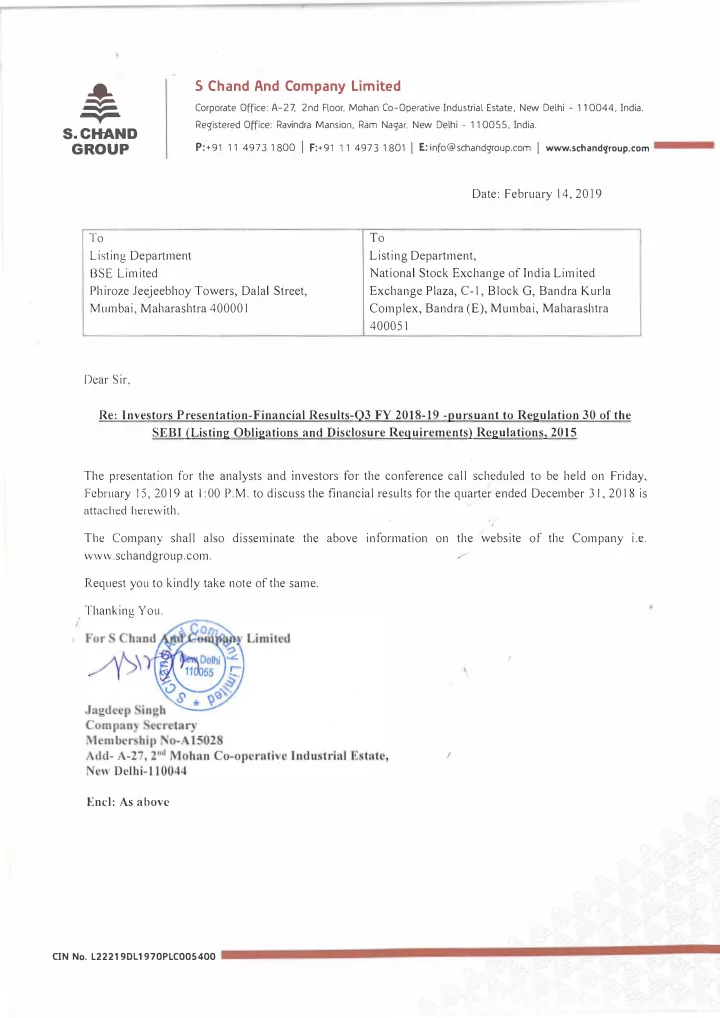
To Listing Depa,tment BSE Limited Phiroze Jeejeebhoy Towers, Dalal Street, Mumbai, Maharashtra 400001 Dear Sir, Date: February 14, 2019 To Listing Department, National Stock Exchange of India Limited Exchange Plaza, C-1, Block G, Sandra Kurla Complex, Sandra (E), Mumbai, Maharashtra 400051 Re: Investors Presentation-Financial Results-O3 FY 2018-19 -pursuant to Regulation 30 of the SEBI (Listing Obligations and Disclosure Requirements) Regulations, 2015 The presentation for the analysts and investors fpr the conffrence call scheduled to be held on Friday, February 15, 2019 at I: 00 P .M. to discuss the financial results for the quarte ended December J I, 2018 is attached herewith.

'

I

The Company shall also disseminate the above infprmation on the website of the Company 1.e. www.schandgroup.com. Request you to kindly take note of the same. Thanking You. Encl: As above

CIN No. L22219Dl 1970PLC005400

/

I

slide-2
SLIDE 2
  • S. Chand and Company Limited

Q3 – FY2018-19 Result Presentation February 14, 2019

slide-3
SLIDE 3

SUMMARY

  • KEY HIGHLIGHTS
  • LAUNCH OF S CHAND 3.0 – FOCUS ON

CASH FLOW IMPROVEMENT

  • SEASONAL NATURE OF OUR BUSINESS
  • CONSOLIDATED FINANCIALS: Q3FY19
  • WORKING CAPITAL CYCLE
  • SHAREHOLDING STRUCTURE
  • LOOKING AHEAD
  • ANNEXURE:
  • China vs India – A Case Study in Education

Sector

  • Indian Education Sector - Overview
  • S Chand – Group Profile
  • S Chand - Historical Financial Performance

2

slide-4
SLIDE 4

KEY HIGHLIGHTS

  • Launched “S Chand 3.0” Program focused on increasing Free cash flow generation
  • We have launched “S Chand 3.0” program in the company which is aimed at generating higher free cash flows from

the business. As a first step, we are targeting better terms with channel partners during the ongoing sales season followed by various operational and business cost control measures across our companies which should lead to better cash flow metrics during the next financial year. Hence, for the purpose of achieving better terms with channel partners this season, we are revising FY19 revenue growth guidance to low single digits.

  • Chetana Publications LLP investment mutually terminated
  • We were awaiting certain conditions precedent to be met in order to complete the acquisition but these have not

been met despite taking additional time extensions. Considering this, both parties have mutually decided not to proceed ahead with the transaction. Do note that this decision has no impact on our financials.

  • Chhaya Prakashani acquisition of the remaining 26% stake on track – To be completed in February
  • We are in the process of acquiring final 26% and taking our stake to 100% in the company. We expect the pay out to

happen within February, 2019.

3

slide-5
SLIDE 5

KEY HIGHLIGHTS

  • Relentless focus on improving debtor days metrics
  • Due to the seasonal nature of our business, Q3 historically contributes only a minor portion of our annual revenues.
  • Our Debtor days has reduced by 23 days QoQ to 155 days (vs. 290 days in Q4FY18, 231 days in Q1FY19 & 178

days in Q2FY19)

  • Our Net Working capital days has increased by 22 days QoQ to 224 days (vs. 253 days in Q4FY18, 235 days in

Q1FY19 & 202 days in Q2FY19) on back of increase in inventory levels for Q4. Do note that historically Q3 sees an increase in the working capital on back of higher inventory for addressing Q4 sales.

  • Q3 saw extraordinary sales return
  • In the process of improving our terms with some channel partners and working capital improvement measures, there

have been an unexpected return of material of Rs226m. This is not in the ordinary course of business and the returned goods are currently being redistributed to other channel partners in Q4.

4

slide-6
SLIDE 6

LAUNCH OF S CHAND 3.0 – FOCUS ON CASH FLOW IMPROVEMENT

5

  • Focusing on better terms with channel partners, improved velocity of

collection, sale productivity metrics etc.

  • Focus on higher margin products.
  • Tightening of discounting structure.

Targeting better terms with channel partners during sales in the current year

  • Focus on portfolio of faster moving titles.
  • Controlling print runs of slow moving titles.
  • Warehouse consolidation.
  • Rationalizing number of SKU’s.

Lower Inventory levels

  • Prioritizing our channel partners based on historic receivable efficiency.
  • Strict escalation of delay in receivable collection from channel partners in

the appropriate manner.

  • Dealer loyalty program launched.

Faster Receivables collection cycle

  • Consolidation of warehousing space
  • Focus on manpower optimization through shared services
  • Renegotiations of major operational cost items

Lowering

  • perating costs

Boost to return ratios Improved margin profile

Increased Free Cash Flows

Improved

  • perational

efficiency

slide-7
SLIDE 7

Q1 April - June Q2 July - September Q3 October - December Q4 January - March

  • Last leg of K-12 sales for new

academic session and delivery

  • f books to distributors/

schools.

  • New academic session

commences in April for CBSE/ ISCE schools.

  • Annual paper contracts

negotiated.

  • Finalisation of title catalogue for

next academic year (new and revised titles).

  • Sales performance review.

(regional/ branches)

  • Content revision/ development

by editorial team in collaboration with authors.

  • Engagement with schools &
  • teachers. (training sessions,

workshops, etc.).

  • Sample distribution.

(September)

  • Return of unsold stock from

distributors as per contractual agreement.

  • Semester 1 (Higher Education)

and Test preparation sales based on government vacancy examinations.

  • Sample distribution and

evaluation by schools.

  • Printing of back list and best

seller titles.

  • Final reconciliation and closure
  • f distributor accounts before

commencement of season sales.

  • Order visibility from schools

starts building up.

  • Significant sales quarter for HE

segment.

  • K-12 season sales and delivery

to distributors/ schools. (Peak Season)

  • Semester 2 (Higher Education)

and Test preparation sales based on government vacancy examinations.

  • Printing of front list titles.
  • Additional printing runs for

back list / best seller titles based on demand.

80% to 85% of annual revenues; Peak Receivables Less than 5% of annual revenues; Peak Inventory Less than 10% of annual revenues; Negative WC Less than 5% of annual revenues; Negative WC

SEASONAL NATURE OF OUR BUSINESS

6

slide-8
SLIDE 8

SEASONAL NATURE OF OUR BUSINESS - A PICTURE IS WORTH A THOUSAND WORDS

The chart clearly highlights the seasonal nature of our industry. The company makes up the whole year profits in Q4 after posting negative profitability in the first three quarters.

7

181 303 453 2,082 340 233 517 2,621

  • 122
  • 123
  • 73

970

  • 68
  • 137
  • 68

1,193

  • 109
  • 114
  • 82

577

  • 79
  • 102
  • 58

746 (300) 300 900 1,500 2,100 2,700 Q1FY17 Q2FY17 Q3FY17 Q4FY17 Q1FY18 Q2FY18 Q3FY18 Q4FY18

S Chand (Standalone) - Historical Quarterly Performance (Rs m)

Revenue EBITDA PAT Q1, Q2 & Q3 historically contributes approx 15%-20% of annual revenues Q4 makes for majority revenues & profitability

slide-9
SLIDE 9

CONSOLIDATED FINANCIAL PERFORMANCE: Q3FY19

Expected business seasonality played out during the quarter as Q3 is typically a low revenue quarter with minor contribution to annual revenues.

8

(₹ in millions) Year ended Dec 31, 2018 Dec 31, 2017 Sep 30, 2018 Dec 31, 2018 Dec 31, 2017 March 31, 2018 Unaudited (Refer note 2) Unaudited (Refer note 2) Unaudited (Refer note 2) Unaudited (Refer note 2) Unaudited (Refer note 2) Audited I Revenue from operations 46 680 106 729 1,398 7,944 II Other income 32 29 17 74 60 127 III Total income (I+II) 78 709 123 803 1,457 8,072 IV Expenses Cost of published goods/materials consumed 611 798 305 1,173 1,170 2,388 Publication expenses 80 144 64 221 292 683 Purchases of traded goods 32 17 49 98 55 74 (Increase)/decrease in inventories of finished goods and work in progress (734) (594) (347) (1,007) (668) 101 Selling and distribution expenses 296 167 209 640 454 737 Employee benefits expenses 403 362 367 1,127 1,015 1,386 Finance cost 71 47 57 182 179 240 Depreciation and amortization expense 67 47 55 177 141 193 Other expenses 208 154 234 616 498 650 Total expenses (IV) 1,035 1,141 994 3,227 3,135 6,450 V Profit/(loss) before share of loss in associates, exceptional items and tax (III-IV) (957) (432) (871) (2,424) (1,678) 1,622 VI Share of loss in associates 10 9 4 19 10 12 VII Profit/(loss) before exceptional items and tax (V-VI) (967) (441) (875) (2,443) (1,688) 1,609 VIII Exceptional items (refer note 11) 226

  • 284
  • IX

Profit/(loss) before tax (VII-VIII) (1,193) (441) (875) (2,728) (1,688) 1,609 X Tax expenses: 1) Current tax 12 28 (8) 6 30 585 2) Deferred tax (390) (210) (295) (849) (538) (46) XI Profit/(loss) for the period/ year from continuing operations (IX-X) (815) (259) (571) (1,884) (1,180) 1,071 Particulars Nine months period ended Quarter ended

slide-10
SLIDE 10
  • Debtors reduced from Rs6,312m as of Q4FY18 to Rs3,085m as of Q3FY19 (vs Rs5,016 in Q1FY19 & Rs3,866 in Q2FY19)
  • Overall net working capital stood at 224 days on back of increased inventory to cater to Q4 sales. This is a usual industry phenomenon.

WORKING CAPITAL CYCLE – ELEVATED IN Q4, REDUCTION CONTINUES TILL Q3

Industry phenomenon of peak receivables in Q4 followed by reduction over following Q1, Q2 and Q3

198 148 127 260 204 151 144 290 231 178 155 229 197 217 250 237 207 186 253 235 202 224 100 150 200 250 300 Q1FY17 Q2FY17 Q3FY17 Q4FY17 Q1FY18 Q2FY18 Q3FY18 Q4FY18 Q1FY19 Q2FY19 Q3FY19

Receivable Days and Net Working Capital Days (Consolidated)

Recievable Days Net Working Capital Days

9

slide-11
SLIDE 11

Key Institutional Investors - December 2018 % Holding Everstone Capital Partners II LLC 9.5% International Finance Corporation 8.0% HDFC Mutual Fund 7.1% Aditya Birla Sun Life Mutual Fund 3.1% Volrado Venture Partners Fund 2.6% Indus India Fund 1.9% Sundaram Mutual Funds 1.3% BNP Paribas 1.1% Market Data As of 13th Feb, 2019 Market Capitalization (Rs Mn) 7,370 Price (Rs) 211

  • No. of shares outstanding (Mn)

34.95 Face Value (Rs.) 5.0

46.7% 36.4% 12.2% 4.7%

Ownership As On December 2018

Promoter Others Mutual Funds FII (Source: www.bseindia.com) (Source: www.bseindia.com) (Source: www.bseindia.com)

SHAREHOLDING STRUCTURE

10

slide-12
SLIDE 12

Annexure:

  • China vs India – A Case Study

in Education Sector

  • Indian Education Sector -

Overview

  • S Chand – Group Profile
  • S Chand - Historical Financial

Performance

11

slide-13
SLIDE 13

CHINA - A CASE STUDY IN GROWTH - INDIA EXPECTED TO FOLLOW SUIT

  • GDP per capita US$ 2,100.
  • Private education market < US$ 50 Billion*.

CHINA 2006 CHINA 2017 INDIA 2017

  • GDP per capital US$ 8,836
  • K-12 market doubled in last 5 years.
  • Private education market at US$ 260 Billion, expected to touch US$

330 Billion by 2020.

  • Largest global educational companies in book publishing, digital and

vocational learning. (TAL - $ 21B, New Oriental - $ 15B, China South Publishing – $ 4 B).

* Industry estimates. ** Per market estimates of GDP being US$ 5 trillion by 2025.

  • GDP per capita US$ 1,940
  • K-12 market growing at ~ 20%.
  • Private education market ~ US$ 30 Billion*.
  • Education market expected to double to US$

180 Billion by 2020.

INDIA 2025

  • GDP per capita expected ~ US$ 3,600**.
  • Over 50% students expected to enroll in

private schools.

  • Emergence of private education market led

by K-12 segment.

  • Billion dollar enterprises in education

industry. 230 MN Student Population 315 MN

12

slide-14
SLIDE 14

(Source: Technopak Research Report. Technopak Outlook on India’s Schooling Segment June 2017. Nielsen: India Book Market Report 2015)

US$90 BN Market Size for the Indian Education Sector

50 15 8 5 5 2 6

India education sector

Formal Education Segment

  • US$65 BN
  • Comprises both K-12 schools and higher

education institutions (colleges, engineering institutes, etc.).

  • Regulated segment, institutions cannot be

set up on a ‘for profit’ basis. Informal Education Segment

  • US$20 BN
  • Comprises of test prep, tutoring, early

education and vocational training.

  • Less regulated; no restrictions on profit

distribution.

1.6 1.9 2.3 2.7 3.2

FY2011 FY2012 FY2013 FY2014 FY2015

(K-12 ancillary market, US$ in billion)

K-12 Higher Education Test prep Vocational Tutoring Early education

  • S. Chand operates in this segment (K-12/ Higher Education content).

➢ Supports formal and informal education segments.

  • Comprises of content, digital content & services like curriculum management.
  • Mostly caters to K-12 & higher education institutions.

➢ Less regulated; no restrictions on profit distribution. ➢ K-12 ancillary market is a fast growing segment. ➢ Robust growth drivers.

  • Eligible K-12 population of about 296 MN students in age group 6 to 17 years.
  • Private unaided schools increased at average rate of 10.4% during 2011-15.
  • India has largest education system in the world with over 750 Universities & 35,000

colleges.

➢ Highly fragmented segment providing room for growth.

US$6 BN Ancillary Education Segment

INDIAN EDUCATION SECTOR - LARGE & GROWING ADDRESSABLE OPPORTUNITY

13

slide-15
SLIDE 15

113 127 133 121 111 348 188 66 9% 11% 11% 10% 9% 29% 16% 6%

  • 30%
  • 20%
  • 10%
0% 10% 20% 30% 40% 50 100 150 200 250 300 350 400 450 500

0 to 4 5 to 9 10 to 14 15 to 19 20 to 24 25 to 44 45 to 64 above 65

  • No. of people (mn)

Percentage of total people

Age-wise population distribution in India : S. Chand target market

Potential Market of 492 MN = 41% of total population

  • Gross

enrolment ratio and students completing primary & secondary education gradually improving in India.

  • Falling dropout rates and increased girls participation led to

improvement in literacy rate.

  • Government promoting education through various schemes with

budgetary support. Literacy rate improving with higher participation from students

  • S. Chand well positioned to benefit from sector tailwinds

5.6% 4.7% 4.3%

0.00% 1.00% 2.00% 3.00% 4.00% 5.00% 6.00% 7.00% 8.00% 9.00% 10.00%

2012 2013 2014

Decrease in drop-out rates for primary education in India

(Source: IBEF Report) (Source: Nielsen Report)

Estimated Population Level of Education % 2017 (MN) % 2022 (MN) Illiterate 20% 269 18% 250 Literate but no formal schooling 2% 27 1% 14 School - Up to 5th standard 35% 471 36% 501 School - Up to 10th standard 18% 242 18% 250 School - Up to 12th standard 11% 148 11% 153 Some college but not graduate 5% 67 5% 70 Graduate 6% 81 7% 97 Postgraduate 3% 40 4% 56 Literate 80% 1076 82% 1141 Total 100% 1345 100% 1391

(Source: Technopak’s Outlook on India Schooling Segment)

INDIAN EDUCATION SECTOR: INFLECTION POINT, STRONG POTENTIAL

14

slide-16
SLIDE 16

Private schools market share increasing every year

80.0% 78.8% 78.5% 77.9% 77.0% 20.0% 21.2% 21.5% 22.1% 23.0%

0% 20% 40% 60% 80% 100% 120%

FY11 FY12 FY13 FY14 FY15 Government schools Private Schools

  • Student share of private schools increasing consistently despite subsidised

fees and free meals/ books in government schools.

  • Government schools losing favour even amongst the rural and not so

affluent population.

  • CBSE and ICSE schools are preferred for their superior curriculum and better

pedagogy.

  • S. Chand is a key beneficiary of increasing number of CBSE and ICSE schools,

being the leading content provider to such schools amongst the private publishers.

CBSE & ICSE increasing faster amongst affiliated board schools

Board 2010-11 2011-12 2012-13 2013-14 2014-15 2015-16 2016-17 CAGR CBSE 11,349 12,337 13,898 14,778 15,933 17,474 19,446 9.4% ICSE 1,461 1,565 1,678 1,798 1,927 2,181 2,295 7.8% State Boards 13,16,401 13,63,862 14,47,487 14,65,871 14,60,455 NA NA NA Total 13,29,211 13,77,764 14,63,063 14,63,447 14,78,315 NA NA NA

(Source : Nielsen Research Report, School Board reports, DISE)

Preference towards private schools continue to rise Indian K-12 education infrastructure

Number of Schools: 1.5 MN Government: 1.1 MN Private: 0.4 MN Number of Students: 260 MN Government: 150 MN Private: 110 MN

  • No. of Teachers: 9 MN

Government: 5 MN Private: 4 MN Annual Intake: 18 MN Government: 10 MN Private: 8 MN Additional Capacity Required: 36 MN Additional Requirement of Teachers: 2 MN Additional Resources: USD 55 BN

(Source: Technopak’s Outlook on India’s Schooling Segment) (Source: IBEF Report)

PREFERENCE TOWARDS PRIVATE, CENTRAL CURRICULUM SCHOOLS

15

slide-17
SLIDE 17

PREFERENCE TOWARDS PRIVATE, CENTRAL CURRICULUM SCHOOLS

Intl Schools

CBSE + ICSE Schools Unaffiliated Private English Medium Schools Private Unaided and Large

  • Govt. State Board Schools in

Tier 1 and 2 cities

  • Govt. Aided State Board Schools with Low

Student Population

25-300 Schools 20,000 schools 55,000 -60,000 schools 220,000 -240,000 schools 32,00,000 schools

Total Schools in India ~ 15,00,000 schools

  • Currently covering 38,000 schools in the target market
  • Target market growing at 8-10% annually in the no. of

schools

  • Total student strength in India is est. 260 million
  • Students strength in the target market is est. 120

million and growing at 7-8 annually.

Target Market is 3,00,000 schools – growing at 8-10 % annually and student strength growing at 7-8%

16

slide-18
SLIDE 18

Strong content, multiple best-sellers.

➢ Offerings spanning entire the

education spectrum

  • Early learning
  • K-12
  • Higher education

➢ Pan-India sales and distribution network

driving deep market reach.

➢ Presence in Central (CBSE, ICSE) and State

Board affiliated schools across India. Delivering content, services and solutions… …across the education continuum …with Pan India reach Portfolio of brands focused on print / digital content. 75+ Years of operating history 53 MN Active book titles Author relationships ➢ Long operating history of over seven decades. ➢ High brand equity across multiple brands. ➢ Strong author relationships. ➢ Keeping pace with time - transition from print into digital content and services. ~ 2,443 29% Revenue CAGR FY2012-18 10,000+ Books sold in FY2018 90 TPD Print Capacity in number of sheets

S CHAND GROUP - LEADER IN INDIAN EDUCATION CONTENT

17

slide-19
SLIDE 19

S CHAND GROUP - BUSINESS SEGMENTS

K-12

80% of FY2018 revenues 40% revenue CAGR(2012-2018)

School students (4 -18 years)

  • Schools affiliated to Central / State Board.
  • Offers print content (books) and digital /

hybrid content and solutions.

  • Largest K-12 content player in India.

Dominant presence in Central Board affiliated schools and increasing presence in State Board affiliated schools.

Higher Education

18% of FY2018 revenues 9% revenue CAGR (2012-2018)

Test prep (>18 years) College students / professionals

  • Colleges and universities (arts, science &

commerce degrees).

  • Test

prep for competitive exams (engineering, government jobs).

  • Offers books, e-books, web and mobile

delivery of content.

Early Learning

2% of FY2018 revenues

Children (2-5 Years)

  • STEM based learning.
  • Children books, educative games, activity

based modules (experiential learning).

  • Also
  • perates

6 pre-schools under ’RiseKids’ brand.

Revenue contribution Target Segment Description/ Highlights

  • Consolidate leadership position in Central

schools as preferred content partner.

  • Increase

presence in large regional markets.

  • Exam
  • riented

content for test preparation.

  • Institutional partnerships.

Strategy

  • Focus on digital to expand reach and

product offering.

  • Complete

presence across student lifecycle.

Brands

18

slide-20
SLIDE 20

Growth Strategy

❖ Consolidated leadership in CBSE/ ICSE schools as preferred content provider. ✓ More offerings in K-12 through multiple brands. ✓ Curriculum management. ❖ Geographical diversification in large regional markets/ state board schools. ✓ Acquisitions/ Joint Ventures. ❖ Higher share of education spend with enhanced content offerings. ✓ Digital/ hybrid offerings. ❖ Continuous content development

5,378

839 1,620 2,173 3,378 3,898 5,427 6,355

FY12 FY13 FY14 FY15 FY16 FY17 FY18 FY12 FY13 FY14 FY15 FY16 FY17 FY18

✓Best selling titles in core subjects (Mathematics, Science, English, Hindi) . ✓Hybrid offerings provide more value per unit to student compared to pure print content

S CHAND GROUP - GROWTH ANCHORED BY LEADERSHIP IN K-12 SEGMENT

19

slide-21
SLIDE 21

Connecting with Learners

  • Art of Book making tour of the Printing Facilities
  • Mystudygear App
  • Social Media

Connecting with Teachers with

  • Teacher Conclaves and Awards
  • Over 2000 Workshops
  • The Progressive Teacher magazine

Connecting with School Leadership

  • Best Practices in Education Tour to Finland
  • The Progressive School magazine

Connecting with Channel Partners

  • Dealer Meets , Events and Awards
  • Monthly mailer “Sampark”

Increasing Brand presence

  • Brand Ambassador
  • Strategic Advertising

S CHAND GROUP - POWERFUL BRAND CONNECT

20

slide-22
SLIDE 22

ACQUISITONS & DIGITAL INITIATIVES

ACCELERATE

NEW LEARNING TOOLS

INNOVATE

CORE BUSINESS

EXECUTE

Maintain Leadership Be Future Ready

3

  • Continue to dominate share of K-

12 content market (CBSE/ICSE/WBB).

  • Improve share of wallet &

student reach.

  • Cover 100,000 schools by FY

2023 from current reach of 40,000+ schools.

  • Expand into regional markets through strategic

alliances/ acquisitions.

  • ”Phygital” to broaden reach and improve
  • utcome.
  • Expand digital & service offerings to new

geographies and segments.

1

  • Smart books for the mobile generation.
  • Education streaming for learners.
  • Activity based learning tools (STEM).

Leverage Reach & Expand

2

S CHAND GROUP - OUR THREE PRONGED STRATEGY

21

slide-23
SLIDE 23

S CHAND GROUP - LEVERAGE REACH & EXPAND – STRATEGIC ALLIANCES / ACQUISITIONS

STRATEGIC ALLIANCES / ACQUISITIONS

  • Strengthen penetration in the CBSE, ICSE Schools and expand into regional markets.
  • Made multiple successful acquisitions in the past, integrating companies with S. Chand Group philosophy
  • Alliances with HMH (USA) , Sigong Media (S. Korea), Robosoft
  • Acquisitions made by the Group in the recent past:

Driver for acquisition

Complemented S. Chand portfolio of books specially Hindi, Commerce , Management , Distance Learning Program

Driver for acquisition

Complemented S. Chand portfolio of books specially Sanskrit, French , Art & Craft , Physical Education , Regional Languages

Driver for acquisition

Expansion in Regional Market of West Bengal, State Board, Supplementary and text book business 22

slide-24
SLIDE 24

S CHAND GROUP - DIGITAL – COMPLEMENTING CORE BUSINESS THROUGH “PHYGITAL"

  • Extensive support to teachers for better

understanding of particular topics.

  • Teacher can seek support from S. Chand.
  • Test preparation and simulated papers

for learners to test their understanding.

  • Students can gauge their performance

and better prepare for exams.

  • More content in form of animations/

videos.

  • Online digital library accessible to

students. Short Multi-media / videos to better illustrate difficult topic to students.

Hybrid Offerings through e-books, QR Codes, mystudygear etc.

  • Complements existing books / content, not a compete / alternative.
  • Not an independent revenue stream but acts as a sales multiplier of the books relative to the books

from unorganized players.

  • Price of the book includes cost of digital access / content. Incremental Revenue ~ ₹600 million (FY18)

23

slide-25
SLIDE 25

In-House (Revenue Stream)

  • Offerings include digital classroom learning solutions,

learning management systems and curriculum management which contribute to the revenue streams in the business.

  • Approximated Investments ₹976 million.

S CHAND GROUP - DIGITAL INITIATIVES – SYNERGIES TO THE CORE BUSINESS

Digital Investments (Inorganic)

  • Focused on investing in early stage digital companies.
  • Total investments in digital investee companies is ~Rs.304

mn.

  • Currently, Investment portfolio commands a valuation of

around 2X as per the latest funding rounds for respective companies.

  • Focus is on establishing synergies with core business

along with investment returns. 24

slide-26
SLIDE 26

+ 18% yoy

Revenue growth FY 2017-18

+ 21% yoy

Ebidta growth FY 2017-18

+ 73% yoy

PAT growth FY 2017-18

INR 31.1

Earning Per Share FY 2017-18

Summary : Consolidated Figures in INR Mn FY 2018 Audited FY 2017 Proforma* YOY% FY 2017 Audited Total Revenues 8,072 6,868 18% 6,622 Ebidta 2,054 1,705 21% 1,687 Profit before taxation 1,622 1,081 50% 1,069 Profit after taxation 1,071 619 73% 613 EPS (in INR) 31.1 20.7

  • 20.5

Financial results have been prepared in accordance with IND-AS. * 2017 Proforma includes consolidation of operational performance of Chhaya for the full year.

S CHAND – HISTORICAL FINANCIAL PERFORMANCE

25

slide-27
SLIDE 27

Increasing Contribution of K-12 to Group Revenues. Revenue Growth = Organic Growth + Acquisitions.

1,746 2,816 3,710 4,785 5,407 6,833 7,945

FY12 FY13 FY14 FY15 FY16 FY17 FY18 6 - Year CAGR : 29%

EBIDTA Growth at a Faster Pace.

271 599 798 1,040 1,281 1,705 2,054

FY12 FY13 FY14 FY15 FY16 FY17 FY18 6 - Year CAGR : 40%

Net Profit Growth (excluding minority).

147 323 423 268 466 582 1,071

FY12 FY13 FY14 FY15 FY16 FY17 FY18

2,173 3,378 3,898 5,427 6,355 1,345 1,237 1,282 1,224 1,403

FY2014 FY2015 FY2016 FY2017 FY2018 Early learning K12 Higher Education Other Revenue 6 - Year CAGR : 39%

Figures for FY 2017 & FY 2018 are as per IND-AS. Prior year figures are as per Indian GAAP and may be fully comparable.

S CHAND – HISTORICAL FINANCIAL PERFORMANCE

26

slide-28
SLIDE 28

Improving Margin Profile

  • Economies of scale
  • Production Efficiency
  • Rationalization of Royalty
  • Improved realization from

DEBs

  • Operating Leverage

S CHAND – IMPROVING MARGIN PROFILE

27

slide-29
SLIDE 29

Disclaimer

This presentation and the following discussion may contain “forward looking statements” by S. Chand & Company Limited (“S. Chand” or the Company) that are not historical in

  • nature. These forward looking statements, which may include statements relating to future

results of operations, financial condition, business prospects, plans and objectives, are based on the current beliefs, assumptions, expectations, estimates, and projections of the management of S. Chand about the business, industry and markets in which S. Chand

  • perates.

These statements are not guarantees of future performance, and are subject to known and unknown risks, uncertainties, and other factors, some of which are beyond S. Chand’s control and difficult to predict, that could cause actual results, performance or achievements to differ materially from those in the forward looking statements. Such statements are not, and should not be construed, as a representation as to future performance or achievements of S. Chand. In particular, such statements should not be regarded as a projection of future performance

  • f S. Chand. It should be noted that the actual performance or achievements of S. Chand

may vary significantly from such statements. Saurabh Mittal Chief Finance Officer Contact No : +91 11 4973 1800 Email : investorrelations@schandgroup.com Atul Soni Head – Investor Relations Contact No : +91 11 4973 1800 Email : asoni@schandgroup.com CIN: L22219DL1970PLC005400 Registered Office: Ravindra Mansion, Ram Nagar, New Delhi-110055, India.

28