
SLIDE 1
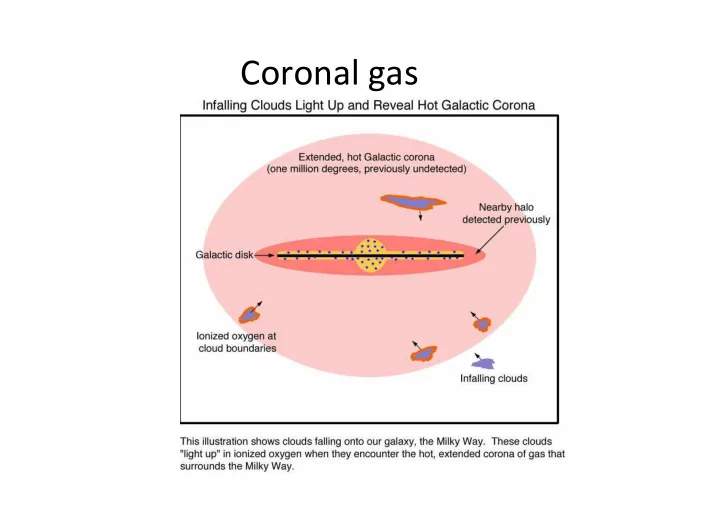
Coronal gas Inverse Compton emission (= sca4ering of photons off - - PowerPoint PPT Presentation
Coronal gas Inverse Compton emission (= sca4ering of photons off rela8vis8c electrons) ~ h 2 h ~h ~h Lab Lab Electron frame Synchotron radia8on Non-relativistic case: balancing centrifugal and Lorentz force gives
Lab Electron frame Lab
hν ~γhν ~γhν ~γ hν
2
Non-relativistic case: balancing centrifugal and Lorentz force gives cyclotron frequency
Red = disc component Green line = synchotron Blue line = inverse Compton
í See ` High energy Astrophysics’ (Melia) p.91
X-ray bremsstrahlung in cluster of galaxies (Perseus) : T=10^8K Radio bremsstrahlung (green) in star forming region NGC3603 cf
0.5 1 1.5 2 35 40 45 50
Log Φ ion Log M_* cf
Pink = H α emitting bubbles surrounding young stars: note spiral structure
Ionising photons can’t penetrate dense gas which con8nues to form stars. Strong ou[lows driven from low density channels but don’t carry much mass
ç ì
ì
Can we understand the dis8rbu8on of holes of different sizes in terms of the distribu8on of clusters of different N?