COPD WITH R ESPIRATORY ESPIRATORY F F AILURE AILURE By: Emily Coker - - PDF document

copd
SMART_READER_LITE
LIVE PREVIEW

COPD WITH R ESPIRATORY ESPIRATORY F F AILURE AILURE By: Emily Coker - - PDF document

C HRONIC O BSTRUCTIVE P ULMONARY D ISEASE ! Disease that limits airflow through inflammation of the lining of the bronchial tubes or by destruction of the alveoli. ! Seen in people of all ages, but common among individuals who smoke and


slide-1
SLIDE 1

COPD COPD WITH

WITH

RESPIRATORY

ESPIRATORY F

FAILURE

AILURE

By: Emily Coker & Jaswant Singh

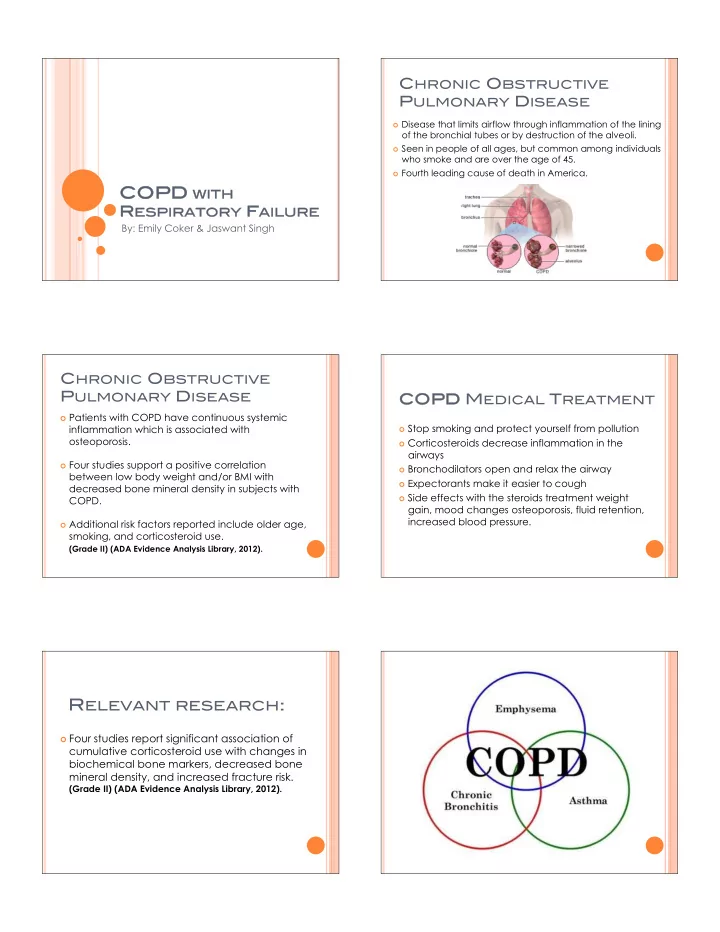
CHRONIC OBSTRUCTIVE PULMONARY DISEASE

! Disease that limits airflow through inflammation of the lining

  • f the bronchial tubes or by destruction of the alveoli.

! Seen in people of all ages, but common among individuals

who smoke and are over the age of 45.

! Fourth leading cause of death in America.

CHRONIC OBSTRUCTIVE PULMONARY DISEASE

! Patients with COPD have continuous systemic

inflammation which is associated with

  • steoporosis.

! Four studies support a positive correlation

between low body weight and/or BMI with decreased bone mineral density in subjects with COPD.

! Additional risk factors reported include older age,

smoking, and corticosteroid use. (Grade II) (ADA Evidence Analysis Library, 2012).

COPD COPD MEDICAL TREATMENT

! Stop smoking and protect yourself from pollution ! Corticosteroids decrease inflammation in the

airways

! Bronchodilators open and relax the airway ! Expectorants make it easier to cough ! Side effects with the steroids treatment weight

gain, mood changes osteoporosis, fluid retention, increased blood pressure.

! Four studies report significant association of

cumulative corticosteroid use with changes in biochemical bone markers, decreased bone mineral density, and increased fracture risk.

(Grade II) (ADA Evidence Analysis Library, 2012).

RELEVANT RESEARCH:

slide-2
SLIDE 2

CHRONIC BRONCHITIS

! Chronic bronchitis caused

by inflammation of the lining of bronchial tubes.

! Results from smoking

cigarette or repeated exposure to smoke and environment pollutants.

! Diagnosis one must have a productive cough and

shortness of breath that lasts about 3 months or more each year for 2 or more years in a row.

EMPHYSEMA

MPHYSEMA

! Caused by the destruction

  • f the lung tissue, which is

a late complication of chronic bronchitis.

! Loss of connective tissue

results in loss of surface area.

! Bronchioles lose their

elasticity.

! Air is trapped in the lungs. ! Results in extreme fatigue

and physical exhaustion.

EMPHYSEMA

! Rare cases emphysema is caused by

deficiency of Alpha 1-antitrypsin protein

  • r Alpha 1-protease inhibitor.

! ATT is produced by the liver, travels to

the lungs to protect them from destruction.

RESPIRATORY FAILURE

! Respiratory failure occurs when the respiratory

system is no longer able to perform its normal function.

! Results from COPD or Cystic Fibrosis. ! Acute Respiratory Distress Syndrome (ARDS)

results from direct damage to lung tissue as is seen with pneumonia and COPD.

! Symptoms of ARDS are dyspnea, severe

hypoxemia, decreased lung function.

! Respiratory failure may be managed by

supplemental oxygen through a mechanical ventilator.

! Enteral nutrition is preferred method of nutritional

support due to its role in maintaining GI function, reduced risk of sepsis and low cost.

! 25 kcals per kilogram appears to be adequate for

most patients.

! Monitor the patient to prevent overfeeding

because overfeeding is associated with increased levels of C02 in the blood which raises the Respiratory Quotient.

RESPIRATORY FAILURE,

(CONTINUED):

! Patients with Acute Respiratory Distress Syndrome

(ARDS) have increased protein requirements. Range 1.2-1.5g/kg/day.

! Enteral and parenteral products high in fat and low

in carbohydrates developed specifically for patient with ARDS have demonstrated decreases in both PaCO2 and time on mechanical ventilation.

! ARDS is associated with the development of

pulmonary edema. Fluid restriction formula may be helpful.

! ARDS is associated with the production of oxygen,

free radical, and inflammatory mediators derived from Arachidonic acid.

RESPIRATORY FAILURE,

(CONTINUED):

slide-3
SLIDE 3

! Recent research suggests that the omega 3

and 6 fatty acids EPA (eicosapentaenoic acid) and GLA (gamma-linolenic acid) can reduce the severity of inflammatory injury.

! Phosphate is essential for optimal pulmonary

function and normal contractibility of the diaphragm.

! When low levels of phosphate in the blood, or

hypophosphatemia, occurs, it can lengthen a patient’s hospital stay and dependence on mechanical ventilation.

RELEVANT RESEARCH:

ASSESSMENT

SSESSMENT

Client Name: Daishi Hayato

Age: 65 years old Gender: Male Ethnicity: Asian American

! Household members:

! Wife, 62 ! four adult children:

live out of the area

! Occupation:

Retired manager of local grocery chain

! Education:

Bachelor’s degree

CHIEF COMPLAINT

! Patient was brought to the emergency room

by his wife after experiencing the sudden onset

  • f severe dyspnea while working in his yard.

MEDICAL HISTORY

! Upon arrival to emergency room, patient

received a chest radiograph which revealed a tension pneumothorax of his left lung.

! Patient has a long-standing history of COPD,

secondary to chronic tobacco use (2 pack/day smoker for 50 years).

! Patient experiences marked limitation of his

exercise capacity due to onset of dyspnea on exertion.

MEDICAL HISTORY

! Wife related general appetite is only fair. ! Usually, breakfast is the largest meal. ! His appetite has been decreased for past

several weeks.

! She states that his highest weight was

135lbs, but she feels he weighs much less than that now.

MEDICAL HISTORY

! Patient experiences two-pillow orthopnea,

swelling in lower extremities, and intermittent claudication, or cramping in his left calf when walking.

! Diagnosed with emphysema over 10 years ago. ! Underwent cholecystectomy 20 years ago, and

total dental extraction 5 years ago.

slide-4
SLIDE 4

MEDICATION

! Combivent (metered dose inhaler) ! 2 inhalations 4x/day ! Lasix ! 40 mg/day ! Oxygen via nasal cannula ! During sleep

NUTRITION DIAGNOSIS (PES)

! Involuntary weight loss (NC-3.2)- related to

acute respiratory distress, COPD and decreased appetite as evidence by 13lb wt. loss in “several” weeks.

KCAL NEEDS

! 66.5+ (13.8 x 55.5)+(5 x 162.56)-(6.8 x 65) = 1203.2 x 1.2= 1444 ! 25kcals x 55.5=1387/ 35kcals x 55.5= 1942kcals ! Protein: 1.2g x 55.5g= 66.6g/ 1.5g x 55.5= 83.25g ! Ireton Jones equation: Ventilator-dependent ! 1784-11(65)+5(55.5)+244(1)+239(0)+804(0)= 1313 ! Significant delay in gastric emptying time after the

higher fat supplement. While respiratory quotient increased significantly after both meals (p=0.01).

(Grade II) (ADA Evidence Analysis Library 2012)

! Patients with COPD who are malnourished (as defined

by BMI) may have lower lung function measurements, more dyspnea, and lower nutritional intake. (Grade II) (Katsura et al 2005; Evidence Analysis Library 2012)

RELEVANT RESEARCH

DIETETICS

IETETICS

PRACTICE

RACTICE

FRAMEWORK

RAMEWORK SCOPE OF

NUTRITION INTERVENTION

! Initiate Enteral Nutrition (ND-2) ! Enteral nutrition initiated on day 2:

! Nutrivent ! 1829 kcal/1.5= 1219mL/ 24 hours=

51 mL/hour

! 1.219L x 100gCHO= 121.9g CHO ! 1.219L x 94= 114.6g fat ! 1.219L x 0.78 = 950.82mL H20 ! 1219-950=879mL H2O/6 hours=

219.75mL flush every 6 hours

slide-5
SLIDE 5

NUTRITION INTERVENTION

! Due to high residuals the patient was started on

Parenteral nutrition formula: ProcalAmine.

! On day 4, the patient was restarted on

enteral nutrition.

! On day 5 parenteral nutrition was discontinued. ! Enteral feedings continued until day 8,

when patient was weaned from ventilator.

OUTCOME

UTCOME GOALS GOALS:

SHORT AND LONG TERM

! Eternal and Parenteral nutrition to help

stabilize the patient.

! Get the patient healthy enough to

wean from the mechanical ventilator.

! Prevent further weight loss.

MONITOR AND EVALUATE

! Weight ! Kcal consumption

to prevent overfeeding

FOLLOW-UP /

POST-HOSPITAL STAY

! Once the patient is released from the

hospital, provide knowledge on mechanically softened diet.

! Encourage: ! fluids ! consumption of small, frequent meals ! use of oxygen while eating to prevent fatigue

and increase kcal consumption.

! Referral to smoking cessation specialist.

CITATIONS

! American Dietetic Association Scope of Dietetics

Practice Framework Decision Tree. Reprinted from reference (1).

! Forli L, Pedersen JI, Bjortuft O, Vatn M, Boe J.! Dietary

support to underweight patients with end-stage pulmonary disease assessed for lung transplantation.! Respiration 2001;68(1):51-7.

! Hugli O, Schutz Y, Fitting JW.! The daily energy

expenditure in stable chronic obstructive pulmonary disease.! Am J Respir Crit Care Med 1996;153(1):294-300.

! Katsura H, Yamada K, Kida K. Both generic and disease

specific health-related quality of life are deteriorated in patients with underweight COPD. Respiratory Medicine 2005;99:624-30.

CITATIONS (CONTINUED)

! Nelms M, Sucher K, Lacey K, Roth S. Nutrition Therapy

and Pathophysiology. 2nd ed. Pacific Grove, Ca: Brooks/ Cole, 2010.

! Scanlon PD, Connett JE, Wise RA, Tashkin DP, Madhok T,

Skeans M, Carpenter PC, Bailey WC, Buist AS, Eichenhorn M, Kanner RE, Weinmann G, The Lung Health Study Research Group.! Loss of bone density with inhaled triamcinolone in Lung Health Study II.! American Journal

  • f Respiratory and Critical Care Medicine

2004;170:1302-1309.

! Soriano JB, Visick GT, Muellerova H, Payvandi N, Hansell

AL.! Patterns of comorbidities in newly diagnosed COPD and asthma in primary care.! Chest 2005;128:2099-2107.