Coordinating Post-Grant Patent Opposition in Europe and the U.S. - - PowerPoint PPT Presentation

coordinating post grant patent opposition in europe and
SMART_READER_LITE
LIVE PREVIEW

Coordinating Post-Grant Patent Opposition in Europe and the U.S. - - PowerPoint PPT Presentation

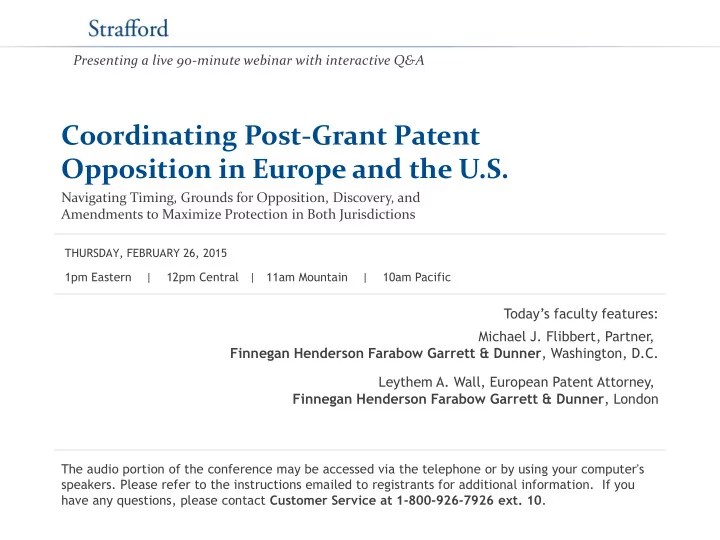
Presenting a live 90-minute webinar with interactive Q&A Coordinating Post-Grant Patent Opposition in Europe and the U.S. Navigating Timing, Grounds for Opposition, Discovery, and Amendments to Maximize Protection in Both Jurisdictions


slide-1
SLIDE 1

Coordinating Post-Grant Patent Opposition in Europe and the U.S.

Navigating Timing, Grounds for Opposition, Discovery, and Amendments to Maximize Protection in Both Jurisdictions Today’s faculty features:

1pm Eastern | 12pm Central | 11am Mountain | 10am Pacific

The audio portion of the conference may be accessed via the telephone or by using your computer's

  • speakers. Please refer to the instructions emailed to registrants for additional information. If you

have any questions, please contact Customer Service at 1-800-926-7926 ext. 10.

THURSDAY, FEBRUARY 26, 2015

Presenting a live 90-minute webinar with interactive Q&A Michael J. Flibbert, Partner, Finnegan Henderson Farabow Garrett & Dunner, Washington, D.C. Leythem A. Wall, European Patent Attorney, Finnegan Henderson Farabow Garrett & Dunner, London

slide-2
SLIDE 2

Sound Quality If you are listening via your computer speakers, please note that the quality

  • f your sound will vary depending on the speed and quality of your internet

connection. If the sound quality is not satisfactory, you may listen via the phone: dial 1-866-570-7602 and enter your PIN when prompted. Otherwise, please send us a chat or e-mail sound@straffordpub.com immediately so we can address the problem. If you dialed in and have any difficulties during the call, press *0 for assistance. Viewing Quality To maximize your screen, press the F11 key on your keyboard. To exit full screen, press the F11 key again.

FOR LIVE EVENT ONLY

slide-3
SLIDE 3

For CLE purposes, please let us know how many people are listening at your location by completing each of the following steps:

  • In the chat box, type (1) your company name and (2) the number of

attendees at your location

  • Click the SEND button beside the box

If you have purchased Strafford CLE processing services, you must confirm your participation by completing and submitting an Official Record of Attendance (CLE Form). You may obtain your CLE form by going to the program page and selecting the appropriate form in the PROGRAM MATERIALS box at the top right corner. If you'd like to purchase CLE credit processing, it is available for a fee. For additional information about CLE credit processing, go to our website or call us at 1-800-926-7926 ext. 35.

FOR LIVE EVENT ONLY

slide-4
SLIDE 4

If you have not printed the conference materials for this program, please complete the following steps:

  • Click on the ^ symbol next to “Conference Materials” in the middle of the left-

hand column on your screen.

  • Click on the tab labeled “Handouts” that appears, and there you will see a

PDF of the slides for today's program.

  • Double click on the PDF and a separate page will open.
  • Print the slides by clicking on the printer icon.

FOR LIVE EVENT ONLY

slide-5
SLIDE 5

Finnegan, Henderson, Farabow, Garrett & Dunner, LLP

Coordinating Post-Grant Patent Opposition in Europe and the U.S.

February 26, 2015 Presented by Michael J. Flibbert and Leythem A. Wall

slide-6
SLIDE 6

6

6

‘The European Patent’

  • 38 EPC Member States as of 1 January 2014
  • 28 EU States, 10 non-EU States
  • Centralized prosecution
  • Bundle of national patents
  • Articles 69 EPC and 138 EPC - National Law ‘largely’ harmonized
  • Theoretically, same results for parallel national proceedings
  • In practice, can be very different results and very expensive
slide-7
SLIDE 7

7

7

Overview

  • What is an Opposition?
  • Post-grant inter-partes procedure at the EPO (administrative, not

litigation)

  • Allows public to challenge grant of European patent
  • No limit to number of opponents
  • No commercial or other interest whatsoever need be shown
  • May result in limitation or revocation of patent
  • Reasons for opposing a patent
  • Infringement
  • Licensing/cross-licensing
  • Strategy
  • Patent intelligence
  • Political/ethical reasons
slide-8
SLIDE 8

8

8

Who Can File

  • “Any person” may have an Opposition filed on their behalf
  • Have to be represented by a European Patent Attorney
  • Opponent cannot be anonymous but can be “straw man”
  • No limit to the number of Opponents per patent, automatically

consolidated into single Opposition proceedings

slide-9
SLIDE 9

9

9

Grounds

  • Grounds of Opposition
  • lack of novelty
  • lack of inventive step
  • invention is insufficiently described
  • added matter
  • non-patentable subject matter
  • not susceptible to industrial application
  • clarity and unity are not available grounds of opposition
slide-10
SLIDE 10

10

10

Filing the Opposition

  • Opposition must be filed in writing at EPO (Munich, The Hague, Berlin) within 9

months from publication of mention of grant of patent. No extension available even if patent republished after voluntary post grant limitation or correction

  • Must set forth fully the Opponent’s case, including “an indication of the facts,

evidence and arguments”. At least one ground must be cited

  • No page limits
  • Needs to be in an EPO Official Language (English, French, German)
  • Opposition Fee is 775 EUR
  • All oppositions instituted if the above requirements satisfied
  • All reasoned grounds considered. No concept of redundant grounds
  • On public file
slide-11
SLIDE 11

11

11

Opposition Written Procedure

  • The Opposition Division
  • 3 EPO Examiners including Examiner who conducted examination
  • Written Proceedings
  • Patentee given a 4-6 month period to reply to opposition once ‘instituted’
  • No further formal written deadlines until Summons to Oral Hearing
  • Summons includes Opposition Division non-binding preliminary opinion
  • Summons sets a deadline for final written submissions, including Auxiliary

Claim Requests from the patent proprietor, for 1 month before Hearing

  • No Discovery
  • Expert declarations rare
slide-12
SLIDE 12

12

12

Claim Amendments

  • Formal
  • Theoretically no limit to number of Auxiliary claim sets (3 to 10 is typical)
  • Can be filed in reply to opposition and summons to Oral Hearing (and also

during hearing but no guarantee will be admitted)

  • Substantive
  • Must satisfy EPC requirements including added matter. Strict assessment,

express basis often requested

  • Must not broaden scope of granted claims
  • Added Matter is a ground of Opposition and claim broadening after grant not

permitted – “The Inescapable Trap” (G1/93)

slide-13
SLIDE 13

13

13

Claim Construction

  • Article 69 EPC:

“the extent of the protection conferred by a European patent or a European patent

application shall be determined by the claims. Nevertheless, the description and drawings shall be used to interpret the claims.”

  • The Protocol on Article 69 EPC

“Article 69 EPC should not be interpreted as meaning that the extent of the protection conferred by a European patent is to be understood as that defined by the strict, literal meaning of the wording used in the claims, the description and drawings being employed

  • nly for the purpose of resolving an ambiguity found in the claims. Nor should it be taken to

mean that the claims serve only as a guideline and that the actual protection conferred may extend to what, from a consideration of the description and drawings by a person skilled in the art, the patent proprietor has contemplated. On the contrary, it is to be interpreted as defining a position between these extremes which combines a fair protection for the patent proprietor with a reasonable degree of legal certainty for third parties”

slide-14
SLIDE 14

14

14

Oral Proceedings

  • Inter-partes Oral Hearing takes place in Munich, The Hague or Berlin
  • Language of the patent (English, French or German). Interpreters provided.
  • Hearing is very rarely more than a day
  • Opposition Division issue Decision at the end of the Hearing i.e. same day
  • Decision will either:
  • revoke the patent (‘kill’)
  • uphold the patent (‘miss’)
  • maintain patent in amended form (‘wound’)
  • Written Decision with full and detailed reasoning issued within a few months
  • Appealable only at the EPO
  • Whole Process 18-30 months, sometimes quicker
slide-15
SLIDE 15

15

15

Opposition Timeline

slide-16
SLIDE 16

16

16

EPO Stats – Technical Areas Opposed

  • Industrial Chemistry, Polymers and Organic Chemistry account for over a

third of all oppositions*

* “The Opposition Procedure and limitation and revocation procedures”, Daniel Closa, Beauce Gaetan, European Patent Office 30 November 2012

slide-17
SLIDE 17

17

17

EPO Stats – Opposition Outcome

  • Approximately 5% of all EP patents granted are opposed
  • Approximately 70% of patents at least wounded, over a quarter killed*

* European Patent Office “Facts and Figures 2014”

slide-18
SLIDE 18

18

18

Reasons for Revocation

  • Revocation mainly on grounds for lack of inventive step
  • Added matter revocation relatively high at 11%*

* van de Kuilen, Aalt (2013) ” Successful European Oppositions: Analysis for the patent information professional”. World Patent Information (Elsevier) 35 (2): 126–129

slide-19
SLIDE 19

19

19

Appeals

  • Notice of Appeal must be filed at EPO within 2 months of Written Decision
  • Grounds of Appeal must be filed at EPO within 4 months of Written Decision
  • Board of Appeal is entirely independent of Opposition Division. 3 members, an

EPO in-house lawyer and two technical EPO members (ex-Examiners or ex- patent attorneys)

  • Written Procedure similar to Opposition
  • Hearing similar nature to Opposition Hearing. Decision will either:
  • remit case back to Opposition Division
  • revoke the patent
  • uphold the patent
  • maintain patent in amended form
  • Decision is not appealable (unless procedural violation by Board of Appeal).

Points of Law can be referred to Enlarged Board of Appeal

  • Whole Process 18-30 months, sometimes quicker, can request acceleration
slide-20
SLIDE 20

20

20

Appeals

  • Board of Appeal (BoA) increasingly strict on admissions into the proceedings:
  • Article 12(4) of the Rules of Procedure of the Boards of Appeal refers to “the

power of the Board to hold inadmissible facts, evidence or requests which could have been presented or were not admitted in the first instance proceedings”

  • T 23/10 – BoA did not admit Auxiliary Claim Requests 8-15. Only 1-7 filed with

Opposition

  • T 144/09 – BoA did not allow simple change to the claim to remove added
  • matter. The proprietor had the chance during Opposition
  • T 361/08 – BoA did not allow requests withdrawn during opposition
slide-21
SLIDE 21

21

21

Settlement and Stays

  • Settlement
  • Opposition Division can continue opposition proceedings, regardless of when

settlement made or opponent withdrawing opposition

  • Appeal proceedings are terminated if appeal is withdrawn
  • Stays and concurrent litigation
  • In some states national proceedings automatically stayed pending opposition
  • utcome (e.g. Germany, France)
  • In some states decision based on whether national or EPO decision likely to be

issued more quickly (e.g. UK)

slide-22
SLIDE 22

22

22

Observations

  • Third Party Observations
  • pportunity to file arguments if opposition deadline is missed but another

party has filed an opposition

  • can also be filed by “straw man”
  • goes on public record
  • Intervention
  • if accused of infringement then can become party of the opposition proceedings

even if you did not file an opposition

slide-23
SLIDE 23

23

23

Estoppel

  • Patent Revocation has final effect across Europe
  • even if there are parallel national proceedings or decisions, effect of EPO

revocation is final and retroactive

  • National Proceedings still available if patent maintained
  • if EPO opposition not successful, patent can still be attacked nationally
  • National Courts not bound by EPO reasoning for patent maintenance or

amendment

  • No litigation estoppel and same grounds and prior art can be used
slide-24
SLIDE 24

24

24

Opposition Pros

  • ~70% chance of at least diminishing scope of the patent
  • ~30% chance of revoking patent
  • Successful opposition (and appeal) means irreversible revocation
  • Significantly lower cost than parallel national proceedings
  • In some states national proceedings automatically stayed

pending opposition outcome (e.g. Germany, France)

  • Consistent decision across Europe
  • No litigation estoppel
  • No litigation in the press!
slide-25
SLIDE 25

25

25

Opposition Cons

  • Process can be slow, several years. Some courts e.g. UK can be

quicker

  • EPO is less able to judge oral evidence than the Courts. For prior

use case this may be significant

  • EPO is less likely to revoke a patent it has granted over the same

prior art (national courts are not bound by EPO reasoning)

slide-26
SLIDE 26

26

26

The Wildly Popular IPR Proceeding

  • America Invents Act (AIA): September 2011
  • New post-grant challenges: September 2012
  • As of February 20, 2015:

– 2,522 inter partes review (IPR) petitions – 299 covered business method review (CBM) petitions – 3 post-grant review (PGR) petitions – Patent Trial and Appeal Board (PTAB) instituting at high rate and holding claims unpatentable at high rate – Related district court litigation is common

slide-27
SLIDE 27

27

27

EP Oppositions Compared with IPRs

EPO Opposition IPR Who can file? Any member of the public other than the patent owner No bar if already challenged patent in national court Any member of the public other than the patent owner If already challenged patent in civil suit, may be barred

slide-28
SLIDE 28

28

28

EP Oppositions Compared with IPRs

EPO Opposition IPR Filing Deadline Within 9 months of grant Can file at any time for patents with effective filing date before March 16, 2013 Otherwise, can file after 9 months

  • f patent issuance
slide-29
SLIDE 29

29

29

EP Oppositions Compared with IPRs

EPO Opposition IPR Where does one file? Electronic filing system (Epoline) Paper filing at European Patent Office (Munich, The Hague, Berlin) Electronic filing through Patent Review Processing System (PRPS) Paper filing even if PRPS and Board’s email address (Trials@uspto.gov) are unavailable US Patent and Trademark Office (Alexandria, VA)

slide-30
SLIDE 30

30

30

EP Oppositions Compared with IPRs

EPO Opposition IPR Filing Fees $1000 $23,000 or more

slide-31
SLIDE 31

31

31

EP Oppositions Compared with IPRs

EPO Opposition IPR Anonymity Real party may remain anonymous (“straw man”) Must identify real party in interest

slide-32
SLIDE 32

32

32

EP Oppositions Compared with IPRs

EPO Opposition IPR Grounds Patentability, insufficiency, added matter, not clarity/unity Lack of novelty and obviousness based on prior art patents or printed publications under 35 U.S.C. §§ 102, 103 Post-grant review (PGR) allows broader challenges, including on grounds of enablement, written description, definiteness, or utility, but is only available for patents having an effective filing date on or after March 16, 2013

slide-33
SLIDE 33

33

33

EP Oppositions Compared with IPRs

EPO Opposition IPR Institution rate Effectively 100% No official “redundancy”

  • f reasoned grounds

Above 70% Board will often narrow proposed grounds of unpatentability based on “redundancy”

slide-34
SLIDE 34

34

34

EP Oppositions Compared with IPRs

EPO Opposition IPR Claim amendments Patent owner may file substitute claims in response to opposition ‘institution’ and summons to oral hearing. No

  • fficial limit on number of

substitute claims Very often admitted into proceedings Additional claim sets can be admitted during oral hearing if resolves issues identified during hearing Patent owner may file one motion to amend as a matter of right. Limit

  • n number of substitute claims (1

for 1) Very few motions to amend have been granted to date Additional motions to amend may be permitted to facilitate settlement

  • r for good cause
slide-35
SLIDE 35

35

35

EP Oppositions Compared with IPRs

EPO Opposition IPR Time to decision Final decision 18-30 months on average. For some technologies (e.g. Chemical, 12-18 months can be typical) Final decision not later than 1 year after institution (may be extended for good cause by up to 6 months)

slide-36
SLIDE 36

36

36

EP Oppositions Compared with IPRs

EPO Opposition IPR Experts Expert declarations rare Cross-examination rare, but technical experts can be questioned during Oral hearings Evidence is usually presented through expert declarations Experts may be cross-examined by deposition

slide-37
SLIDE 37

37

37

EP Oppositions Compared with IPRs

EPO Opposition IPR Discovery None Limited

  • Routine discovery: exhibits cited,

inconsistent information, cross- examination of declarants

  • Additional discovery: upon

agreement or if “in the interests

  • f justice”
slide-38
SLIDE 38

38

38

EP Oppositions Compared with IPRs

EPO Opposition IPR Duty of Disclosure

Patent Office (if not EPO) search results for priority application must be disclosed to EPO for EP application claiming priority No requirement to disclose Patent Office search reports for corresponding

  • applications. EPO can

request this No requirement to disclose

  • wn prior art search results

No requirement that experimental data included in application or submitted in support of application includes all results obtained

Any individuals substantively involved in proceedings before the USPTO (e.g., inventors, in-house counsel, outside counsel) have a continuing duty to disclose material information Rule 42.51(b)(1)(iii) also requires service of certain “relevant information that is inconsistent with a position advanced during the proceeding” as part of routine discovery

slide-39
SLIDE 39

39

39

EP Oppositions Compared with IPRs

EPO Opposition IPR Claim construction Typically broadest reasonable interpretation

  • f claims

“a fair protection for the patent proprietor with a reasonable degree of legal certainty for third parties” Broadest reasonable interpretation

  • f claims
slide-40
SLIDE 40

40

40

EP Oppositions Compared with IPRs

EPO Opposition IPR Oral argument Must file a request for

  • ral argument;

automatically granted Generally no live witnesses, though technical experts presented can be asked questions Length and number of

  • ral arguments vary

depending on facts of case and claim sets considered Must file a request for oral argument; routinely granted Generally, no live witnesses Length of oral argument varies (e.g., one hour per side)

slide-41
SLIDE 41

41

41

EP Oppositions Compared with IPRs

EPO Opposition IPR Settlement Settlement does not guarantee termination of proceedings Opposition Division may decide patentability despite settlement based

  • n public interest

considerations Can be settled, particularly if still early in proceeding Board may decide patentability despite settlement in some circumstances (e.g., case has been fully briefed) based on public interest considerations

slide-42
SLIDE 42

42

42

EP Oppositions Compared with IPRs

EPO Opposition IPR Challenger win rate High ‘wounding’ rate ~ 70% patents opposed either revoked (~ 30%) or maintained in amended form (~ 40%) High petitioner win rate: in

  • ver 70% of cases no

claims have survived

slide-43
SLIDE 43

43

43

EP Oppositions Compared with IPRs

http://www.aiablog.com/

slide-44
SLIDE 44

44

44

EP Oppositions Compared with IPRs

http://www.aiablog.com/

European Patent Office “Facts and Figures 2014”

slide-45
SLIDE 45

45

45

EP Oppositions Compared with IPRs

EPO Opposition IPR Appeal Forum EPO Board of Appeal Either party may appeal an adverse decision US Court of Appeals for the Federal Circuit Either party may appeal an adverse decision

slide-46
SLIDE 46

46

46

EP Oppositions Compared with IPRs

EPO Opposition IPR Effect of later enforcement No estoppel Litigation estoppel as to grounds of unpatentability that were raised or reasonably could have been raised Estoppel applies in courts and USPTO after the Board issues a final written decision Courts and USPTO have not yet interpreted the estoppel provision

slide-47
SLIDE 47

47

47

EP Oppositions Compared with IPRs

slide-48
SLIDE 48

48

48

Real-Life Example: Smith & Nephew v Convatec

  • Smith & Nephew Inc. filed IPR in December 2012 against US7,267,828 of Convatec

Technologies Inc.

  • PTAB’s written decision (IPR2013-00102) entered 29 May 2014 held that all 32 challenged

claims of Convatec’s US patent were unpatentable for anticipation or obviousness.

  • It further rejected ConvaTec’s attempt to amend the claims.
  • Smith & Nephew also filed an opposition in November 2011 against Convatec’s

corresponding European patent (EP1343510).

  • Same prior art as cited in US proceedings “Kreidl” and “Gibbins”
  • Amended Claims admitted into proceedings
  • EP patent successfully maintained in amended form by Opposition Division December
  • 2012. Subsequent appeal/opposition in October 2014 led to patent revocation.
  • Corresponding UK litigation considered UK patent valid in amended form in June 2012,

confirmed on appeal December 2012

slide-49
SLIDE 49

49

49

Strategic Considerations

EP Oppositions:

  • Extremely cost effective
  • Typically leads to proprietor filing amended claims
  • No redundant grounds, hence can test different arguments to see which one

has best chance of success

  • High ‘wounding’ rate
  • Technically trained Opposition Division and Board of Appeal
  • Can oppose in name of “straw man”
  • Consistent decision across Europe
  • No litigation estoppel
  • Potential stay of related litigation, in some states automatically stayed
slide-50
SLIDE 50

50

50

Strategic Considerations

IPRs:

  • Quick (decision within about 12-18 months)
  • Lower cost than litigation
  • No presumption of validity
  • Lower burden of proof than litigation: preponderance of evidence (i.e., 51%)
  • Broadest reasonable interpretation of claims
  • Technically trained Administrative Patent Judges (APJs)
  • Expert testimony routine
  • High institution and “kill” rates
  • Litigation estoppel – uncertain scope/untested in courts
  • Potential stay of related litigation
  • Immediate Federal Circuit appeal
slide-51
SLIDE 51

51

51

Finnegan Resources

  • http://www.aiablog.com/blog/global-harmonization/
  • "Coordinating European and U.S. Post-Grant Patent Opposition" -

Corporate Counsel, November 2014

slide-52
SLIDE 52

52

52

Questions?

slide-53
SLIDE 53

53

53

Thank You!

Leythem A. Wall Finnegan Europe LLP 16 Old Bailey London EC4M 7EG United Kingdom Tel +44 (0)20 7864 2814 leythem.wall@finnegan.com Michael J. Flibbert Finnegan, Henderson, Farabow, Garrett & Dunner, LLP 901 New York Avenue, NW Washington, DC 20001-4413 Tel +1 202 408 4493 michael.flibbert@finnegan.com

slide-54
SLIDE 54

54

54

Speaker Information

Leythem Wall is a chartered UK patent attorney, a European patent attorney and a European trademark and design attorney. His practice involves patent drafting, prosecution, opinions on infringement and validity, and portfolio management. He has extensive experience in Oppositions and Appeals including representation in Oral Proceedings before the EPO. Mike Flibbert is a partner is Finnegan’s Washington, DC

  • ffice and chairs the firm’s chemical practice group. He

represents clients in patent disputes before federal district courts and the Federal Circuit and also serves as lead counsel in IPR and other contested proceedings before the Patent Trial and Appeal Board of the U.S. Patent and Trademark Office. He lectures frequently in the United States and abroad on patent law topics, including the America Invents Act (AIA).

slide-55
SLIDE 55

55

55

Disclaimer

These materials have been prepared solely for educational and entertainment purposes to contribute to the understanding of U.S. and European intellectual property law. These materials reflect only the personal views of the authors and are not individualized legal advice. It is understood that each case is fact specific, and that the appropriate solution in any case will vary. Therefore, these materials may or may not be relevant to any particular situation. Thus, the authors, Finnegan, Henderson, Farabow, Garrett & Dunner, LLP (including Finnegan Europe LLP, and Fei Han Foreign Legal Affairs Law Firm) cannot be bound either philosophically or as representatives of their various present and future clients to the comments expressed in these materials. The presentation of these materials does not establish any form of attorney-client relationship with these authors. While every attempt was made to ensure that these materials are accurate, errors or omissions may be contained therein, for which any liability is disclaimed.