Cooperation among workers in the informal economy: Focus on - - PowerPoint PPT Presentation

cooperation among workers in the informal economy focus
SMART_READER_LITE
LIVE PREVIEW

Cooperation among workers in the informal economy: Focus on - - PowerPoint PPT Presentation

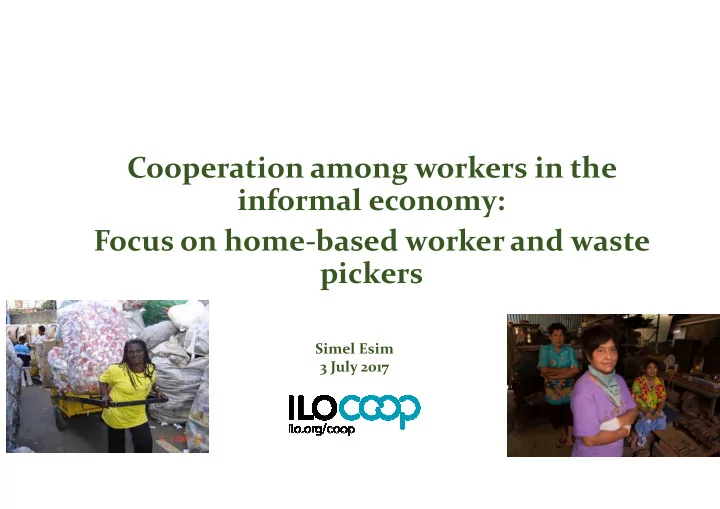
Cooperation among workers in the informal economy: Focus on home-based worker and waste pickers Simel Esim 3 July 2017 ILO WIEGO initiative Aims to deepen understanding of the nature and role of cooperatives and other SSE organizations


slide-1
SLIDE 1

Cooperation among workers in the informal economy: Focus on home-based worker and waste pickers

Simel Esim 3 July 2017

slide-2
SLIDE 2

ILO – WIEGO initiative

Aims to deepen understanding of the nature and role

  • f cooperatives and other SSE organizations and

enterprises in formalizing the informal economy Initial focus on waste pickers and home workers, with a view to expand to other target groups such as domestic workers and street vendors Methodology: Survey & interviews with 50 respondents (21 HBWs from 10 countries, 29 WPs from 6 countries), mainly by WIEGO staff and through WIEGO/ILO partners Literature review – conceptualization of cooperatives of HBWs & WPs, as well as case studies

slide-3
SLIDE 3

Key findings I - Characteristics

Legal status: Most entities legally registered. Under various laws (coop, micro-enterprise, association, etc.) Reasons for registering: Access to incentives & support from local and national governments and private sector; HBWs: Financial reasons are the most important WPs: Access to social benefits and social protection are the priorities Coop structure: Adherence to coop values & principles, regardless of the

  • rganizational type

Structures such as BoD, committees in place Sources of funding: Member dues relatively small &

  • ften times insufficient -

Therefore need financial support from external actors

slide-4
SLIDE 4

Key findings II - Activities

Activities and functions: WPs: Collecting, sorting, recycling of waste HBWs: Diverse activities e.g. garment production, clothing, crafts; food, catering, farming through subcontracting and

  • wn-account work

Economic benefits: Coops support market access, work space, training and skills upgrading Skills training: Technical and legal training, accounting, business planning HBWs: production skills, marketing, use of equipment, also leadership training WPs: technical skills and advocacy skills Financial service provision: Crucial for members’ livelihoods & for cooperatives Through government or credit unions in form of e.g. microloans Some coops provide microloans to members for equipment or raw materials as well

slide-5
SLIDE 5

Key findings III – Voice & recognition

Voice & recognition: Fighting stigma & marginalization through negotiation, creating alliances & mobilization Negotiations and sales: Support of larger organizations increases negotiation power Negotiations with buyers (enterprises, middlemen), NGOs, other coops Sales often through intermediaries Negotiate with state for social benefits and improved conditions – advocacy efforts Economies of scale: HBWs: Supply of materials at lower costs; sharing of work space & equipment WPs: Negotiate with big waste generators Alliances and affiliations: With other coops, trade unions, social movements at different levels WPs: Strong national, international affiliations HBWs: Some national & subregional networks

slide-6
SLIDE 6

Key findings IV - Challenges

Economic & market-related Difficulties in achieving real economies of scale Weak institutional infrastructure WPs: Privatization of waste management systems HBWs: Competition with larger companies Policy-related Old laws that do not reflect the current realities Laws that may not be pro-poor

  • r recognizing informal

economy workers’ rights Lack of enforcement of existing laws & local regulations that can facilitate access to available infrastructure & services Internal Weak structure, internal tensions, lack of a common vision, absence of strategic planning, lack of technical & political know-how & capacity building, blurred division of work