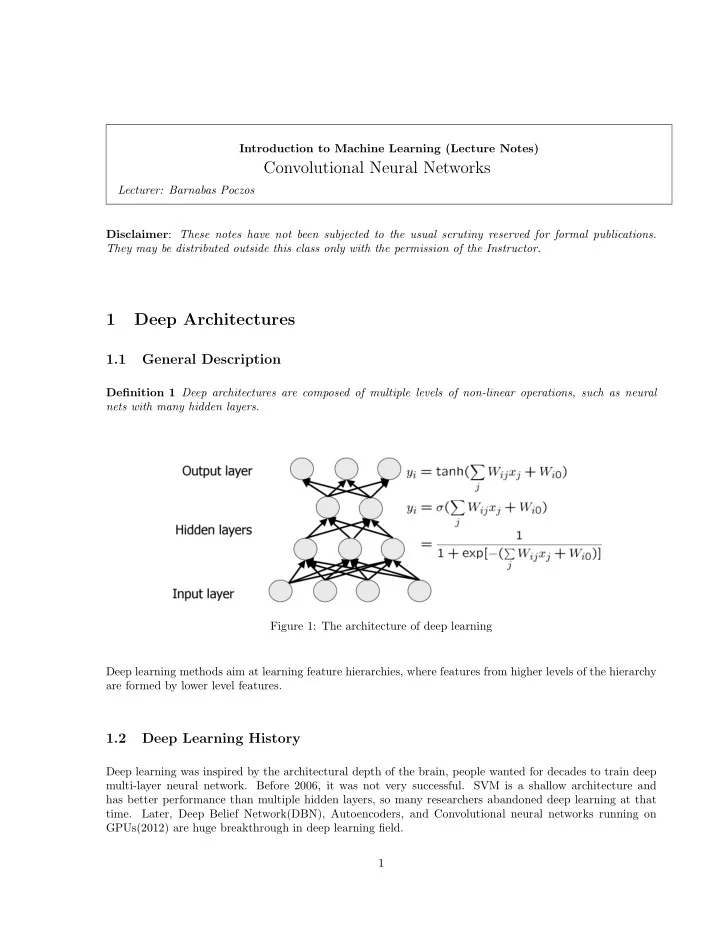
SLIDE 1
2 Convolutional Neural Networks: Barnabas Poczos
1.3 Theoretical Advantages of Deep Architectures
Functions that can be compactly represented by a depth k architecture might require an exponential number
- f computational elements to be represented by a depth k − 1 architecture.
- Computational: We don’t need exponentially many element in the layers.
- Statistical: poor generalization may be expected when using an insufficiently deep architecture for
representing some functions.
2 Convolutional Neural Networks
Convolutional Neural Networks (CNNs) are designed in such a way, that they can take into account spatial structure of the input. They were inspired by mice visual system and were originally designed to work with images. Compared to standard neural networks, CNNs have much fewer parameters which makes it possible to efficiently train very deep architectures (usually more than 5 layers which is almost impossible for fully-connected networks). But theoretical performance of CNNs is likely to be only slightly worse which is confirmed by numerous practical examples. Most layers of CNNs use convolution operation. In continuous case convolution of two functions f and g is defined as following: (f ∗ g)(t) = ∞
−∞
f(τ)g(t − τ)dτ = ∞
−∞
f(t − τ)g(τ)dτ In discrete case an integral is replaced by a sum: (f ∗ g)(n) =
∞
- m=−∞
f(m)g(n − m) =
∞
- m=−∞
f(n − m)g(m) If discrete g has support on {−M, ..., M}: (f ∗ g)(n) =
M
- m=−M
f(n − m)g(m) In this case g is called a kernel function. All this definitions can be naturally extended to multi-dimensional
- case. Convolutional Neural Networks usually perform 2D convolution on images:
(f ∗ g)(x, y) =
M
- m=−M
N
- n=−N