A quick review The clustering problem: partition genes into - - PowerPoint PPT Presentation

a quick review
SMART_READER_LITE
LIVE PREVIEW

A quick review The clustering problem: partition genes into - - PowerPoint PPT Presentation

A quick review The clustering problem: partition genes into distinct sets with high homogeneity and high separation Hierarchical clustering algorithm: 1. Assign each object to a separate cluster. 2. Regroup the pair of clusters


slide-1
SLIDE 1
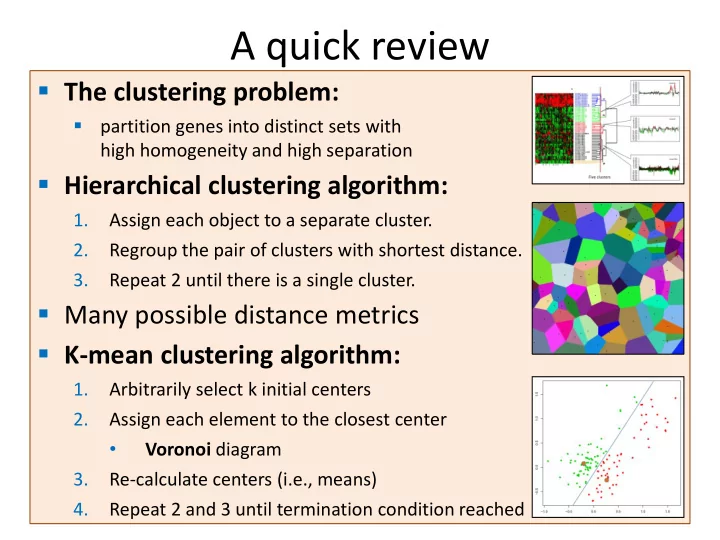
  • The clustering problem:
  • partition genes into distinct sets with

high homogeneity and high separation

  • Hierarchical clustering algorithm:

1. Assign each object to a separate cluster. 2. Regroup the pair of clusters with shortest distance. 3. Repeat 2 until there is a single cluster.

  • Many possible distance metrics
  • K-mean clustering algorithm:

1. Arbitrarily select k initial centers 2. Assign each element to the closest center

  • Voronoi diagram

3. Re-calculate centers (i.e., means) 4. Repeat 2 and 3 until termination condition reached

A quick review

slide-2
SLIDE 2

Biological Networks Analysis

Introduction

Genome 373 Genomic Informatics Elhanan Borenstein

slide-3
SLIDE 3

Why we need networks (and systems biology)?

VS.

slide-4
SLIDE 4

Biological networks

What is a network? What networks are used in biology? Why do we need networks (and network theory)? How do we find the shortest path between two nodes?

slide-5
SLIDE 5

What is a network?

  • A collection of nodes and links (edges)
  • A map of interactions or relationships
slide-6
SLIDE 6

A long history of network/graph theory!!

Network theory Graph theory Social sciences

(and Biological sciences)

Computer science Mostly 20th century Since 18th century!!! Modeling real-life systems Modeling abstract systems Measuring structure & topology Solving “graph- related” questions

slide-7
SLIDE 7
  • Published by Leonhard Euler, 1736
  • Considered the first paper in graph theory

The Seven Bridges of Königsberg

Leonhard Euler 1707 –1783

slide-8
SLIDE 8
  • Published by Leonhard Euler, 1736
  • Considered the first paper in graph theory

The Seven Bridges of Königsberg

Leonhard Euler 1707 –1783

slide-9
SLIDE 9

Edge properties and special topologies

  • Edges:
  • Directed/undirected
  • Weighted/non-weighted
  • Simple-edges/Hyperedges
  • Special topologies:
  • Trees
  • Directed Acyclic Graphs (DAG)
  • Bipartite networks
slide-10
SLIDE 10

Transcriptional regulatory networks

  • Reflect the cell’s genetic

regulatory circuitry

  • Nodes: transcription factors

and genes;

  • Edges: from TF to the genes

it regulates

  • Directed; weighted?;

“almost” bipartite

  • Derived through:
  • Chromatin IP
  • Microarrays
  • Computationally
slide-11
SLIDE 11
  • S. Cerevisiae

1062 metabolites 1149 reactions

Metabolic networks

  • Reflect the set of biochemical reactions in a cell
  • Nodes: metabolites
  • Edges: biochemical reactions
  • Directed; weighted?; hyperedges?
  • Derived through:
  • Knowledge of biochemistry
  • Metabolic flux measurements
  • Homology
slide-12
SLIDE 12
  • S. Cerevisiae

4389 proteins 14319 interactions

Protein-protein interaction (PPI) networks

  • Reflect the cell’s molecular interactions and signaling

pathways (interactome)

  • Nodes: proteins
  • Edges: interactions(?)
  • Undirected
  • High-throughput experiments:
  • Protein Complex-IP (Co-IP)
  • Yeast two-hybrid
  • Computationally
slide-13
SLIDE 13

Other networks in biology/medicine

slide-14
SLIDE 14

Non-biological networks

  • Computer related networks:
  • WWW; Internet backbone
  • Communications and IP
  • Social networks:
  • Friendship (facebook; clubs)
  • Citations / information flow
  • Co-authorships (papers)
  • Co-occurrence (movies; Jazz)
  • Transportation:
  • Highway systems; Airline routes
  • Electronic/Logic circuits
  • Many many more…
slide-15
SLIDE 15

The Bacon Number Game

Tropic Thunder (2008) Frost/Nixon Tropic Thunder Iron Man

Tom Cruise Robert Downey Jr. Frank Langella Kevin Bacon

Tropic Thunder Iron Man Proof Flatliners

Tom Cruise Robert Downey Jr. Gwyneth Paltrow Kevin Bacon Hope Davis

slide-16
SLIDE 16

The Paul Erdos Number Game

slide-17
SLIDE 17
slide-18
SLIDE 18
  • Find the minimal number of “links” connecting node A

to node B in an undirected network

  • How many friends between you and someone on FB

(6 degrees of separation, Erdös number, Kevin Bacon number)

  • How far apart are two genes in an interaction network
  • What is the shortest (and likely) infection path
  • Find the shortest (cheapest)

path between two nodes in a weighted directed graph

  • GPS; Google map

The shortest path problem

slide-19
SLIDE 19

Dijkstra’s Algorithm

"Computer Science is no more about computers than astronomy is about telescopes."

Edsger Wybe Dijkstra 1930 –2002

slide-20
SLIDE 20
  • Solves the single-source shortest path problem:
  • Find the shortest path from a single source to ALL nodes in

the network

  • Works on both directed and undirected networks
  • Works on both weighted and non-weighted networks
  • Approach:
  • Iterative : maintain shortest path

to each intermediate node

  • Greedy algorithm
  • … but still guaranteed to

provide optimal solution !!

Dijkstra’s algorithm

slide-21
SLIDE 21
  • 1. Initialize:

i. Assign a distance value, D, to each node. Set D to zero for start node and to infinity for all others. ii. Mark all nodes as unvisited.

  • iii. Set start node as current node.
  • 2. For each of the current node’s unvisited neighbors:

i. Calculate tentative distance, Dt, through current node. ii. If Dt smaller than D (previously recorded distance): D Dt

  • iii. Mark current node as visited (note: shortest dist. found).
  • 3. Set the unvisited node with the smallest distance as

the next "current node" and continue from step 2.

  • 4. Once all nodes are marked as visited, finish.

Dijkstra’s algorithm

slide-22
SLIDE 22
  • A simple synthetic network

Dijkstra’s algorithm

B C A D E F

9 3 1 3 4 7 9 2 2 12 5

1.Initialize: i. Assign a distance value, D, to each node. Set D to zero for start node and to infinity for all others.

  • ii. Mark all nodes as unvisited.
  • iii. Set start node as current node.

2.For each of the current node’s unvisited neighbors: i. Calculate tentative distance, Dt, through current node.

  • ii. If Dt smaller than D (previously recorded distance): D Dt
  • iii. Mark current node as visited (note: shortest dist. found).

3.Set the unvisited node with the smallest distance as the next "current node" and continue from step 2. 4.Once all nodes are marked as visited, finish.

slide-23
SLIDE 23
  • Initialization
  • Mark A (start) as current node

Dijkstra’s algorithm

B C A D E F

9 3 1 3 4 7 9 2 2 12 5

D: 0 D: ∞ D: ∞ D: ∞ D: ∞ D: ∞

A B C D E F ∞ ∞ ∞ ∞ ∞

slide-24
SLIDE 24
  • Check unvisited neighbors of A

Dijkstra’s algorithm

B C A D E F

9 3 1 3 4 7 9 2 2 12 5

D: 0 D: ∞ D: ∞ D: ∞ D: ∞ D: ∞

A B C D E F ∞ ∞ ∞ ∞ ∞

0+3 vs. ∞ 0+9 vs. ∞

slide-25
SLIDE 25
  • Update D
  • Record path

Dijkstra’s algorithm

B C A D E F

9 3 1 3 4 7 9 2 2 12 5

D: 0 D: ∞,3 D: ∞ D: ∞ D: ∞ D: ∞,9

A B C D E F ∞ ∞ ∞ ∞ ∞ 9 3 ∞ ∞ ∞

slide-26
SLIDE 26
  • Mark A as visited …

Dijkstra’s algorithm

B C A D E F

9 3 1 3 4 7 9 2 2 12 5

D: 0 D: ∞,3 D: ∞ D: ∞ D: ∞ D: ∞,9

A B C D E F ∞ ∞ ∞ ∞ ∞ 9 3 ∞ ∞ ∞

slide-27
SLIDE 27
  • Mark C as current (unvisited node with smallest D)

Dijkstra’s algorithm

B C A D E F

9 3 1 3 4 7 9 2 2 12 5

D: 0 D: ∞,3 D: ∞ D: ∞ D: ∞ D: ∞,9

A B C D E F ∞ ∞ ∞ ∞ ∞ 9 3 ∞ ∞ ∞

slide-28
SLIDE 28
  • Check unvisited neighbors of C

Dijkstra’s algorithm

B C A D E F

9 3 1 3 4 7 9 2 2 12 5

D: 0 D: ∞,3 D: ∞ D: ∞ D: ∞ D: ∞,9

A B C D E F ∞ ∞ ∞ ∞ ∞ 9 3 ∞ ∞ ∞

3+2 vs. ∞ 3+4 vs. 9 3+3 vs. ∞

slide-29
SLIDE 29
  • Update distance
  • Record path

Dijkstra’s algorithm

B C A D E F

9 3 1 3 4 7 9 2 2 12 5

D: 0 D: ∞,3 D: ∞ D: ∞,6 D: ∞,5 D: ∞,9,7

A B C D E F ∞ ∞ ∞ ∞ ∞ 9 3 ∞ ∞ ∞ 7 3 6 5 ∞

slide-30
SLIDE 30
  • Mark C as visited
  • Note: Distance to C is final!!

Dijkstra’s algorithm

B C A D E F

9 3 1 3 4 7 9 2 2 12 5

D: 0 D: ∞,3 D: ∞ D: ∞,6 D: ∞,5 D: ∞,9,7

A B C D E F ∞ ∞ ∞ ∞ ∞ 9 3 ∞ ∞ ∞ 7 3 6 5 ∞

slide-31
SLIDE 31
  • Mark E as current node
  • Check unvisited neighbors of E

Dijkstra’s algorithm

B C A D E F

9 3 1 3 4 7 9 2 2 12 5

D: 0 D: ∞,3 D: ∞ D: ∞,6 D: ∞,5 D: ∞,9,7

A B C D E F ∞ ∞ ∞ ∞ ∞ 9 3 ∞ ∞ ∞ 7 3 6 5 ∞

slide-32
SLIDE 32
  • Update D
  • Record path

Dijkstra’s algorithm

B C A D E F

9 3 1 3 4 7 9 2 2 12 5

D: 0 D: ∞,3 D: ∞,17 D: ∞,6 D: ∞,5 D: ∞,9,7 D: 0

A B C D E F ∞ ∞ ∞ ∞ ∞ 9 3 ∞ ∞ ∞ 7 3 6 5 ∞ 7 6 5 17

slide-33
SLIDE 33
  • Mark E as visited

Dijkstra’s algorithm

B C A D E F

9 3 1 3 4 7 9 2 2 12 5

D: 0 D: ∞,3 D: ∞,17 D: ∞,6 D: ∞,5 D: ∞,9,7

A B C D E F ∞ ∞ ∞ ∞ ∞ 9 3 ∞ ∞ ∞ 7 3 6 5 ∞ 7 6 5 17

slide-34
SLIDE 34
  • Mark D as current node
  • Check unvisited neighbors of D

Dijkstra’s algorithm

B C A D E F

9 3 1 3 4 7 9 2 2 12 5

D: 0 D: ∞,3 D: ∞,17 D: ∞,6 D: ∞,5 D: ∞,9,7

A B C D E F ∞ ∞ ∞ ∞ ∞ 9 3 ∞ ∞ ∞ 7 3 6 5 ∞ 7 6 5 17

slide-35
SLIDE 35
  • Update D
  • Record path (note: path has changed)

Dijkstra’s algorithm

B C A D E F

9 3 1 3 4 7 9 2 2 12 5

D: 0 D: ∞,3 D: ∞,17,11 D: ∞,6 D: ∞,5 D: ∞,9,7

A B C D E F ∞ ∞ ∞ ∞ ∞ 9 3 ∞ ∞ ∞ 7 3 6 5 ∞ 7 6 5 17 7 6 11

slide-36
SLIDE 36
  • Mark D as visited

Dijkstra’s algorithm

B C A D E F

9 3 1 3 4 7 9 2 2 12 5

D: 0 D: ∞,3 D: ∞,17,11 D: ∞,6 D: ∞,5 D: ∞,9,7

A B C D E F ∞ ∞ ∞ ∞ ∞ 9 3 ∞ ∞ ∞ 7 3 6 5 ∞ 7 6 5 17 7 6 11

slide-37
SLIDE 37
  • Mark B as current node
  • Check neighbors

Dijkstra’s algorithm

B C A D E F

9 3 1 3 4 7 9 2 2 12 5

D: 0 D: ∞,3 D: ∞,17,11 D: ∞,6 D: ∞,5 D: ∞,9,7

A B C D E F ∞ ∞ ∞ ∞ ∞ 9 3 ∞ ∞ ∞ 7 3 6 5 ∞ 7 6 5 17 7 6 11

slide-38
SLIDE 38
  • No updates..
  • Mark B as visited

Dijkstra’s algorithm

B C A D E F

9 3 1 3 4 7 9 2 2 12 5

D: 0 D: ∞,3 D: ∞,17,11 D: ∞,6 D: ∞,5 D: ∞,9,7

A B C D E F ∞ ∞ ∞ ∞ ∞ 9 3 ∞ ∞ ∞ 7 3 6 5 ∞ 7 6 5 17 7 6 11 7 11

slide-39
SLIDE 39

A B C D E F ∞ ∞ ∞ ∞ ∞ 9 3 ∞ ∞ ∞ 7 3 6 5 ∞ 7 6 5 17 7 6 11 7 11

  • Mark F as current

Dijkstra’s algorithm

B C A D E F

9 3 1 3 4 7 9 2 2 12 5

D: 0 D: ∞,3 D: ∞,17,11 D: ∞,6 D: ∞,5 D: ∞,9,7

slide-40
SLIDE 40

A B C D E F ∞ ∞ ∞ ∞ ∞ 9 3 ∞ ∞ ∞ 7 3 6 5 ∞ 7 6 5 17 7 6 11 7 11 11

  • Mark F as visited

Dijkstra’s algorithm

B C A D E F

9 3 1 3 4 7 9 2 2 12 5

D: 0 D: ∞,3 D: ∞,17,11 D: ∞,6 D: ∞,5 D: ∞,9,7

slide-41
SLIDE 41

A B C D E F ∞ ∞ ∞ ∞ ∞ 9 3 ∞ ∞ ∞ 7 3 6 5 ∞ 7 6 5 17 7 6 11 7 11 11

  • We now have:
  • Shortest path from A to each node (both length and path)
  • Minimum spanning tree

We are done!

B C A D E F

9 3 1 3 4 7 9 2 2 12 5

D: 0 D: ∞,3 D: ∞,17,11 D: ∞,6 D: ∞,5 D: ∞,9,7

Will we always get a tree? Can you prove it?

slide-42
SLIDE 42
slide-43
SLIDE 43
  • Which is the most useful representation?

B C A D A B C D A 0 1 B 0 C 1 D 0 1 1

Connectivity Matrix List of edges: (ordered) pairs of nodes

[ (A,C) , (C,B) , (D,B) , (D,C) ]

Object Oriented

Name:A ngr: p1 Name:B ngr: Name:C ngr: p1 Name:D ngr: p1 p2

Computational Representation

  • f Networks