Convention on the Protection of the Marine Environment of the Baltic - - PowerPoint PPT Presentation

convention on the protection of the marine environment
SMART_READER_LITE
LIVE PREVIEW

Convention on the Protection of the Marine Environment of the Baltic - - PowerPoint PPT Presentation

Convention on the Protection of the Marine Environment of the Baltic Sea Area (Helsinki Convention) First signed in 1974 in Helsinki, Finland Updated in 1992 Convention Area Definitions Fundamental Principles: Precautionary, BAT/BEP,


slide-1
SLIDE 1

Convention on the Protection of the Marine Environment

  • f the Baltic Sea Area (Helsinki Convention)

First signed in 1974 in Helsinki, Finland Updated in 1992

  • Convention Area
  • Definitions
  • Fundamental Principles: Precautionary,

BAT/BEP, polluter pays principle, transboundary

  • Basic provisions: Prevention, cooperation,

communication

  • Annexes: Harmful substances, BEP/BAT,

Prevention of pollution from land sources, Prevention of pollution from ships, Exemptions from prohibition of dumping, Prevention of pollution from offshore activities, Response to pollution incidents

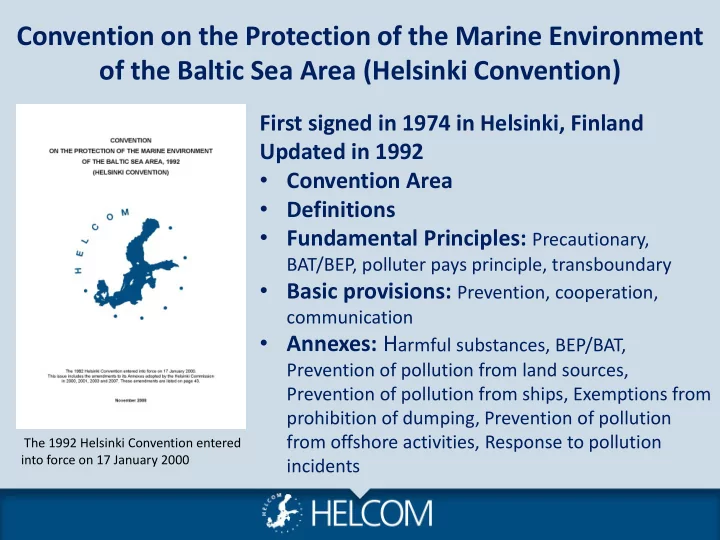
The 1992 Helsinki Convention entered into force on 17 January 2000

slide-2
SLIDE 2

Baltic Marine Environment Protection Commission Helsinki Commission

  • 1974  1992
  • intergovernmental
  • 9 countries + EU
  • legal commitment
  • watershed-based
  • policy-maker
slide-3
SLIDE 3

HELCOM Observers

BONUS Baltic Organizations' Network for Funding Science (BONUS EEIG), European Chemical Industry Council, Coalition Clean Baltic, Conference of Peripheral Maritime Regions of Europe - Baltic Sea Commission, European Boating Association, European Chlor-Alkali Industry, European Community Shipowners' Association, Cruise Lines International Association Europe, European Dredging Association, Fertilizers Europe, European Sea Ports Organisation, The Coastal and Marine Union, European Federation of National Associations of Water and Wastewater Services, Federation of European Private Port Operators, Global Water Partnership Central and Eastern Europe, International Association of Oil and Gas Producers, International Chamber of Shipping, International Dialogue on Underwater Munitions, Local Authorities International Environmental Organisation (KIMO International), Nordic Hunters' Cooperation, Oceana, Sea Alarm Foundation, Union of the Baltic Cities, World Wide Fund for Nature Government of Belarus, Government of Ukraine, ASCOBANS, Baltic 21, Baltic Pilotage Authorities Commission, Baltic Sea Parliamentary Conference, Black Sea Commission, Bonn Agreement, The Great Lakes Commission, Intergovernmental Oceanographic Commission of UNESCO, International Atomic Energy Agency, International Council for the Exploration of the Sea, International Maritime Organization, Paris and Oslo Commissions, United Nations Environment Programme, UNEP/AEWA, United Nations Economic Commission for Europe, World Health Organization Regional Office for Europe, World Meteorological Organization, Baltic Farmers' Forum on Environment, Baltic Operational Oceanographic System, Baltic Ports Organisation, Baltic Sea Forum, BIMCO, BirdLife International,

slide-4
SLIDE 4

HELCOM’s role in the Baltic

Environmental policy maker developing common objectives and actions (e.g. ministerial declarations, recommendations)

Scientific Assessments Coordinated monitoring Concrete targets Policy advice Actions

Management Science

Environmental focal point for the Baltic Sea Coordinating body

Status Reports

slide-5
SLIDE 5
slide-6
SLIDE 6

Gear

Group for the Implementation

  • f the Ecosystem Approach

Tristan Martin

Region-wide co-operation on marine strategies and policies, including other Regional Seas Conventions

Regional coordination

MSFD: EU members Maritime Doctrine: Russian Federation

Managerial role

Integration & coherence between other HELCOM groups

Permanent

slide-7
SLIDE 7

Pressure*

Working Group on Reduction of Pressures from the Baltic Sea Catchment Area*

  • 1. Guide PLC
  • 2. Nutrient reduction scheme follow up system
  • 3. Identify the needs for further reduction of nutrients and

limiting emissions/losses of hazardous substances

  • 4. Coordination of marine litter and underwater noise

Anu Suono

* Tentative name

Permanent

slide-8
SLIDE 8

Maritime working group Response working group

Prevention of pollution from ships Swift national and international response to maritime pollution incidents

HELCOM

Permanent

slide-9
SLIDE 9

HELCOM-VASAB Maritime Spatial Planning Working Group

Coherent regional maritime spatial planning processes in the Baltic Sea

Manuel Frias

Time-limited

slide-10
SLIDE 10

State*

Working Group on the State of the Environment and Nature Conservation

Monitoring and assessment (biodiversity, status of & effects on marine environment) Nature conservation and biodiversity protection Working across monitoring-indicators-assessment chain Cross-cutting: Holistic assessment on the ecosystem health

* Tentative name

Ata Foto Grup

Permanent

slide-11
SLIDE 11

Aim: to achieve good environmental status by 2021

  • Based on an ecosystem-based approach to

management of human activities

  • Vision: A marine environment with diverse

biological components functioning in balance, resulting in good environmental status, supporting wide range of sustainable human activities

  • Strategic goals and ecological objectives
  • Eutrophication
  • Hazardous substances
  • Biodiversity and nature conservation
  • Maritime activities
  • Harmonized with other international

agreements

HELCOM Baltic Sea Action Plan

slide-12
SLIDE 12
  • Nutrient reduction targets
  • Nutrient balanced fertilisation
  • Red list of species and biotopes
  • Marine litter, microplastics
  • Underwater noise
  • Shoreline response
  • Impacts of pharmaceuticals
  • Indicator-based monitoring
slide-13
SLIDE 13

2013 HELCOM Copenhagen Ministerial Meeting agreed that:

  • the level of ambient and distribution of

impulsive sounds in the Baltic Sea should not have negative impact on marine life

  • human activities that are assessed to result in

negative impacts on marine life should be carried out only if relevant mitigation measures are in place

Marta Ruiz Minna Pyhälä Lena Avellan 11/26/2014 13

slide-14
SLIDE 14

2013 HELCOM Copenhagen Ministerial Meeting agreed that:

Accordingly as soon as possible and by the end of 2016, using mainly already on-going activities, to:

  • establish a set of indicators including technical standards which may be

used for monitoring ambient and impulsive underwater noise in the Baltic Sea;

  • encourage research on the cause and effects of underwater noise on

biota;

  • map the levels of ambient underwater noise across the Baltic Sea;
  • set up a register of the occurrence of impulsive sounds;
  • Consider regular monitoring on ambient and impulsive underwater noise

as well as possible options for mitigation measures related to noise taking into account the ongoing work in IMO on non-mandatory draft guidelines for reducing underwater noise from commercial ships and in CBD context

Marta Ruiz Minna Pyhälä Lena Avellan 11/26/2014 14

slide-15
SLIDE 15

20th meeting of HELCOM Monitoring and Assessment group (April 2014)

Thematic session on underwater noise:

  • took note of information on BIAS project
  • was of the opinion that a common Baltic Sea registry of impulsive

underwater noise would be useful and pointed out that it would be useful if the registry was harmonized with an OSPAR register

  • took note that BIAS will recommend monitoring requirements and possibly

also threshold values which could be used to feed into the work of HELCOM for developing core pressure indicators

  • was of the opinion that there is a need to establish a broader Baltic Sea

regional expert group on noise and proposed that for the time being BIAS should serve as a basis for a regional expert group on underwater noise

  • agreed on arrangement of this workshop
  • asked Contracting Parties to respond to questions raised by the BIAS project

Marta Ruiz Minna Pyhälä Lena Avellan 11/26/2014 15

slide-16
SLIDE 16

Comments from other HELCOM meetings

  • 1. CORESET II project meeting in Sept. 2014 agreed that the

indicators ‘Low and mid frequency impulsive sounds’, ‘Ambient noise’, should be further developed in CORESET II.

  • 2. GEAR 8-2014, when discussing joint programmes of

measures for implementation of MSFD agreed that work, in the short-term, should focus on starting monitoring on noise and building sufficient knowledge and data base.

  • 3. PRESSURE 1-2014 invited Contracting Parties to

investigate nationally on-going activities and report on these at the next meeting of PRESSURE.

Marta Ruiz Minna Pyhälä Lena Avellan 11/26/2014 16