Controlling the Controlled Substances: How February 15, 20/20 an - - PDF document

controlling the controlled substances how february 15 20
SMART_READER_LITE
LIVE PREVIEW

Controlling the Controlled Substances: How February 15, 20/20 an - - PDF document

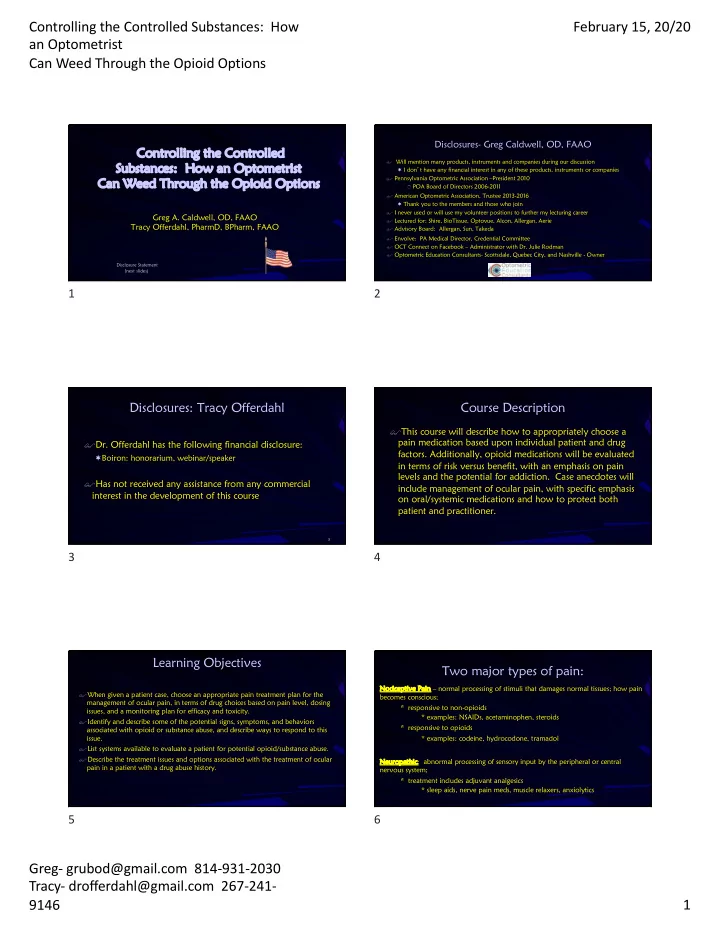
Controlling the Controlled Substances: How February 15, 20/20 an Optometrist Can Weed Through the Opioid Options Disclosures- Greg Caldwell, OD, FAAO Co Cont ntrolling ng the he Co Cont ntrolled d $ Will mention many products,


slide-1
SLIDE 1

Controlling the Controlled Substances: How an Optometrist Can Weed Through the Opioid Options February 15, 20/20 Greg- grubod@gmail.com 814-931-2030 Tracy- drofferdahl@gmail.com 267-241- 9146 1

Co Cont ntrolling ng the he Co Cont ntrolled d Su Substances: Ho How an Optometrist Can Can Weed d Thr hrough h the he Opioid d Options ns

Greg A. Caldwell, OD, FAAO Tracy Offerdahl, PharmD, BPharm, FAAO

Disclosure Statement (next slides)

1

Disclosures- Greg Caldwell, OD, FAAO

$ Will mention many products, instruments and companies during our discussion

¬ I don’t have any financial interest in any of these products, instruments or companies

$ Pennsylvania Optometric Association –President 2010 2 POA Board of Directors 2006-2011 $ American Optometric Association, Trustee 2013-2016

¬ Thank you to the members and those who join

$ I never used or will use my volunteer positions to further my lecturing career $ Lectured for: Shire, BioTissue, Optovue, Alcon, Allergan, Aerie $ Advisory Board: Allergan, Sun, Takeda $ Envolve: PA Medical Director, Credential Committee $ OCT Connect on Facebook – Administrator with Dr. Julie Rodman $ Optometric Education Consultants- Scottsdale, Quebec City, and Nashville - Owner

2 Disclosures: Tracy Offerdahl

$Dr. Offerdahl has the following financial disclosure: ¬Boiron: honorarium, webinar/speaker $Has not received any assistance from any commercial

interest in the development of this course

3

3 Course Description

$This course will describe how to appropriately choose a

pain medication based upon individual patient and drug

  • factors. Additionally, opioid medications will be evaluated

in terms of risk versus benefit, with an emphasis on pain levels and the potential for addiction. Case anecdotes will include management of ocular pain, with specific emphasis

  • n oral/systemic medications and how to protect both

patient and practitioner.

4 Learning Objectives

$When given a patient case, choose an appropriate pain treatment plan for the

management of ocular pain, in terms of drug choices based on pain level, dosing issues, and a monitoring plan for efficacy and toxicity.

$Identify and describe some of the potential signs, symptoms, and behaviors

associated with opioid or substance abuse, and describe ways to respond to this issue.

$List systems available to evaluate a patient for potential opioid/substance abuse. $Describe the treatment issues and options associated with the treatment of ocular

pain in a patient with a drug abuse history.

5 Two major types of pain:

No Nociceptive Pain – normal processing of stimuli that damages normal tissues; how pain becomes conscious; * responsive to non-opioids * examples: NSAIDs, acetaminophen, steroids * responsive to opioids * examples: codeine, hydrocodone, tramadol Ne Neuropathic: abnormal processing of sensory input by the peripheral or central nervous system; * treatment includes adjuvant analgesics * sleep aids, nerve pain meds, muscle relaxers, anxiolytics

6

slide-2
SLIDE 2

Controlling the Controlled Substances: How an Optometrist Can Weed Through the Opioid Options February 15, 20/20 Greg- grubod@gmail.com 814-931-2030 Tracy- drofferdahl@gmail.com 267-241- 9146 2

Drug Treatment Options…Neuropathic Pain

$Why is this relevant? $Adjuvants – means “add on” medications ¬Some of them have addiction potential

2 Anti-seizure medications that address nerve damage/inflammation – MOA: work on the GABA system – similar to benzodiazepines (ex. Xanax) – Gabapentin (Neurontin) – controlled substance in multiple states – Pregabalin (Lyrica) – controlled substance in all 50 states 2 Anti-anxiety and sleep medications – Zolpidem (Ambien) – Alprazolam (Xanax), Lorazepam (Ativan), Diazepam (Valium)

7 Pain Assessments and Scales

$Adds objective data to a patient’s feeling of pain ¬It is a subjective problem to assess! ¬Remember…no patient should needlessly suffer! $“Does the injury or wound or diagnosis fit the patient’s

presentation?

¬It is important to be able to assess the degree of pain in a patient.

8 9 Combination Pain Scale… 10

Drug Treatment Options… Nociceptive Pain

3 3 Grou

  • ups of
  • f analgesics

¬Non-opioids

2 Acetaminophen (Tylenol) 2 NSAIDs (Ibuprofen, naproxen sodium) 2 Glucocorticosteroids (methylprednisolone, prednisone)

¬Opioids –

2 Codeine (Tylenol with codeine) 2 Hydrocodone (Vicodin) 2 Tramadol (Ultram)

11

Controlled Substance Schedules

Sc Schedule I – not considered to be medically necessary, research only ¬ Heroin ¬ “Medical” Marijuana 2 State control of marijuana and CBD ¬ LSD ¬ Mushrooms ¬ Ecstasy Sc Schedule II – mo more likely to be abused (as comp mpared to Schedule III, IV, V) ¬ Op Opioids, AKA “Narcotics” 2 Ox Oxycodone (Ox OxyContin) 2 Hydrocodone (Vicodin, Lorcet, Norco) 2 Morphine (MSContin, MSIR) 2 Hydromorphone (Dilaudid) 2 Methadone 2 Fentanyl (Duragesic) ¬ ADD/ADHD meds: 2 Methylphenidate (Ritalin) 2 Mixed amphetamine salts (Adderall)

12

slide-3
SLIDE 3

Controlling the Controlled Substances: How an Optometrist Can Weed Through the Opioid Options February 15, 20/20 Greg- grubod@gmail.com 814-931-2030 Tracy- drofferdahl@gmail.com 267-241- 9146 3

Controlled Substance Schedules

Schedule III - Safer, less likely to be abused (as compared to Schedule II) ¬Combination products with APAP or ASA (codeine) ¬Esketamine – nasal spray for treatment resistant depression Schedule IV – Safer, less likely to be abused (as compared to Schedule II and III) ¬Tramadol (Ultram) ¬Benzodiazepines (lorazepam, diazepam, oxazepam) ¬Sleep agents (zolpidem, etc.) Schedule V – safest, least likely to be abused ¬Expectorants with codeine

13 Opioids “narcotics”

$Mainstay of therapy for the treatment of pain $NO maximum daily dose limitation $Useful for acute and chronic pain

14 Morphine Products

Mo Morphine

¬Standard for comparison of other agents

$MS

MSIR (IR caps) (q 3-4 hours prn)

$MS

MS Co Contin (CR tabs) (q 8–12 hours)

$Ka

Kadian (CR caps) (q 12 – 24 hours)

$Av

Avinza (CR caps) (q 24 hours)

15 Hydromorphone Products

Hy Hydromorphone (Di Dilaudi did) tablets – immediate release Hy Hydromorphone ER (Ex Exal algo) ) tablets – extended release

$Used for severe pain

16 Codeine-Based

$Codeine – C3; Schedule III $Hydrocodone – C2; Schedule II $Oxycodone – C2; Schedule II

17 Codeine tablets

$WEAK analgesic: commonly used, so MOST have heard of it! $Add acetaminophen/aspirin – Schedule III

¬Tyl Tyleno nol #3 = 300 mg acetaminophen & 30 mg codeine

$Add expectorant – Schedule V ¬ If you think someone won’t try to get their hands on “codeine cough syrup” as a drug of abuse, you’d be surprised!!!

18

slide-4
SLIDE 4

Controlling the Controlled Substances: How an Optometrist Can Weed Through the Opioid Options February 15, 20/20 Greg- grubod@gmail.com 814-931-2030 Tracy- drofferdahl@gmail.com 267-241- 9146 4

Oxycodone Products

Lo Long-Ac Acting, g, Ext xtende ded-Re Release OxyContin Im Immediate R Release; s short-ac actin ing tab ablets Ox OxyIR (IR cap) Ro Roxico codone ne solution with Acetaminophen: Pe Percocet and Endocet (oxycodone/APAP dose)

19

Ox OxyCONt ONtin (Controlled release tablets (q 12 hours…once in a while q 8 hours); new formulation is out to help control abuse

20 21 Hydrocodone Products

$Immediate-Release Products:

AS OF AUGUST 2014, hydrocodone products are ALL CII!!

Hy Hydr drocodo done 7. 7.5 5 mg g + IBU 20 200 mg g (Vi Vicoprofen) Hy Hydr drocodo done + acetaminophen:

$“Vi

Vicodin” 5/300; 7.5/300; 10/300

$Lortab = 2.5/300, 5/300, 7.5/300, 10/300 $Norco = 5/325, 7.5/325, 10/325

22 Miscellaneous

$Fe

Fentan anyl Pat atch (Duragesic)

¬MOST potent opioid ¬Black Box Warning against use in acute pain and in opioid naïve patients $Me

Methadone

¬Typically reserved for morphine/codeine allergic patients

23 Methadone tidbits…

$Chronic pain or opioid abuse deterrent $2-phase elimination

¬ Alpha phase = 8 hrs

2 Offers pain control

¬ Beta phase = 16+ hrs

2 Mitigates withdrawal symptoms

$Patient 1: On a short-acting pain med = likely being used to treat chronic pain

¬ Twice per day dosing

$Patient 2: On methadone ONLY; lower doses

¬ Once daily dosing

24

slide-5
SLIDE 5

Controlling the Controlled Substances: How an Optometrist Can Weed Through the Opioid Options February 15, 20/20 Greg- grubod@gmail.com 814-931-2030 Tracy- drofferdahl@gmail.com 267-241- 9146 5

Tramadol

Tra Tramadol (Ultra ram) tabs Tra Tramadol with h 325 mg APA PAP P (Ultra racet), Tra Tramadol ER tabs ¬Dual action: mu mu receptors & inhibits neuronal uptake of se serotonin & no norepine nephrine ne ¬Lowers seizure threshold; increases serotonin levels

2 watch drug interactions with other meds that ↑ serotonin

– Selective serotonin reuptake inhibitors (SSRIs): fluoxetine/Prozac – Migraine meds (“triptans”): sumatriptan/Imitrex

2 AS OF AUGUST 2014, NOW A C4 (Schedule IV) 2 “tramies” = abuse potential; helps decrease withdrawal symptoms

25 Opioid Allergies

$If a patient states “codeine allergic”, ask appropriate

questions…

¬“You have indicated that you have an allergy to codeine, can you describe what happens when you take codeine?”

2 This is SIGNIFICANT, because if a patient is truly allergic to codeine,

then they are most likely allergic to morphine, hydromorphone,

  • xycodone, hydrocodone, and tramadol

2 AND…if they had an opioid IV after surgery, then their “reaction” may

have been due to histamine release…

– NOT always an allergic reaction

26 Opioid Allergies

$DO YOU KNOW WHAT A PATIENT CAN TAKE?

2Fentanyl 2Methadone 2Meperidine

$Assessing “allergies” appropriately helps practitioners sort

through ACTUAL allergy potential and “placebo allergies”

2Fear versus drug seeking

27

Specific Medications Using Numeric Pain Scale

Mi Mild pain = 1 – 3

$Acetaminophen (APAP; Tylenol) $Ibuprofen (Advil, Motrin) $Naproxen sodium (Aleve) $Tramadol (Ultram) - low dose

Mo Moderate pain = 4 – 6

$Tramadol (Ultram) – mid to high dosing $Tylenol with codeine (Tylenol #3) $Acetaminophen with oxycodone (Percocet) $Acetaminophen with hydrocodone (Vicodin, etc.)

28

Specific Medications Using Numeric Pain Scale

Se Severe re pain = 7 – 10 10

$Tylenol with hydrocodone (Vicodin, etc.) – higher doses $Tylenol with oxycodone (Percocet, etc.) – higher doses $Morphine (MSIR) $Hydromorphone (Dilaudid) $Fentanyl (Duragesic patch; Actiq lozenge on a stick)

29

Opioid Effects/ADRs

$Sedation $Euphoria – mu receptors $Dysphoria/Hallucinations $Pruritis – allergy versus normal release of histamine $nausea/vomiting

¬triggers CTZ ¬Codeine “allergy”

30

slide-6
SLIDE 6

Controlling the Controlled Substances: How an Optometrist Can Weed Through the Opioid Options February 15, 20/20 Greg- grubod@gmail.com 814-931-2030 Tracy- drofferdahl@gmail.com 267-241- 9146 6

$Confusion $Miosis $Respiratory depression – this is what kills a patient

¬Mi Mixing opioids with other CNS depressants

2 Al

Alcohol

2 Benz

Benzodiazep epines nes

2 Mu

Muscle relaxers

2 Sl

Sleep ag agents

2 An

Antihistamines

2 An

Anti-se seizure medications

Opioid Effects/ADRs

31 Opioid Effects/ADRs

$Withdrawal symptoms: ¬Short half-life agents are more likely to cause abrupt withdrawal symptoms ¬Sweating ¬High sympathetic tone: increase in heart rate and blood pressure, mydriasis ¬Agitation ¬Irritation ¬Irrational behavior ¬Symptoms disappear with (immediate) use of an opioid

32

Opioid Antagonists

Na Naloxone (Na Narcan) & Na Naltrexone (Re ReVi Via) * * Used to treat opioid overdose

33

Mixed Opioid Agonist-Antagonist

$Exhibit partial agonist or antagonist activity at the opioid receptors

Ag Agonist/An Antagonist combinations for the TREAT ATMENT NT of chronic pain ¬NO NOT appropriate for the treatment of acute pain ¬Mo Morphine/Naltrexone (Em Embeda eda) ¬Ox Oxycodone/Naltrexone (Tr Troxyc yca ER ER)

$Sc

Schedule II contro rolled su subst stance

34

Mixed Opioid Agonist-Antagonist

$Exhibit partial agonist or antagonist activity at the opioid receptors

Ag Agonist/An Antagonist combinations for the TREAT ATMENT NT of opioid ab abuse/ad addicti tion

$Bu

Bupreno enorphine ne (Bu Buprenex enex)

$Buprenorphine/Naloxone (Suboxone) $Sc

Schedule III

$Adverse effects

¬Less respiratory depression & less abuse potential?

$Precipitate withdrawal in an opioid-dependent patient

35

Painful Ocular Problems – things to consider...

$Acute or chronic?

¬YOU are in charge! ¬Legal and ethical issues – do not allow yourself to be bullied by the patient!

$Work with other practitioners! $Only a pain specialist should write RXs for CII medications for chronic pain issues

¬If something looks suspicious, then make inquiries! Especially before you write an RX for a drug that can be abused and/or sold!

36

slide-7
SLIDE 7

Controlling the Controlled Substances: How an Optometrist Can Weed Through the Opioid Options February 15, 20/20 Greg- grubod@gmail.com 814-931-2030 Tracy- drofferdahl@gmail.com 267-241- 9146 7

Painful Ocular Problems – things to consider…

$Use the tools that are available! ¬State databases

2 PD

PDMP = Prescription Drug Monitoring Program

¬Pharmacists

37 Tolerance

$Escalation of dose to maintain effect (analgesia

  • r euphoria)

¬Happens to everyone $Regarding euphoria = may be life threatening

because respiratory depression does not show much tolerance

38

“True Addiction” (formerly “psychological dependence”)

$Compulsive use despite harm $many times triggered by cravings in response to specific cues

¬Lifestyle is geared to the acquisition of the drugs ¬Borrowing from others, injecting oral formulations, prescription “loss”, requesting specific drugs (not always a sign…as some drugs just work better)

$Quality of life is not improved by the medication and eventually it

becomes compulsive (“wanting without liking”)

$relapse is very common even after “successful” withdrawal…it is a

relapsing disease that is incredibly hard to treat

39 Identifying Behaviors of Abuse/Addiction

$New patients that don’t seem to “fit” $“fast talkers” $Strange allergies $Excuses for “loss” of meds or why they need “a strong

pain medication”

40 Ways to respond

$Avoid getting “bullied” $Avoid acting like you are judging the patient $State data bases

¬Call your local pharmacy/pharmacist

$Legal/ethical issues

¬If you didn’t write it down, then it didn’t happen! ¬If you accidentally give an addict a script for a pain medication, you won’t get into “trouble”…

41 Substance abuse history…

$Avoid all opioids in a patient with a history of heroin use ¬This includes tramadol ¬May trigger dopamine reward and the drug “need” ¬Stick with higher doses of a NSAID +/- acetaminophen $Patients with abuse history for other substances (ex.

Benzodiazepines, alcohol, amphetamines)?

¬It is a judgement call ¬Some evidence to suggest that all addictive meds should be avoided!

42

slide-8
SLIDE 8

Controlling the Controlled Substances: How an Optometrist Can Weed Through the Opioid Options February 15, 20/20 Greg- grubod@gmail.com 814-931-2030 Tracy- drofferdahl@gmail.com 267-241- 9146 8

Pain Management in Eye Care 43 Conditions Which May Require Pain Management

$Large cornea abrasions ¬ Cornea burn ¬ PRK/PTK $Orbital trauma $Orbital blowout fractures $Scleritis

44 Cases Where I Recently Used My DEA 45 A “bit” Too Close 46 How Deep 47 Ouch 48

slide-9
SLIDE 9

Controlling the Controlled Substances: How an Optometrist Can Weed Through the Opioid Options February 15, 20/20 Greg- grubod@gmail.com 814-931-2030 Tracy- drofferdahl@gmail.com 267-241- 9146 9

DSEK 49

Questions? Thank you!

50