Contin ontinued ued Participat Participation on Req equire - - PDF document

contin ontinued ued participat participation on req
SMART_READER_LITE
LIVE PREVIEW

Contin ontinued ued Participat Participation on Req equire - - PDF document

Contin ontinued ued Participat Participation on Req equire uirement ments f s for or Regio Regional nal Ce Centers nters By y Joseph Joseph P. P. Whalen Whalen (Monday Monday, April 3 , April 3, 2 , 2017 17) The latest update


slide-1
SLIDE 1

Page Page 1 of

  • f 6

Contin

  • ntinued

ued Participat Participation

  • n Req

equire uirement ments f s for

  • r Regio

Regional nal Ce Centers nters

By y Joseph Joseph P.

  • P. Whalen

Whalen (Monday Monday, April 3 , April 3, 2 , 2017 17)

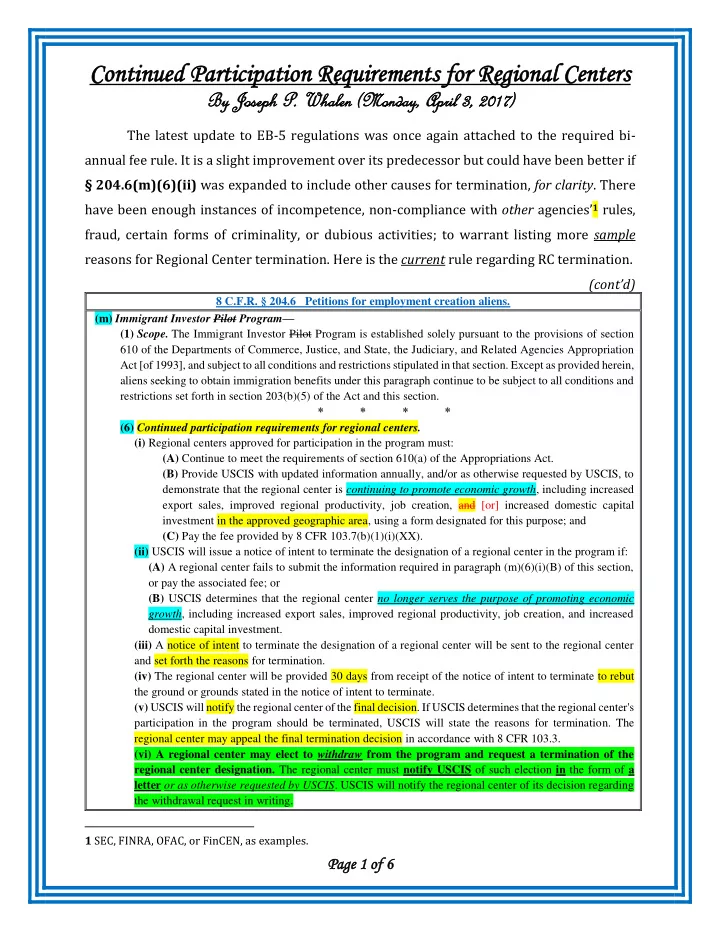
The latest update to EB-5 regulations was once again attached to the required bi- annual fee rule. It is a slight improvement over its predecessor but could have been better if § 204.6(m)(6)(ii) was expanded to include other causes for termination, for clarity. There have been enough instances of incompetence, non-compliance with other agencies’1 rules, fraud, certain forms of criminality, or dubious activities; to warrant listing more sample reasons for Regional Center termination. Here is the current rule regarding RC termination. (cont’d)

8 C.F.R. § 204.6 Petitions for employment creation aliens. (m) Immigrant Investor Pilot Program— (1) Scope. The Immigrant Investor Pilot Program is established solely pursuant to the provisions of section 610 of the Departments of Commerce, Justice, and State, the Judiciary, and Related Agencies Appropriation Act [of 1993], and subject to all conditions and restrictions stipulated in that section. Except as provided herein, aliens seeking to obtain immigration benefits under this paragraph continue to be subject to all conditions and restrictions set forth in section 203(b)(5) of the Act and this section. * * * * (6) Continued participation requirements for regional centers. (i) Regional centers approved for participation in the program must: (A) Continue to meet the requirements of section 610(a) of the Appropriations Act. (B) Provide USCIS with updated information annually, and/or as otherwise requested by USCIS, to demonstrate that the regional center is continuing to promote economic growth, including increased export sales, improved regional productivity, job creation, and [or] increased domestic capital investment in the approved geographic area, using a form designated for this purpose; and (C) Pay the fee provided by 8 CFR 103.7(b)(1)(i)(XX). (ii) USCIS will issue a notice of intent to terminate the designation of a regional center in the program if: (A) A regional center fails to submit the information required in paragraph (m)(6)(i)(B) of this section,

  • r pay the associated fee; or

(B) USCIS determines that the regional center no longer serves the purpose of promoting economic growth, including increased export sales, improved regional productivity, job creation, and increased domestic capital investment. (iii) A notice of intent to terminate the designation of a regional center will be sent to the regional center and set forth the reasons for termination. (iv) The regional center will be provided 30 days from receipt of the notice of intent to terminate to rebut the ground or grounds stated in the notice of intent to terminate. (v) USCIS will notify the regional center of the final decision. If USCIS determines that the regional center's participation in the program should be terminated, USCIS will state the reasons for termination. The regional center may appeal the final termination decision in accordance with 8 CFR 103.3. (vi) A regional center may elect to withdraw from the program and request a termination of the regional center designation. The regional center must notify USCIS of such election in the form of a letter or as otherwise requested by USCIS. USCIS will notify the regional center of its decision regarding the withdrawal request in writing. 1 SEC, FINRA, OFAC, or FinCEN, as examples.

slide-2
SLIDE 2

Page Page 2 of

  • f 6

While USCIS maintains that the supplementary information included with the 2010, Fee Schedule Final Rule, when the Forms I-924 and I-924A were initially adopted, sufficiently allows for the inclusion of additional reasons for termination; some clarification wouldn’t

  • hurt. Undoubtedly, the most egregious cases of EB-5 fraud involve money issues, including,

but not limited to: misappropriation, misuse, or misdirection of funds, embezzlement, and the use of unsourced or “dirty “money, as well as outright theft. Still others have engaged in various other forms of criminality, unethical behaviors that only border on criminal, and let’s not forget good old fashioned gross incompetence. The worst of the aforementioned “bad acts” have garnered the most attention by making national headlines. Several cases involving the misappropriation of funds have been the result of various motives and modus operandi. There have been standard Ponzi schemes, and multi-layered transactions in attempts to hide the source and/or use of funds, excessive fees, fake companies charging fake fees with no actual work performed—often “consulting fees” to oneself or family members, and double-dealing of various sorts. All of the aforementioned are only some of the methods used by the bad actors involved. Price gouging such as the various “fee” scams mentioned above, might rear its ugly head in many forms. For example, sometimes one piece of property is sold to a series of closely held shell companies, one after another, after another before it is finally sold to the EB-5 project developer. With each sale, the price went up thus artificially increasing the price regardless of the actual fair market value. A few Regional Center principals have simply ‘robbed Peter to pay Paul’ in order to bolster other NCEs, JCEs, from

  • ther RC-affiliated projects (or phases), covering operating expenses of the Regional Center,

and/or associated entities that were failing, even at businesses completely outside of the reaches of the EB-5 investments. Some folks may agree with me when I say that I think the worst problems have been in those situations that show a complete disregard for law and order. Those ‘situations’ include such disgraceful behavior as using the EB-5 capital to buy mansions, exclusive country club memberships, and vacations to exotic locations, expensive cars, yachts, ivy- league tuition, and numerous other luxury items—all the while believing there’s nothing that can be done to stop them. These bad actors take advantage of the hopes and dreams of people in search of a better life for themselves and their families. These crooks mistakenly believe that their foreign victims have no recourse after being cheated, but that is not true.

slide-3
SLIDE 3

Page Page 3 of

  • f 6

Let’s take a look at some of the ‘supplementary information’ from the 2010, FR Notice where the I-924 and I-924A were introduced, along with an associated regulatory change, and a clarification about the Program.

“Another commenter mentioned the proposed amendment to 8 CFR 204.6(m)(6), which would provide for an annual reporting requirement for Regional Centers in connection with the USCIS authority to terminate a regional center’s designation. The commenter suggested that the language ‘‘no longer serves the purpose of promoting economic growth,’’ was vague, and in need of more specifics regarding practices that are either prohibited or required in order for the regional center to continue to ‘‘serve the purpose of promoting economic growth.’’ The commenter recommended that USCIS adopt a rule to ensure ongoing regional center compliance, such as termination proceedings if a regional center does not file a single Immigrant Petition by Alien Entrepreneur within a fiscal year. DHS notes that the regulation at 8 CFR 204.6(m)(6) already provides a means to terminate a regional center if the regional center ‘‘no longer serves the purpose’’ of the

  • program. DHS believes that the potential reasons for the termination of a regional center

extend beyond inactivity on the part of a regional center. This regulation currently provides for a process of notice and rebuttal. The amended regulatory language leaves this process

  • intact. Regional centers have been and will be provided with ample opportunity to overcome

the reasons for termination of the regional center under this process. DHS is exploring means by which information regarding termination proceedings may be shared, and will consider making this information available in the annual disclosure report. DHS is making no changes in the final rule as a result of this comment.”

75 FR 58962, 58980 (Friday, September 24, 2010).

“In addition to establishing the fee, DHS is clarifying the related regulations that provide for the annual regional center review related to the Form I–924A. In addition, a change is proposed to accommodate regional centers that seek to withdraw their designation. Proposed 8 CFR 204.6(m)(6)(vi). USCIS has received requests recently from regional centers seeking to withdraw their designation and discontinue their participation in the program. We currently have no procedure for this request and instead must proceed with the formal termination process of issuing a Notice of Intent to Terminate followed by a termination

  • notice. Providing a withdrawal procedure will simplify the ability to terminate a regional

center when the entity seeks to withdraw its designation. In conjunction with the fee, DHS wants to ensure that the requirements for continued participation for regional centers and the procedures to follow to meet the requirements are clear. Proposed 8 CFR 204.6(m)(6).”

81 FR 26904, 26912 (Wednesday, May 4, 2016). 8 CFR 204.6(m)(6)(vi) informs us that ‘[a] regional center may elect to withdraw from the program … and … must notify USCIS … in the form of a letter or as otherwise requested by USCIS. …”. It is that last part that makes me think that USCIS might create a simple withdrawal form. Then again, that might be too simple, convenient, and easy for a government bureaucracy. We’ll just have to wait and see how that issue is eventually

  • resolved. Moving right along, as the commenter correctly noted back in 2010, there is
slide-4
SLIDE 4

Page Page 4 of

  • f 6

ambiguity in the phrase “no longer serves the purpose of promoting economic growth”. That phrase was adapted, with slight changes, from portions of Pub. L. 102–395, § 610(a). This public law is the statutory source for the Regional Center Program which is not part of the INA, but is codified alongside it as a note under 8 U.S.C. § 1153, entitled: Immigration

  • Program. This “Program” goes above and beyond that portion of the INA which authorizes

and defines the EB-5 “Employment Creation” visa. The visa is a permanent immigrant visa category while the Regional Center is not—it is set to sunset (again) on April 28, 2017. Please lobby your Congressional Representatives in the House and Senate to act favorably to at least extend it again, to at least the end of the fiscal year. Anyway, § 610(a) reads in full as follows:

"(a) Of the visas otherwise available under section 203(b)(5) of the Immigration and Nationality Act (8 U.S.C. 1153(b)(5)), the Secretary of State, together with the Secretary of Homeland Security, shall set aside visas for a program to implement the provisions of such

  • section. Such program shall involve a regional center in the United States, designated by the

Secretary of Homeland Security on the basis of a general proposal, for the promotion of economic growth, including increased export sales, improved regional productivity, job creation, or increased domestic capital investment. A regional center shall have jurisdiction

  • ver a limited geographic area, which shall be described in the proposal and consistent with

the purpose of concentrating pooled investment in defined economic zones. The establishment

  • f a regional center may be based on general predictions, contained in the proposal, concerning

the kinds of commercial enterprises that will receive capital from aliens, the jobs that will be created directly or indirectly as a result of such capital investments, and the other positive economic effects such capital investments will have.

Please note the emphasized words and phrases above and observe that § 610(c) adds to the mix with additional language as follows:

(c) In determining compliance with section 203(b)(5)(A)(iii)[(ii)] of the Immigration and Nationality Act [8 U.S.C. 1153(b)(5)(A)(iii)[(ii)]], and notwithstanding the requirements of 8 CFR 204.6, the Secretary of Homeland Security shall permit aliens admitted under the program described in this section to establish reasonable methodologies for determining the number of jobs created by the program, including such jobs which are estimated to have been created indirectly through revenues generated from increased exports, improved regional productivity, job creation, or increased domestic capital investment resulting from the program.

Again, please note the emphasized words. Represented among them are “active”, “positive”, and “forward-looking” concepts in specific words in § 610(a) which are later used as measures for results, presented in the past tense in § 610(c). Specifically, the words to watch include: created, generated, increased, improved, and productivity. Collectively, they support the agency’s inclusion of the purposely inexact phrase “no longer serves the purpose of promoting economic growth” in the regulation. Those few words speak volumes,

slide-5
SLIDE 5

Page Page 5 of

  • f 6

and in light of the supplementary information within the Federal Register publication of that regulation, one can infer, as did AAO, that this key phrase is meant to be broad and open to

  • interpretation. And so it encompasses and applies to, so much more than mere “inactivity”.

The following excerpts show AAO’s current view on the scope of activities, or lack thereof, which support or refute termination of a Regional Center. I suggest that this interpretation is not new. Instead, it is a return to pre-I-924 standard operating procedures. Prior to the introduction of the form and imposition of a fee, USCIS demanded more of RC principals, but did so ‘informally’ because there was formal mechanism in place.

“… The Chief considered the Applicant's arguments but found termination nevertheless appropriate on the ground that the Applicant no longer serves the purpose of promoting economic growth due to evidence that it failed to exercise proper oversight of SDRC, Inc., which resulted in the improper diversion of funds away from job creation and economic growth. The Chief then certified to us his proposed termination, specifically whether "the reasons why a regional center may no longer serve the purpose of promoting economic growth are varied and ‘extend beyond inactivity on the part of a regional center.’” At p. 3

* * * * *

“In addition to this contextual evidence in the regulations, common sense dictates that DHS cannot be compelled to maintain a malfeasant entity in the EB-5 program indefinitely and regardless of how egregious its acts may be. It would be absurd to suggest, for example, that USCIS could not terminate a regional center's designation due to clear evidence of widespread criminal activity simply because there is some evidence of economic growth. Congress authorized DHS to designate regional centers to pool immigrant investor funds for the purpose of creating jobs and promoting economic growth. DHS would ill-serve that purpose by turning a blind eye to bad acts within the EB-5 program. We retain authority to ensure the integrity of the EB-5 program. Accordingly, we construe the regional center termination rule to encompass more than mere inactivity.” At pp. 5-6 (Emphases added.)

* * * * *

“In sum, we must balance all the equities on a case-by-case basis to determine whether a regional center is continuing to promote economic growth. Where both positive and negative indications of the promotion of economic growth exist, we look at all relevant documentation to reach a conclusion regarding whether, on balance, the regional center is continuing to promote economic growth. Positive factors include job creation, capital investment, and other signs of positive economic impact. Negative factors include mismanagement, theft, or fraud by the regional center or related entities. Each case will therefore be assessed on its own merits. In doing so, we consider the factors’ relative weight as determined by surrounding

  • circumstances. See Matter of Sotelo-Sotelo, 23 I&N Dec. 201, 203 (BIA 2001) (“In any balancing

test, various factors, whether positive or negative, are accorded more weight than others according to the specific facts of the individual case.”).” At p. 6 (Emphasis added.)

See Matter of S-D-R-C-, ID# 13768 (AAO Mar. 15, 2017)2 for additional discussion of the concepts in these excerpts, and more. There have been significant developments in the

2 https://www.uscis.gov/sites/default/files/err/K2%20- %20Regional%20Center%20Termination/Decisions_Issued_in_2017/MAR152017_01K2610.pdf

slide-6
SLIDE 6

Page Page 6 of

  • f 6

assessment methodology to be employed when determining the question of continued participation in the Regional Center Program. While the following points are drawn from Matter of S-D-R-, they are not recognized as “Official Holdings”. These are only my suggestions as the important points of interest for further study and exploration.

  • 1. Evidence of a Regional Center's improper or unlawful activities is relevant to the question of

whether that center is continuing to promote economic growth, but derogatory evidence must be weighed against countervailing equities on a case-by-case basis.

  • 2. The question of whether a Regional Center merits continued designation is not contingent on

its EB-5 foreign national investors and their immigration statuses, but whether or not the Regional Center's activities continue to serve the EB-5 Regional Center Program's purposes of creating U.S. jobs and promoting regional economic growth.

  • 3. Where a case contains evidence of the diversion of funds away from job-creating activities, as

well as evidence of substantial economic activity that created thousands of jobs, then USCIS must consider these, and all relevant factors, in determining whether the Applicant's Regional Center designation should be terminated or maintained.

  • 4. Each case will therefore be assessed on its own merits. In doing so, one must consider each

factors' relative weight as determined by surrounding circumstances. “In any balancing test, various factors, whether positive or negative, are accorded more weight than others according to the specific facts of the individual case.” Matter of Sotelo-Sotelo, 23 I&N Dec. 201, 203 (BIA 2001)3, followed.

  • 5. More serious misconduct necessarily weighs more heavily against an exercise of discretion

than do less serious bad acts or derogatory information. Therefore, an Applicant may need to present “additional offsetting favorable evidence” to counterbalance an egregious adverse factor such as serious criminal activity. Matter of Marin, 16 I&N Dec. 581, 585 (BIA 1978)4, followed.

  • 6. No Applicant can immunize or absolve itself of responsibility for its company's wrongdoing

simply by the fact that it contracted out its operations to another company.

Continued participation in the EB-5 Immigrant Investor Program and maintenance of USCIS-Designation as a Regional Center, are not automatic. USCIS-Designation is not guaranteed to continue through only minimal efforts at compliance. Annual I-924A filing alone, is insufficient for maintenance of USCIS-Designation, just as inactivity alone, may be insufficient for Regional Center Termination. A Regional Center needs to be productive or explain its efforts be so, and towards serving the purpose of promoting economic growth.

That hat’s s My My-Two Cen Two Cents, F ts, For Now

  • r Now!

3 https://www.justice.gov/eoir/vll/intdec/vol23/3460.pdf 4 https://www.justice.gov/eoir/vll/intdec/vol16/2666.pdf